
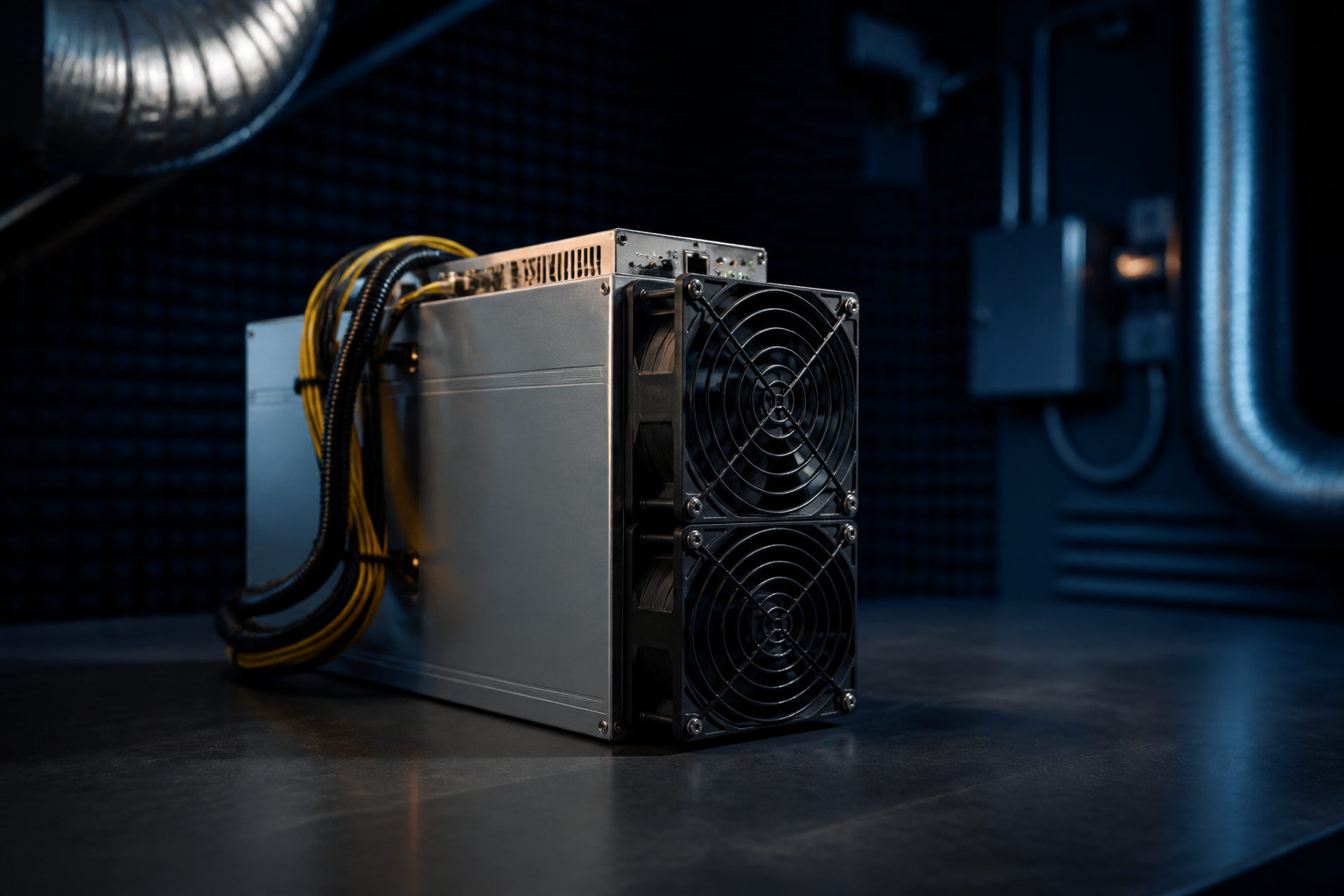
A good hash rate for mining Bitcoin has no universal answer. The right level depends on machine efficiency, electricity cost, cooling, noise, and whether you plan to mine solo or join a pool.
Think of hash rate as speed in a bookkeeping race
Bitcoin miners compete to win the right to add the next block to the chain. They do that by running specialized hardware that performs repeated calculations under Bitcoin's proof-of-work system. In simple terms, more hash rate means a larger share of the network's total computing effort, which usually means a better chance of earning block rewards over time.
That basic idea is true, but it often leads beginners to the wrong question. They focus on how much hash rate sounds “good” on paper, while the practical issue is whether that hash rate can be delivered consistently in the real world. A machine that looks powerful in a product sheet may become far less impressive once heat, power draw, downtime, and maintenance enter the picture.
Bitcoin started with the genesis block in 2009, and mining has changed from a hobbyist activity into a highly specialized competition. Today, the gap between raw computing power and usable computing power matters a lot. A miner that runs steadily day after day can be more suitable than a faster unit that keeps throttling, disconnecting, or shutting down.
What “good” hash rate really means
For most people, a good hash rate is not the highest number available. It is the amount of hash rate that fits your setup, your budget for operating costs, and your reason for mining in the first place. Someone who wants to learn how mining works has a different standard from someone building a long-term operation.
| Factor | What to check | Why it matters |
|---|---|---|
| Raw hash rate | Total computing power the machine can provide | Sets your share of the competition |
| Efficiency | How much power is used for that computing output | Shapes long-term operating pressure |
| Stability | Whether the miner stays online without frequent errors | Downtime turns advertised performance into lost time |
| Cooling needs | How much airflow and heat removal the machine requires | Heat can reduce real performance |
| Noise level | Whether your location can tolerate continuous fan noise | Many home users stop here before profit is even discussed |
| Maintenance demands | Your ability to handle firmware, fans, power supply, and network issues | Small faults can keep a miner offline for long periods |
A “good” setup is one where the miner can stay online, run near its intended output, and avoid obvious operational strain. That standard sounds less exciting than chasing the biggest machine you can find, but it is much closer to how mining actually works.
There is also a difference between nominal hash rate and effective hash rate. Nominal hash rate is what a device is rated for under expected conditions. Effective hash rate is what you really deliver after heat buildup, network interruptions, poor ventilation, dust, unstable power, or firmware problems take their share. The second number is the one that affects your real mining experience.
Solo mining and pool mining change the answer
The same machine can feel very different depending on how you participate. In solo mining, you are competing on your own for block discovery. In pool mining, many miners combine their work, and rewards are distributed according to contribution under the pool's rules.
| Mining mode | Best suited for | How to think about hash rate | Main trade-off |
|---|---|---|---|
| Solo mining | Operators with strong infrastructure and tolerance for uncertainty | Small or modest setups usually feel highly uneven | Large variance and unpredictable timing |
| Pool mining | Most individual miners | Steady contribution matters more than headline speed alone | Smoother payouts, but under pool rules |
This is why the phrase “good hash rate for mining Bitcoin” needs context. If you are joining a mining pool, a good hash rate is one your hardware can sustain cleanly and continuously. If you want to mine solo, the bar feels much higher because you are trying to win blocks against the entire network on your own.
Many newcomers think they need more speed when what they really need is more consistency. A miner that remains online, submits valid work, and avoids long interruptions can make much more sense than a louder and hotter device that spends too much time under stress.
Operating conditions decide whether your hash rate is usable
Bitcoin produces a new block about every 10 minutes, so mining is a nonstop process. When your machine is offline, your chance to participate during that time disappears. That makes supporting conditions just as important as the miner itself.
| Operating condition | Typical issue | Effect on mining |
|---|---|---|
| Power supply | Overloaded circuits, unstable voltage, sudden shutdowns | Restarts and interruptions reduce effective uptime |
| Cooling | Hot air trapped in the room | The machine may throttle or shut itself down |
| Noise tolerance | Home or shared spaces cannot handle sustained fan noise | The miner may be turned off or run less often |
| Network quality | Unstable router or connection drops | Delayed or interrupted work submission |
| Maintenance skill | Slow fault diagnosis or poor routine cleaning | Minor issues become extended downtime |
For that reason, most people should not judge a miner by hash rate alone. A machine with strong specifications but weak environmental fit can become a frustrating purchase. Home users run into this quickly because heat and fan noise are not abstract concerns; they affect daily life right away.
There is another point beginners often miss. The question is not only whether a machine can mine Bitcoin, but whether it makes sense for your situation. Specialized ASIC hardware dominates Bitcoin mining today, so using a regular computer to learn the process is one thing, while expecting it to serve as a practical mining device is another.
Bitcoin's total supply is capped at 21 million coins, and miners help secure the system while new coins are issued under the protocol's schedule. Roughly every 210,000 blocks, or about every 4 years, the block subsidy halves. That structure is part of why efficiency matters so much in mining: hardware competes inside a system where the issuance side keeps tightening over time.
How beginners should decide whether to chase more hash rate
Start with your goal, not with a machine catalog. If your goal is education, you should focus on how mining pools work, how wallets receive funds, and how blocks are confirmed. If your goal is long-term participation, then electricity, cooling, uptime, and maintenance become central from the start.
| Your goal | Focus first | Common mistake |
|---|---|---|
| Learn how Bitcoin mining works | Pool workflow, wallet setup, block production | Shopping for top-end equipment too early |
| Mine over the long term | Efficiency, site conditions, power quality, maintenance | Looking only at the headline hash rate |
| Try mining at home | Heat, noise, and electrical safety | Ignoring practical limits of the location |
| Build a larger operation | Uptime management, parts replacement, standardized maintenance | Assuming single-unit experience scales cleanly |
If you have not yet thought through wallet setup, pool connection, power delivery, ventilation, and routine troubleshooting, buying more speed can magnify the wrong problems. Higher-performance machines usually demand more from everything around them.
A more grounded approach is to choose your participation method first, then compare machines by efficiency and environmental fit. Once you can keep a setup stable, it becomes much easier to judge whether expanding your hash rate is actually useful.
FAQ
Is a higher hash rate always better for Bitcoin mining?
Higher hash rate usually improves your share of the competition, but that does not make it automatically better for your situation. If the machine creates too much heat, noise, or operating strain, the extra speed may be hard to use effectively.
Can I mine Bitcoin at home?
That depends on your power setup, cooling options, and tolerance for sustained noise. Many residential settings are a poor fit for dedicated mining hardware even before cost becomes the main issue.
Can a regular computer mine Bitcoin?
A regular computer can help you understand the process, but it is generally not a practical tool for modern Bitcoin mining. Specialized ASIC miners dominate because the competition is too advanced for general-purpose hardware to stay efficient.
Does hash rate still matter if I join a mining pool?
Yes, because pool rewards are usually tied to the work you contribute. Still, once you join a pool, stable uptime and reliable performance matter just as much as the machine's advertised speed.
What should I check before buying a Bitcoin miner?
Look at efficiency, cooling demands, noise, power requirements, and how easy the unit is to maintain. A miner that fits your site and can run steadily is often a better choice than one that only looks impressive in a specification list.
Before choosing hardware, write down your electricity situation, cooling capacity, noise tolerance, and the time you can spend on maintenance. That list will tell you far more about what counts as a good hash rate for mining Bitcoin than any headline number by itself.
Disclaimer: This article is for informational and educational purposes only and is not investment, financial, or legal advice. Crypto assets are highly volatile and you could lose your entire investment. Do your own research and decide carefully.