
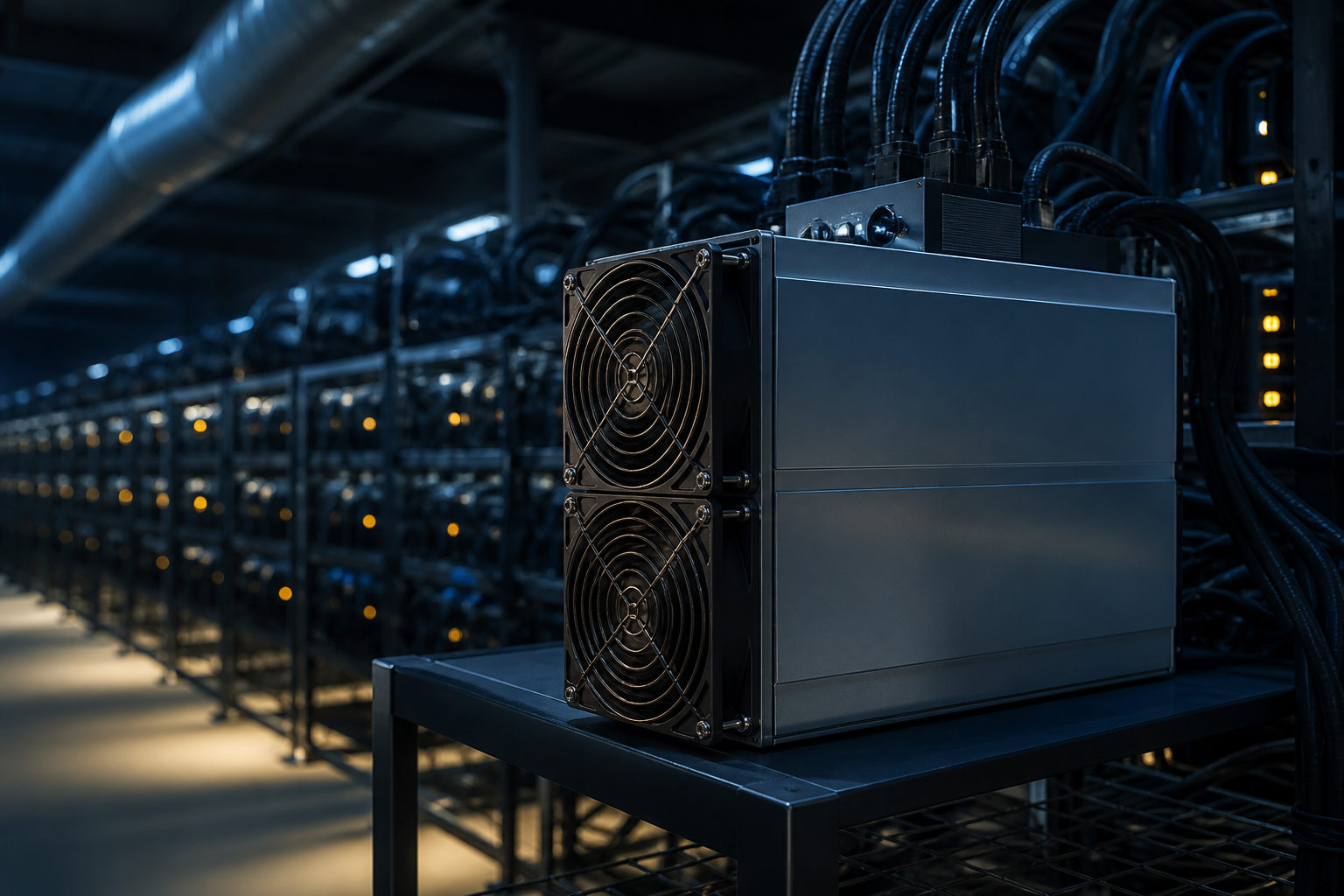
Yes, people are still mining Bitcoin, and the network still depends on miners to keep adding new blocks. What changed is how mining is done: it has moved far beyond the days when a home computer could compete.
Why Bitcoin mining still exists
Bitcoin mining is a nonstop bookkeeping race. New transactions are grouped into blocks, and miners compete with computing power to produce a valid block under the network’s rules. The miner that succeeds gets to add that block to the blockchain and can receive the block reward plus transaction fees.
Bitcoin has no central operator maintaining the ledger. Since the genesis block on 2009-01-03, the network has run through a mix of nodes and miners spread across many locations. The protocol aims for a new block about every 10 minutes, so as long as Bitcoin is running, mining continues.
The current block reward is 3.125 BTC, set after the halving on 2024-04-19. Bitcoin halves its block subsidy every 210,000 blocks, about every 4 years. The halving dates already passed are 2012-11-28, 2016-07-09, 2020-05-11, and 2024-04-19, with the next one expected around 2028. At roughly 144 blocks per day, the network creates about 450 BTC daily. That figure applies to the entire network, not to any one miner or mining firm.
Mining also continues because Bitcoin still has coins left to issue. The hard cap is 21,000,000 BTC, with issuance expected to continue until about 2140. Before then, miners can receive newly issued bitcoin through block rewards. After that point, transaction fees remain part of the incentive model.
Who is still mining Bitcoin today
Bitcoin mining used to be more accessible to hobbyists. Over time, competition increased, hardware specialized, and mining turned into an activity shaped by dedicated machines, power planning, cooling, repair work, and scale.
Today’s miners usually fall into a few groups: large-scale operators running mining sites, smaller participants using hosted machines, independent miners connecting their hardware to pools, and technical teams that manage uptime and maintenance.
| Mining approach | How common it is now | Main feature | Best fit |
|---|---|---|---|
| Home computer solo mining | Rare | Very weak competitive position | Learning the basics only |
| Dedicated miner run alone | Less common | Requires handling power, noise, cooling, and repairs yourself | People with space and technical ability |
| Dedicated miner in a pool | Very common | Combines hashpower with others for steadier payouts | Most practical participants |
| Hosted mining hardware | Common | Machines are placed in a professional facility | People without a suitable site at home |
Mining pools are important to understand. Solo mining means competing on your own, and a successful block may take a very long time to find. In a pool, many miners combine their hashpower, and rewards are shared according to contribution when the pool finds a block. That does not increase the network’s total daily issuance of about 450 BTC; it only changes how results are distributed among participants.
Can an ordinary person still take part?
Yes, but that does not mean it is practical for everyone. If you have hardware, network access, a wallet, and a way to connect to mining software or a pool, you can take part in Bitcoin mining. In practice, power cost, machine efficiency, noise, heat, maintenance, and local space limits usually matter more than the basic setup steps.
Many newcomers mix up three different actions: buying bitcoin, holding bitcoin, and mining bitcoin. Buying means acquiring BTC directly in the market. Holding means storing and managing BTC you already own. Mining means providing computing power and operational support to compete for block production.
| Activity | What you are doing | Main barrier | Common misunderstanding |
|---|---|---|---|
| Buying bitcoin | Getting BTC directly from the market | Account setup, payment access, safe storage | Thinking ownership equals network maintenance |
| Holding bitcoin | Managing and securing BTC you already have | Wallet use and private key safety | Ignoring backups and test transactions |
| Mining bitcoin | Providing hashpower to compete for block creation | Power, hardware, cooling, uptime, maintenance | Treating marketing claims as guaranteed results |
If your goal is education, it often makes more sense to learn how wallets work, how block confirmations happen, and how mining pools split rewards before buying mining machines.
What actually determines whether mining makes sense
The biggest factor is usually electricity. Mining machines are built to run continuously, so power cost shapes the whole decision. Hardware efficiency matters too, because two machines can consume power in very different ways while delivering very different levels of performance. Heat and noise can also make residential use difficult.
Maintenance is another major factor. Machines fail, connections drop, dust builds up, temperatures rise, and downtime cuts into output. Bitcoin also adjusts mining difficulty over time to keep the block interval near 10 minutes. That means there is no fixed answer to how much any one person can mine in a day.
The halving cycle makes cost control even more important. Every 210,000 blocks, the subsidy is cut in half. After 2024-04-19, the block reward became 3.125 BTC, so miners have to be more selective about operating conditions.
One smaller detail helps when reading pool dashboards or wallet balances: the smallest unit of bitcoin is 1 satoshi, equal to 0.00000001 BTC. That does not decide whether mining is a good fit, but it helps people understand tiny reward fragments, fee amounts, and accounting entries.
How to judge whether mining is realistic for you
A useful starting point is to make a plain checklist. Do you have a place where machines can run for long periods? Can you handle continuous noise and heat? Are you willing to learn wallet safety and pool configuration? Can you deal with repair issues or unexpected downtime?
If several of those answers are negative, learning the system first is usually the better move. You can study the white paper published by Satoshi Nakamoto on 2008-10-31, learn how blocks and incentives fit together, and understand why mining remains part of Bitcoin’s design.
| Question to ask yourself | If the answer is mostly yes | If the answer is mostly no |
|---|---|---|
| Do you have a suitable location? | You can keep evaluating a real setup | Hosted options or pure learning may suit you better |
| Can you manage power and cooling? | You have a base for hands-on mining | Long-term operation will be difficult |
| Can you handle maintenance and downtime? | You are closer to practical participation | Operational interruptions may be a constant problem |
| Do you understand wallets and key safety? | You are in a better position to proceed carefully | Start with the basics before buying hardware |
FAQ
Can individuals still mine Bitcoin today?
Yes, individuals can still participate, but usually through dedicated mining hardware and often through a pool. Casually mining with a normal household computer no longer matches how competitive the network is today.
Why is home computer mining no longer realistic?
Bitcoin mining has become highly specialized, and purpose-built machines dominate the process. A standard home computer cannot usually compete on performance or power efficiency.
Does joining a mining pool increase the total reward?
No. A pool does not change the total amount created by the Bitcoin network. It mainly makes reward distribution steadier for participants by combining their hashpower.
Do miners keep going after a halving?
Yes. The halving reduces the block subsidy, but it does not stop mining. It pushes miners to pay closer attention to electricity, machine efficiency, and operating conditions.
Is mining the same as buying bitcoin?
No. Buying bitcoin means acquiring BTC directly. Mining means contributing hashpower and infrastructure to compete for block rewards and fees.
What should I learn before thinking about mining hardware?
Start with wallet basics, private key safety, block confirmations, and how pool payouts work. Once those pieces make sense, you can judge the hardware side with a much clearer view.
If you are seriously thinking about mining, the key question is whether your power setup, space, cooling plan, maintenance ability, and wallet security habits are strong enough for the job.
Disclaimer: This article is for informational and educational purposes only and is not investment, financial, or legal advice. Crypto assets are highly volatile and you could lose your entire investment. Do your own research and decide carefully.