
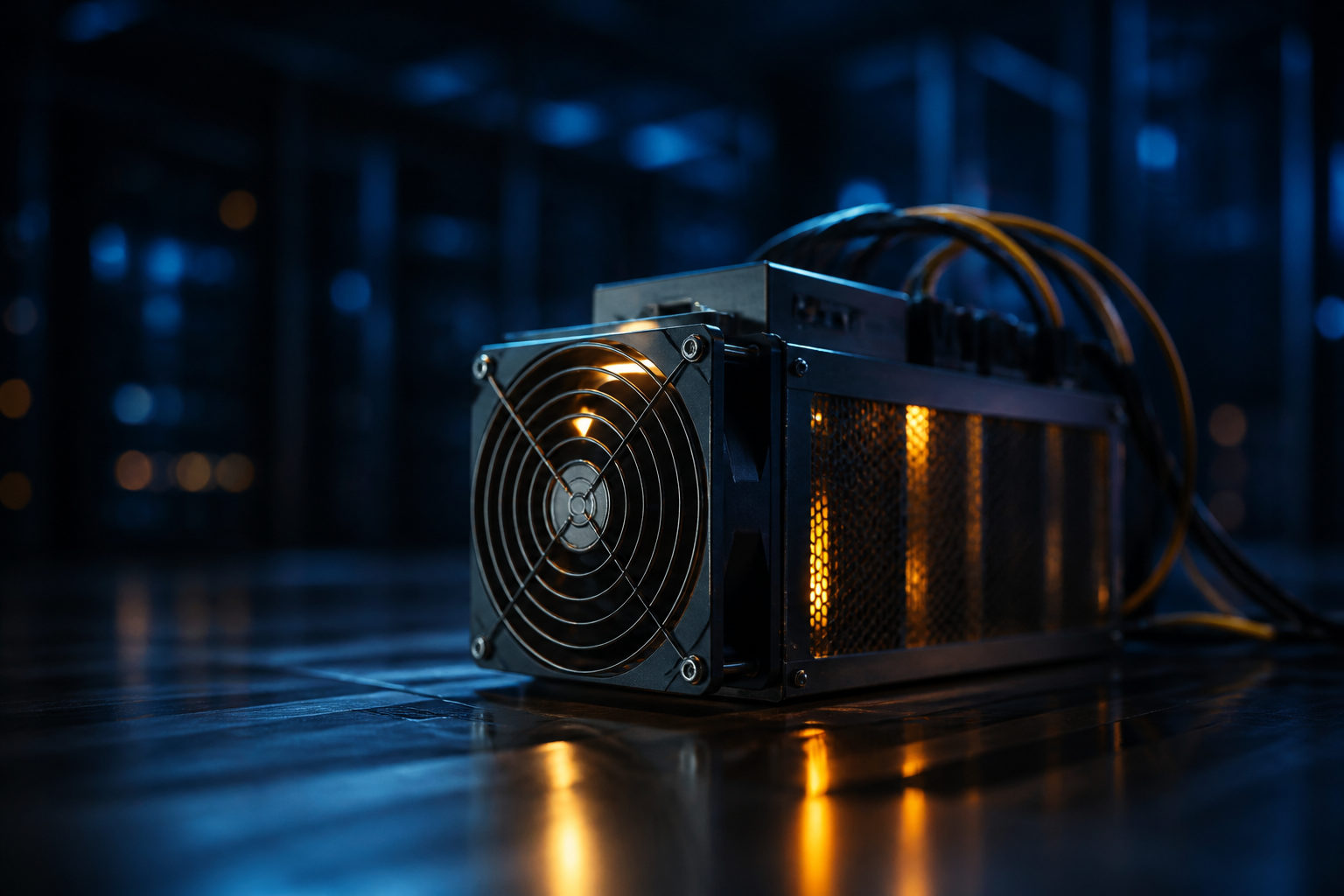
Bitcoin mining is not dead. It still powers block production and transaction confirmation on the Bitcoin network, but it no longer looks like a casual hobby for most people.
Think of mining as a race to write the next page of the ledger
The word “mining” can be misleading. In Bitcoin, miners are competing for the right to add the next block of transactions to a public ledger that anyone can inspect.
That competition is based on proof of work. Miners gather pending transactions, build a candidate block, and run specialized machines that keep hashing until one valid result meets the network rules. When that happens, the new block can be added, and the miner that found it may receive the block reward plus transaction fees.
This is why mining still matters. It is the mechanism that helps Bitcoin operate without a central bookkeeper. The network keeps moving because many participants are trying to produce valid blocks, and other participants can verify the result.
Bitcoin produces a block about every 10 minutes, and the system adjusts mining difficulty to keep that rhythm relatively steady. So when people ask whether bitcoin mining is dead, the short answer is no: as long as the network keeps producing blocks, mining is still alive.
Why so many people say bitcoin mining is dead
Most of the time, they do not mean the process has stopped. They mean the easy version is gone. In the early period, participation was simpler. Over time, competition intensified, hardware changed, and mining became a specialized activity with tighter margins and more operational demands.
That shift matters because mining is tied to the physical world. Electricity, heat, noise, machine upkeep, downtime, and hardware aging all affect whether an operation is practical. A person can look at those pressures and conclude that mining is “dead,” even while the Bitcoin network continues to function exactly as designed.
Another source of confusion is profitability talk. People often reduce the topic to a single question about whether buying a machine will generate easy income. That frame misses the point. Mining is closer to running a hardware-based process business than installing software and waiting for money to appear.
| Claim | What people often mean | More accurate reading |
|---|---|---|
| Bitcoin mining is dead | Small operators face tougher conditions | The mechanism still exists, but the bar is higher |
| You can’t mine anymore | Home setups rarely have an edge | Professional operations are more common |
| Mining no longer works | Old assumptions about easy returns broke down | Success depends on cost structure and execution |
How people still participate in bitcoin mining today
There is more than one way to approach bitcoin mining. Some people run their own machines. Some join mining pools so their hash power is combined with others. Some study nodes, wallets, and block validation first, then decide whether they even want exposure to mining hardware.
Running your own mining machines
This is the most direct route. You need specialized ASIC hardware built for Bitcoin mining, along with stable power, internet access, cooling, and a place where noise will not become an immediate problem.
The appeal is control. You choose the hardware, decide how to operate it, and manage the setup yourself. The tradeoff is that every weak point is also yours to solve, from machine failures to heat management.
Joining a mining pool
A mining pool combines the hash power of many participants. Instead of waiting alone for a rare successful block, miners in a pool contribute work and receive payouts according to the pool’s rules.
For smaller participants, this can make outcomes feel less erratic. Still, a pool is not a shortcut around due diligence. Fee structures, payout methods, service reliability, and operational transparency all deserve close attention.
Learning before buying equipment
For many readers, this is the best starting point. If you do not yet understand how blocks are produced, what difficulty adjustment does, or why ASICs dominate, buying hardware too early can turn a knowledge gap into an expensive mistake.
| Path | Who it fits | Main challenge | What to examine first |
|---|---|---|---|
| Self-run machines | People with space and technical discipline | Power, cooling, noise, maintenance | Whether the setup can run consistently |
| Mining pool | Participants who want smoother payout patterns | Rules, fees, service quality | How rewards are calculated and paid |
| Study first | Newcomers still building context | Marketing claims can distort expectations | How Bitcoin block production actually works |
The real question is whether your conditions make sense
If you want an honest answer to “is bitcoin mining dead,” start with your own operating conditions. Cheap and stable electricity matters. So do ventilation, noise tolerance, replacement planning, and the ability to handle machine issues without long interruptions.
Hardware wear is another part of the picture. Mining machines are not static assets that behave the same forever. They run hard, they age, and they can become less attractive as competition changes and newer machines enter the market.
Local rules can also shape what is realistic. Depending on where you are, noise restrictions, property limits, energy policies, and business compliance may all affect whether a mining setup is even practical. Many failed attempts are not caused by Bitcoin itself but by poor fit between the plan and the environment.
There is also a difference between wanting exposure to Bitcoin and wanting to operate mining equipment. Plenty of people are better served by learning self-custody, transaction confirmation, and node basics before they decide whether mining belongs in their plan at all.
| Condition | Why it matters | Common mistake |
|---|---|---|
| Electricity cost | It shapes long-term viability | Focusing only on machine specs |
| Cooling and noise | They affect uptime and usable space | Assuming a home setup is automatically fine |
| Maintenance ability | Downtime interrupts production | Treating mining gear like normal consumer electronics |
| Compliance environment | It affects whether operation can continue | Researching hardware but ignoring local rules |
What mining is, and what it is not
Bitcoin mining is still the backbone of Bitcoin’s proof-of-work security model. It is how new blocks are produced, how new bitcoin enters circulation under the protocol rules, and how miners compete to earn rewards.
What it is not is a guaranteed side income button. It is equipment-heavy, operationally demanding, and sensitive to variables that many beginners ignore at first glance. That does not make it obsolete. It means the modern version is serious work.
Bitcoin also has a halving cycle every 210,000 blocks, roughly every 4 years, with halvings in 2012, 2016, 2020, and 2024. That changes the block subsidy over time and forces miners to keep reevaluating efficiency and costs. The system keeps running, but weaker setups can be pushed out.
FAQ
Can an individual still mine bitcoin today?
Yes, but the answer depends less on access and more on operating conditions. Space, power, cooling, and maintenance discipline matter far more than enthusiasm alone.
Can I mine bitcoin with a regular home computer?
In a technical sense, computing devices can perform hashing work. In practical terms, home computers are not the standard tool for bitcoin mining today because specialized ASIC machines dominate this activity.
Does joining a mining pool solve the main problem?
It can reduce the randomness of solo mining by spreading results across many participants. It does not remove the need to understand fees, payout rules, and service reliability.
Did halving kill bitcoin mining?
No. Halving changes the reward structure, which can pressure inefficient operators, but it does not shut down the mining process. It tends to separate stronger operations from weaker ones.
What should I do first if I want to explore mining?
Learn how blocks are produced, why ASICs are used, and how pools distribute rewards. After that, review your power, noise, cooling, and compliance situation before thinking about hardware purchases.
If you are deciding whether bitcoin mining makes sense for you, make a simple checklist before anything else: power, cooling, noise, maintenance, and local rules. That review will tell you far more than hype ever will.
Disclaimer: This article is for informational and educational purposes only and is not investment, financial, or legal advice. Crypto assets are highly volatile and you could lose your entire investment. Do your own research and decide carefully.