
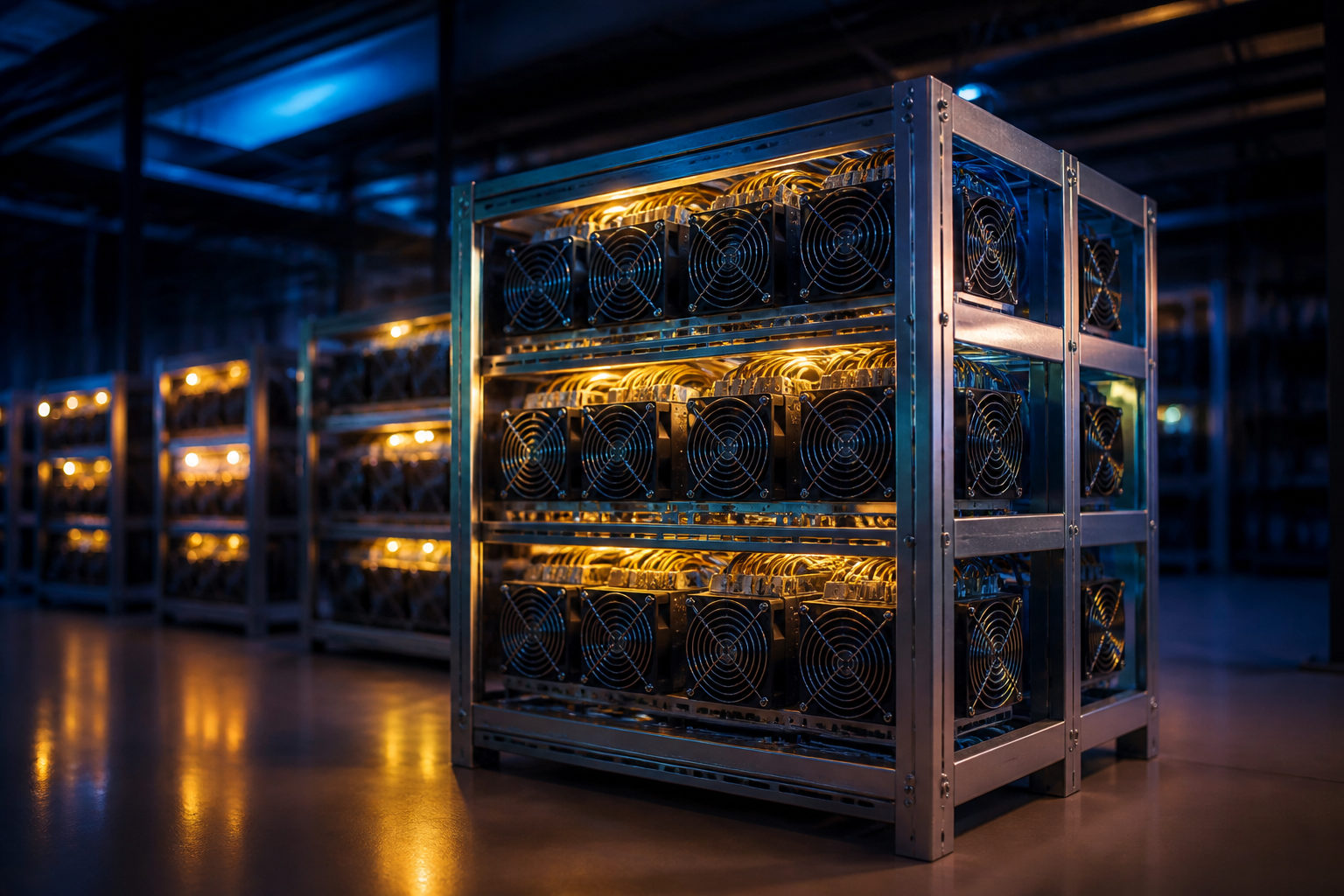
A bitcoin mining operation is the business of running specialized hardware and power systems to compete in Bitcoin's block-writing race and earn block rewards plus transaction fees.
What a bitcoin mining operation actually does
A simple way to understand it is to picture Bitcoin as a public ledger that anyone can inspect. New transactions need to be grouped into blocks, and the network needs a rule for deciding who gets to add the next block. Miners compete to do that job by performing repeated hash calculations under Bitcoin's proof-of-work rules.
When people say “bitcoin mining,” they often think of a machine producing coins. A mining operation is wider than that. It includes the machines, electricity supply, cooling, networking, monitoring, wallet setup, repair work, and the financial planning needed to keep all of it running over time.
This matters because mining is not a casual background task on ordinary computers anymore. It is a specialized activity with real operating pressure. The business side comes from managing costs and uptime well enough to stay in the race while the network keeps producing blocks at a target pace of about one block every 10 minutes.
Bitcoin also has a fixed issuance schedule. The block reward is cut in half every 210,000 blocks, roughly every 4 years. The halvings already took place on 2012-11-28, 2016-07-09, 2020-05-11, and 2024-04-19. After the 2024 halving, the current block reward is 3.125 BTC, and the next halving is expected around 2028.
The core parts of a mining operation
From the outside, a mining site can look like rows of loud machines. In practice, it works more like a production system built around computing power. One weak link can affect the whole setup, so the operation has to be managed as a chain rather than a single device.
| Component | Role | Main operational concern |
|---|---|---|
| Mining hardware | Performs hash calculations and provides hashrate | Efficiency, failures, replacement timing |
| Electricity | Keeps machines running continuously | Power cost, stability, capacity |
| Cooling | Controls heat and protects hardware | Temperature, dust, airflow, noise |
| Network connection | Links miners to a pool and the Bitcoin network | Latency, outages, dropped connections |
| Mining pool | Combines hashrate and distributes proceeds | Fee structure, payout rules, platform risk |
| Wallet | Receives mining payouts | Key management, address control |
| Operations | Monitoring, repair, and routine maintenance | Spare parts, response speed, downtime |
Hardware sits at the center of the operation, but hardware alone does not make a business. A miner that is powerful on paper can still underperform if it overheats, disconnects often, or sits idle while waiting for repairs. That is why experienced operators pay close attention to uptime, airflow, cleaning, and replacement planning.
Electricity is often the hardest reality check for beginners. Mining hardware is meant to run continuously, so the power side is not just about plugging in a machine. It involves the cost of electricity, the quality of the supply, and whether the location can support sustained high-load operation without frequent interruptions.
Cooling is just as practical. These machines generate significant heat, and poor thermal management can lead to instability, throttling, or shutdowns. For many small operators, the first problem is not Bitcoin at all. It is heat, noise, and maintenance inside a real physical space.
How mining works and where the bitcoin comes from
Mining does not create bitcoin by magic. Miners repeatedly try to find a valid hash that satisfies the network's current difficulty target. The first miner, or pool participant on behalf of a pool, to produce a valid result gets to propose the next block. Other nodes verify the block, and if it follows the rules, it becomes part of the chain.
The payout from a successful block has two sources: the block reward and the transaction fees included in that block. Right now, the block reward is 3.125 BTC. At the network level, Bitcoin adds about 450 BTC per day, based on the current reward and the target rate of about 144 blocks per day. That figure applies to the entire network, not to any single person, machine, or company.
This point is easy to miss. A mining operation does not receive a fixed amount just because its machines are switched on. Actual results depend on effective hashrate, uptime, pool rules, and plain statistical variance. That is why most participants join mining pools instead of mining alone.
| Approach | How it works | Who it suits | Main drawback |
|---|---|---|---|
| Solo mining | You keep the full block payout if you find a block | Very large operators that can handle long dry spells | Highly uneven results |
| Pool mining | Many miners combine hashrate and split payouts by contribution | Most individuals and smaller operators | Dependence on pool rules and payout methods |
Bitcoin has worked this way since the genesis block on 2009-01-03. Its total supply is capped at 21,000,000 BTC, with issuance expected to continue until about 2140. For mining operations, that fixed schedule means the business always sits at the intersection of protocol rules, machine efficiency, and operating discipline.
How people participate today
There are several ways to take part in a bitcoin mining operation. Some people run their own machines. Others own hardware but place it with a hosting provider. A third group buys cloud mining or similar contracts that promise exposure to mining output without direct control over equipment.
| Participation model | What you control | Why people choose it | What to check first |
|---|---|---|---|
| Self-run mining | Hardware, wallet, and day-to-day setup | Highest transparency | Can your location handle power, heat, and noise? |
| Hosted mining | You own the machines while a third party runs the site | No need to build your own facility | Contract terms, downtime rules, fee structure |
| Cloud mining or similar contracts | Usually a claim on output rather than direct machine control | Low barrier to entry | Whether the operation is verifiable at all |
If you are new to the topic, the first useful question is not how much a setup might make. It is whether you can clearly identify where the reward comes from, who controls the hardware, who controls the wallet path, and what happens when machines stop running. Real mining operations can explain those points in plain terms.
Cloud mining deserves extra caution because it often removes the physical side from view. If a provider will not explain the machine type, hosting arrangement, payout rules, downtime handling, and withdrawal process, you do not have enough information to judge whether the offer reflects a real mining business or just a sales wrapper.
The cost reality behind the idea
Mining sounds simple at the concept level: add hashrate, compete for blocks, receive bitcoin. The business reality is harder. Costs continue whether conditions are favorable or not, machines age, and downtime can quickly damage results even when the broader network keeps operating normally.
Power is the first pressure point. A machine may be technically capable of mining, yet still be a poor fit if the electricity setup is unstable or expensive. The second pressure point is equipment life. Mining hardware does not stay equally competitive forever, and an older machine can lose relative efficiency as newer models enter the market and network difficulty changes.
Then there is maintenance. Fans fail, dust builds up, temperatures spike, and network interruptions happen. An operator who ignores these details is not running a mining business for long. This is one reason many newcomers underestimate the gap between understanding the theory of Bitcoin mining and managing a working operation.
Even payout records need context. Bitcoin can be divided into very small units, and 1 satoshi equals 0.00000001 BTC, which is one hundred millionth of a bitcoin. Knowing that helps when reading pool statements and wallet entries, where proceeds may arrive in small increments rather than one large transfer.
For context on Bitcoin's history, the white paper titled Bitcoin: A Peer-to-Peer Electronic Cash System was released by Satoshi Nakamoto on 2008-10-31. The network later recorded the well-known Pizza Day purchase on 2010-05-22, when Laszlo Hanyecz spent 10,000 BTC for two pizzas. Those facts matter here because they show that mining is tied to Bitcoin's issuance and transaction system from the start, not to a separate reward program built later.
FAQ
Is a bitcoin mining operation the same as buying bitcoin?
No. Buying bitcoin means acquiring the asset directly on the market, while a mining operation means running or funding an operating system that competes for newly issued bitcoin and fees. One is an asset purchase; the other is an ongoing business activity.
Can an individual still run a bitcoin mining operation?
Yes, but suitability depends on practical conditions more than interest alone. Power, heat, noise, repair ability, and site limitations all matter before a single machine is turned on.
Why do most miners join pools?
Pools reduce payout variance by combining many miners into one shared effort and distributing proceeds by contribution. That does not remove risk, though, because payout methods and pool rules still affect what each participant receives.
Does the halving matter to mining operations?
Yes, directly. Bitcoin cuts the block reward every 210,000 blocks, and the current reward is 3.125 BTC after the 2024-04-19 halving. Any mining business has to operate under that issuance schedule.
How can I tell whether a mining offer is credible?
Ask for specifics about hardware, hosting, payout rules, wallet withdrawals, and downtime responsibility. If the explanation stays vague while the marketing stays confident, you still do not know what business you are being asked to trust.
If you want to evaluate a bitcoin mining operation, start with three checks: who controls the machines, what costs keep running even during downtime, and how payouts are actually calculated. Those answers are more useful than any sales promise.
Disclaimer: This article is for informational and educational purposes only and is not investment, financial, or legal advice. Crypto assets are highly volatile and you could lose your entire investment. Do your own research and decide carefully.