
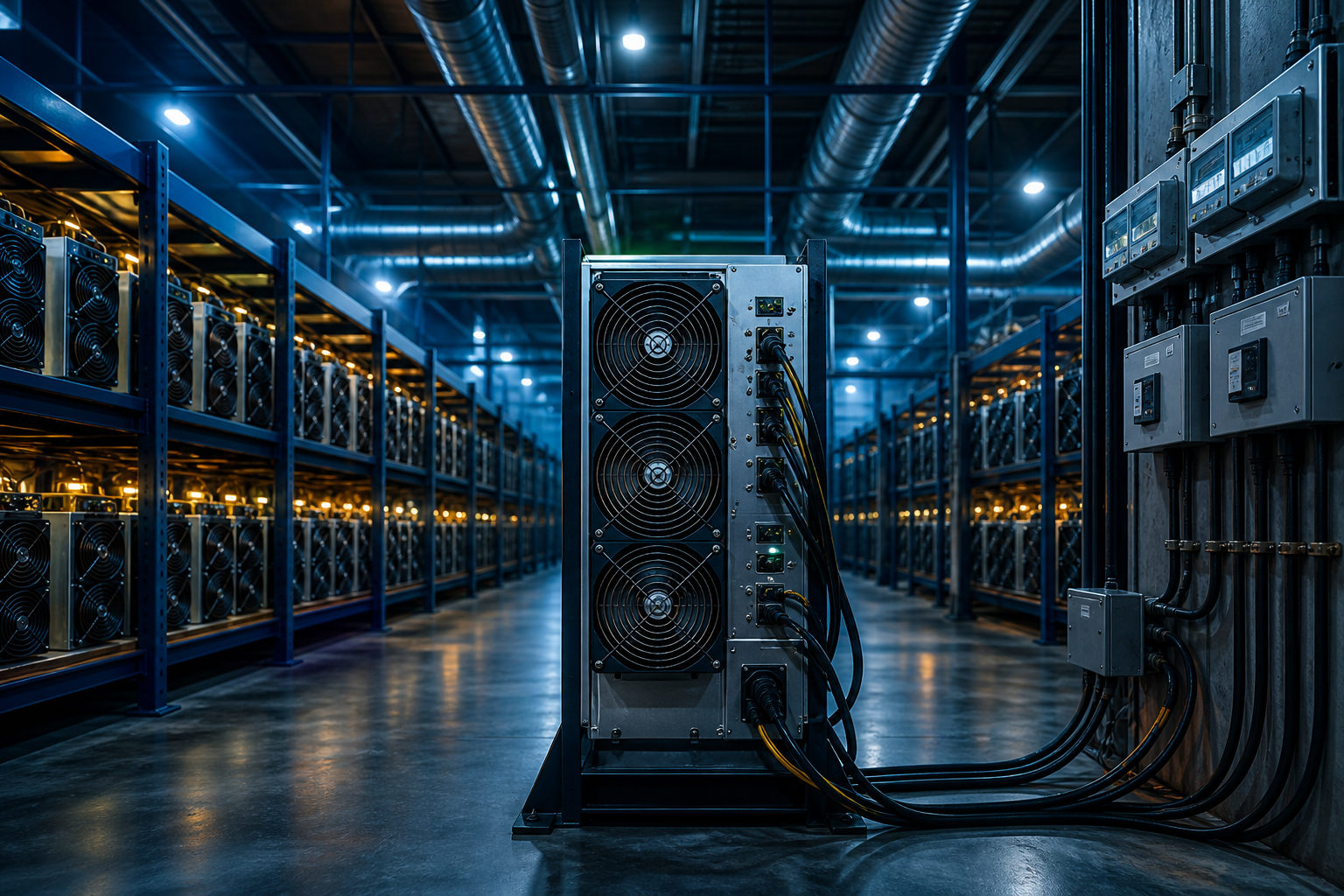
Yes, it may still be possible to mine Bitcoin profitably in 2026, but for most people the real question is not price optimism. It is whether your power cost, hardware efficiency, operating setup, and risk control are good enough to survive a very competitive business.
Think of Bitcoin mining as a nonstop bookkeeping race
The easiest way to understand Bitcoin mining is to stop picturing it as a magic machine that prints coins. A better comparison is a public bookkeeping race that never stops. People broadcast transactions to the network, and miners compete to package those transactions into a new block that can be added to the blockchain.
The miner that meets the network rules first gets the right to add that block and receive the block reward plus transaction fees. Bitcoin produces a new block about every 10 minutes, so this race keeps going day and night. When you mine, you are not just turning on a device. You are entering a global competition.
That framing matters because it changes how you judge profitability. In a race, wanting to win is not enough. Your machine, your electricity bill, your cooling, your uptime, and your operational discipline all matter. The market price of Bitcoin can influence mining economics, but it does not erase weak fundamentals at the machine level.
Why profitability is about costs first, not hopes first
When people ask whether they can still mine Bitcoin profitably in 2026, they often mean something broader: is it too late to get involved? The short answer is that mining is still a business, not a shortcut. Even if you are bullish on Bitcoin over the long term, mining only makes sense when your cost structure is strong enough.
Electricity is the clearest variable. Mining hardware converts electrical power into hash power, and your room for profit gets squeezed quickly if your energy rate is high. Hardware efficiency is next. Two machines can consume power in the same broad range, but the more efficient one has a better chance of staying viable when competition gets harder.
Then there is operations. Machines run hot, they make noise, they collect dust, they need stable internet access, and they do fail. Any downtime cuts into output. Any maintenance weakness can turn a plan that looked reasonable on paper into a poor real-world result.
Network conditions also change over time. Your share of the total competition does not stay fixed. If other miners upgrade faster, secure cheaper power, or run larger and cleaner operations, your position can weaken even if your own setup has not changed.
The halving schedule is another key part of the picture. Bitcoin has a supply cap of 21 million coins. The block reward is cut roughly every 4 years, or every 210,000 blocks. Halving years so far include 2012, 2016, 2020, and 2024. That means anyone thinking about mining in 2026 is looking at a post-halving environment, where efficiency and fee income usually matter even more than before.
What participation looks like for ordinary users
There is more than one way to get involved in Bitcoin mining, but the choices are not equal. Each path shifts the balance between control, complexity, and counterparty risk.
Buy your own miner and run it yourself
This is the most direct route, and it is also the one many beginners misjudge. Buying the machine is only the start. You need suitable power access, cooling, noise tolerance, a stable network connection, and a plan for maintenance. In many home settings, the first problems are not technical theory but heat and sound.
That is why home mining often looks easier online than it feels in practice. A machine that runs constantly can create a serious daily burden. If your location is not built for this kind of use, the friction may outweigh the appeal very quickly.
Join a mining pool
Solo mining means you bear the full variance of block discovery on your own. A mining pool combines hash power from many participants and shares rewards according to pool rules. That usually makes payouts smoother, which can help planning, but it does not fix a bad cost base.
You still need to understand payout methods, pool fees, account security, and how the operator handles reporting and settlement. A pool can reduce income volatility. It cannot turn expensive electricity or weak hardware into a strong mining business.
Use hosting or cloud-style arrangements
These options sound convenient because someone else may run the machines or sell you access to mining capacity. Convenience comes with a different problem: trust. You need clarity on whether the hardware is real, how downtime is handled, what fees are charged, how transparent reporting is, and what happens if you want to exit.
For beginners, this area is often less about mining knowledge and more about spotting weak promises. If a service emphasizes easy passive income while staying vague on hardware, operating terms, or settlement details, caution is justified. Bitcoin mining is not a guaranteed-income product.
How to judge whether mining in 2026 makes sense for you
A useful way to approach the question is to stop asking for a universal yes-or-no answer. Mining is highly sensitive to individual conditions. The same year can be workable for one operator and a bad fit for another.
- Do you have a power cost advantage? If the answer is no, your margin for error is usually much smaller.
- Is your hardware source reliable? Machine condition, warranty support, repair access, and delivery risk all matter.
- Can you handle ongoing operations? Mining is not a one-time purchase. It is a constant management task.
- Do you understand income variability? Fees, competition, outages, and machine performance all affect what you actually receive.
- Do you have an exit plan? You should know in advance whether you would keep running, sell equipment, or shut down if conditions worsen.
People with real operating experience usually do not start by asking how fast they can break even. They start by asking whether they have a durable edge. In Bitcoin mining, discipline often matters more than excitement. A weak setup can look attractive during optimistic moments, then fail once normal operating pressure returns.
It also helps to remember where Bitcoin is in its life cycle. The genesis block was created in January 2009. The white paper, titled Bitcoin: A Peer-to-Peer Electronic Cash System, was released in 2008 under the name Satoshi Nakamoto, whose identity remains unknown. This is no longer an early experiment with wide open margins for casual participants. Mining now rewards careful execution far more than simple enthusiasm.
Many people are better off studying mining before spending on mining
Learning how Bitcoin mining works is extremely useful even if you never run a machine. It teaches you why proof of work requires real-world resources, why miners matter to network security, how block rewards and transaction fees fit together, and why halvings change business pressure across the sector.
Still, understanding the system is different from being well placed to operate inside it. For many readers, the better first move is to map the full process before buying hardware. Learn how miners connect to pools, how payouts reach a wallet, how private keys should be stored, and how to separate access permissions if more than one person is involved. Those basics are not glamorous, but they decide whether your setup is resilient.
Security after mining is another practical issue. Receiving Bitcoin is only one step. You also need a wallet plan, backup procedures, operational records, and a clear method for handling account access. In other words, profitability does not only depend on what happens at the machine. It also depends on what happens after coins are earned.
There is also a unit concept worth knowing. The smallest unit of Bitcoin is one satoshi, and 1 satoshi equals one hundred millionth of 1 BTC. You do not need to mine whole bitcoins for payouts to matter. But that fact should not be confused with easy profitability. Small units make accounting flexible; they do not remove the business realities of mining.
FAQ
Is home Bitcoin mining still realistic for individuals?
For many people, home mining is possible in theory but awkward in practice. Noise, heat, power limits, and daily maintenance are often more difficult than expected.
If your main goal is to understand the process, start by learning how mining pools, wallets, and hardware efficiency work before bringing a machine into your living space.
Does joining a mining pool make Bitcoin mining profitable?
A mining pool can make payouts more consistent because you share variance with other miners. That helps with planning, but it does not improve your electricity rate or upgrade poor hardware.
So a pool changes payout smoothness, not the basic economics of your operation.
If my electricity is expensive, should I avoid mining?
High power cost is usually one of the biggest warning signs. It reduces your margin for error and makes downtime, maintenance, and hardware aging much harder to absorb.
That does not mean mining is automatically impossible, but it does mean you need a much stricter standard before committing capital.
Are hosted mining and cloud mining safer for beginners?
They may be simpler to access, yet they add counterparty risk. You need clear terms on equipment, fees, downtime, reporting, and exit rights before trusting any provider.
The less visibility you have into the real operation, the more careful you should be.
What should I check first when evaluating Bitcoin mining for 2026?
Start with your own operating reality, not with price narratives. Review power cost, site suitability, cooling, noise tolerance, hardware sourcing, maintenance ability, and how you would stop if conditions become unfavorable.
If those basics do not hold up, no optimistic story is likely to rescue the business.
If you want a serious answer to whether you can still mine Bitcoin profitably in 2026, build your own checklist first: power terms, machine efficiency, hosting terms if any, pool rules, wallet security, and a clean exit path.
Disclaimer: This article is for informational and educational purposes only and is not investment, financial, or legal advice. Crypto assets are highly volatile and you could lose your entire investment. Do your own research and decide carefully.