
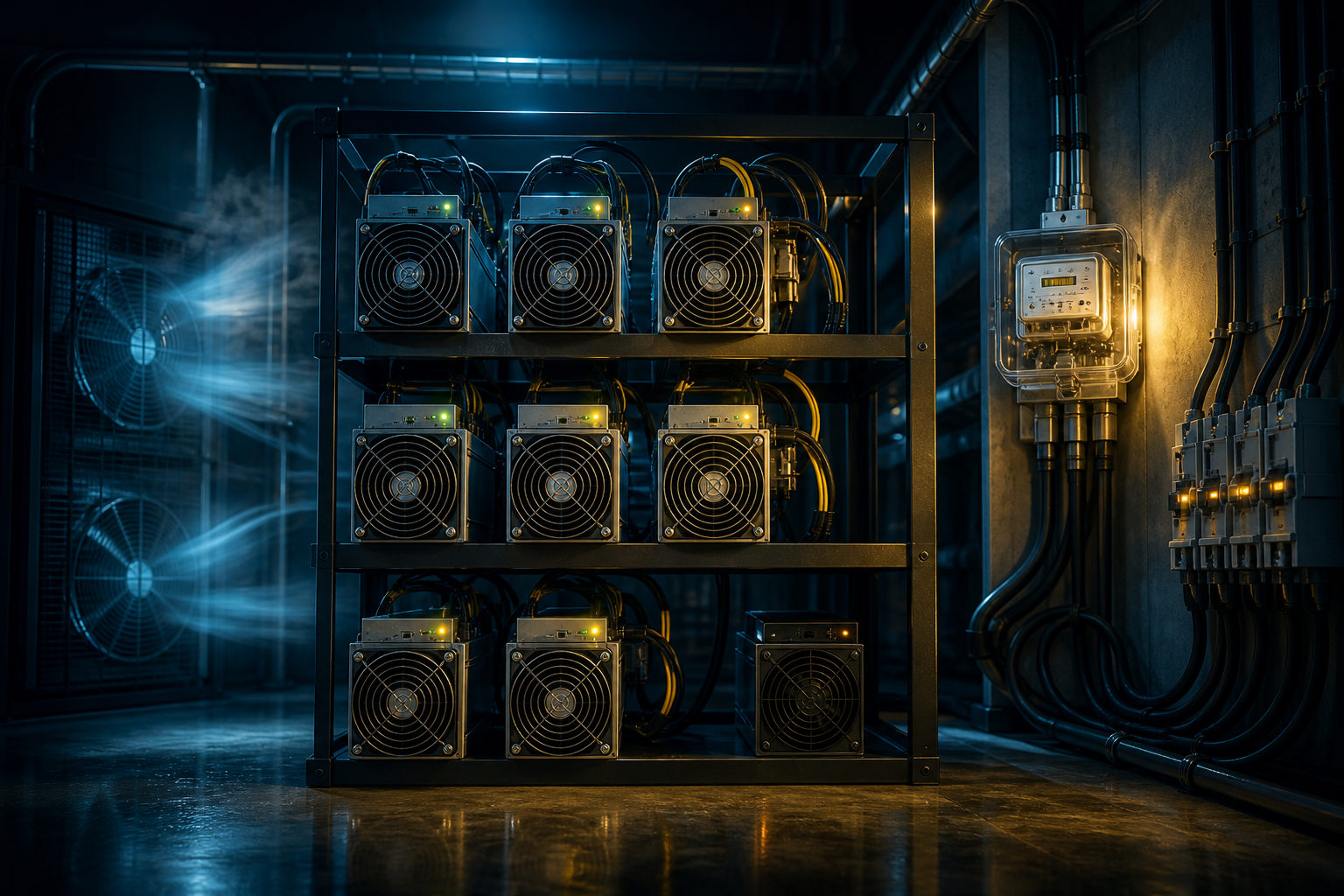
Is crypto mining profitable in 2026? For Bitcoin mining, the first real filter is electricity cost, not market excitement. Profitability depends on whether your hardware can run efficiently and consistently under your local conditions after power, cooling, maintenance, and downtime are considered.
Think of mining as a competition to earn the right to write the next page
A simple way to understand Bitcoin mining is to picture a giant public ledger that anyone can verify. Mining is the process where specialized machines compete for the right to package new transactions into a block and broadcast that block to the network.
This is not a race of reflexes. It is a race of computation, energy use, and operational discipline. Miners keep running hardware to search for a valid result under Bitcoin's rules. Roughly every 10 minutes, a new block is produced, and the miner that finds a valid block can receive the block reward plus transaction fees.
That structure matters because mining is not a guaranteed income stream. You are spending real resources to compete for a chance at network rewards. If your setup is inefficient, expensive to power, noisy to manage, or unstable over time, the economics can break down even if interest in Bitcoin stays high.
What really determines Bitcoin mining profitability
Electricity cost is usually the first dividing line
When people ask about bitcoin mining profitability electricity cost, they are asking the right question. Mining hardware draws power continuously, and that makes energy one of the most persistent costs in the whole process. A setup with cheap, stable electricity can look very different from one running in a location where power is expensive or unreliable.
New miners often focus on the machine itself and ignore the bill that arrives after long periods of runtime. The issue is not only the wattage of the miner. You also have to deal with cooling, ventilation, power distribution, dust control, and the practical burden of keeping the machine online. A machine may be capable of mining, yet still fail the profitability test once the full operating picture is included.
Machine efficiency decides how expensive your competition really is
Two miners can participate in the same network and face very different economics. The reason is hardware efficiency. A more efficient ASIC can usually produce more competitive output from the same energy input, while an older or weaker unit may burn through electricity with less to show for it.
This is why a low purchase price can be misleading. Cheap second-hand hardware may look attractive at first, but the real question is whether it can operate efficiently enough over time. If the unit runs hot, breaks down often, needs frequent attention, or performs poorly relative to its power draw, the lower upfront cost may not help much.
Network competition does not stand still
Mining economics are dynamic. A machine does not exist in a vacuum. Your results depend not only on your own setup, but also on the strength of competition across the Bitcoin network. If more efficient operators are active, a single machine may earn less than expected even if that machine has not changed at all.
That is why old stories about easy mining can lead people in the wrong direction. Past conditions do not transfer neatly into a later period. Hardware changes, operating conditions change, and the fee environment can change. Anyone thinking about mining in 2026 should treat it as a moving operating business, not as a static formula.
Uptime is part of profitability
Many beginners underestimate how much value is lost when a miner is offline. Overheating, unstable internet, clogged airflow, fan wear, power issues, firmware problems, and poor room conditions can all reduce runtime. Every interruption cuts into your chance to participate in that ongoing block race.
Home miners feel this quickly. The problem is often not that a machine cannot mine, but that the surrounding environment cannot support steady operation. If your setup only works in ideal conditions and fails under normal stress, the paper model and the real result will diverge fast.
Common ways people participate in Bitcoin mining
There is no single way to get exposure to mining. The method you choose changes the kind of risk you take. Before asking whether crypto mining is profitable in 2026, it helps to separate direct operation from pooled participation, hosted arrangements, and indirect industry exposure.
Buying and running your own ASIC miners
This is the most direct route and the one that puts the most responsibility on you. You have to source the hardware, set up power, manage cooling, handle noise, maintain connectivity, and troubleshoot failures. The upside is that you control the equipment. The downside is that every operational problem lands on your side.
For many people, the hardest part is not technical theory. It is the reality of heat, sound, airflow, dust, and constant monitoring. A machine running in a brochure setting and a machine running in a spare room are not the same experience.
Joining a mining pool
A mining pool combines the computing power of many participants and distributes rewards according to the pool's rules. For smaller operators, this can smooth out results. Instead of waiting a long time for a rare solo success, pool participation usually gives a steadier distribution pattern.
That does not mean a pool turns bad economics into good economics. Pool fees, payout rules, reliability, and operational transparency still matter. A pool can reduce variance, but it cannot erase expensive electricity or make an inefficient machine suddenly competitive.
Cloud mining or rented hash power
Cloud mining sounds convenient because it removes the need to manage hardware directly. On paper, that looks appealing to beginners. In practice, the largest issue is often verification. If you cannot clearly inspect the operator's equipment, cost structure, uptime standards, and contract terms, it becomes difficult to judge what you are actually buying.
The challenge here is less about mining itself and more about contract risk and information gaps. If a service is hard to evaluate, then the claimed simplicity may only hide the fact that the user has less visibility into the real economics.
Indirect exposure instead of mining yourself
Some people study bitcoin mining profitability electricity cost and then decide they do not want to run machines at all. In that case, they may look at businesses connected to mining, such as hosting, hardware supply, or energy-related services. That is a different kind of exposure with a different risk profile.
You avoid direct machine management, but you take on business execution risk, sector cycles, and market sentiment. It is still useful to understand how mining works, because without that foundation it is hard to evaluate what part of the value chain you are actually betting on.
Why many people confuse “can mine” with “can profit”
One of the most common mistakes is to anchor on price alone. Price matters, of course, but miners live or die by the spread between what they spend and what they earn. Electricity, equipment efficiency, maintenance, cooling, repair delays, downtime, and operating discipline all shape that spread.
Put differently, owning a miner is not the same as owning a productive asset under your conditions. A machine has to run well enough, long enough, and cheaply enough to cover total operating costs. If any major cost is ignored, the conclusion can look attractive on paper and fail in practice.
Another mistake is to view mining as passive income. It is closer to an operations-heavy activity. Hardware needs attention. Rooms need airflow. Dust accumulates. Fans age. Power issues happen. If the setup is left alone for too long, the economics can deteriorate without much warning.
How to evaluate a setup before spending money
- Check your electricity situation first. If your local power cost is already unfavorable, the rest of the plan starts from a weak position.
- Compare hardware by efficiency, not only by purchase price. A cheaper machine can become the more expensive choice once it runs for a long period.
- Review your physical environment. Heat, noise, airflow, dust, internet stability, and power quality all affect uptime.
- Know your participation model. Self-hosting, pool mining, hosted mining, and cloud contracts each shift risk in different ways.
- Leave room for maintenance and downtime. Do not assume perfect nonstop operation as your default case.
If your main question is about “how much” rather than “how,” the right move is to check live market prices and current mining calculators on mainstream data platforms, then plug in your own electricity rate and machine specs. Without those inputs, any profitability claim is just a guess.
FAQ
Can a regular person still make money from Bitcoin mining in 2026?
A regular person can still participate, but that does not mean the setup will be profitable. The main limits are usually power cost, space, noise tolerance, cooling, and the ability to keep equipment running well.
If those conditions are weak, buying a machine first and asking questions later can become expensive. Cost analysis should come before hardware shopping.
Does a higher Bitcoin price automatically make mining profitable?
No. A stronger market price can improve the picture, but it does not cancel high power bills or poor machine efficiency. Mining economics depend on the relationship between revenue and total operating cost.
If your baseline costs are too high, a better price environment may only reduce pressure rather than create durable profit. Focus on the factors you can control first.
Does joining a pool make mining profitable?
Not by itself. A pool mainly changes how rewards are distributed over time, which can make results feel steadier. It does not improve your hardware efficiency or lower your local electricity rate.
That means a pool can help with variance, but not with a weak cost structure. You still need to review pool fees, payout rules, and reliability.
Is cloud mining a good choice for beginners?
It may look easier because you do not handle the machines directly, but convenience is not the same as safety. The core issue is whether you can verify the service, understand the terms, and judge the operator's incentives.
If the contract is hard to explain in plain language, caution is justified. A setup you cannot evaluate is hard to trust.
What should I check first before buying a miner?
Start with efficiency, then match that to your local electricity cost and physical setup. Looking at machine specs without looking at your environment often leads to bad decisions.
After that, examine maintenance needs, repair support, and expected uptime. A machine that looks strong on a spec sheet may still be a poor fit in the real world.
If you are evaluating bitcoin mining profitability electricity cost, write down the factors you can confirm now: power price, room conditions, cooling, noise limits, maintenance time, and your participation method. Once those basics are clear, checking live prices and machine data becomes useful instead of misleading.
Disclaimer: This article is for informational and educational purposes only and is not investment, financial, or legal advice. Crypto assets are highly volatile and you could lose your entire investment. Do your own research and decide carefully.