
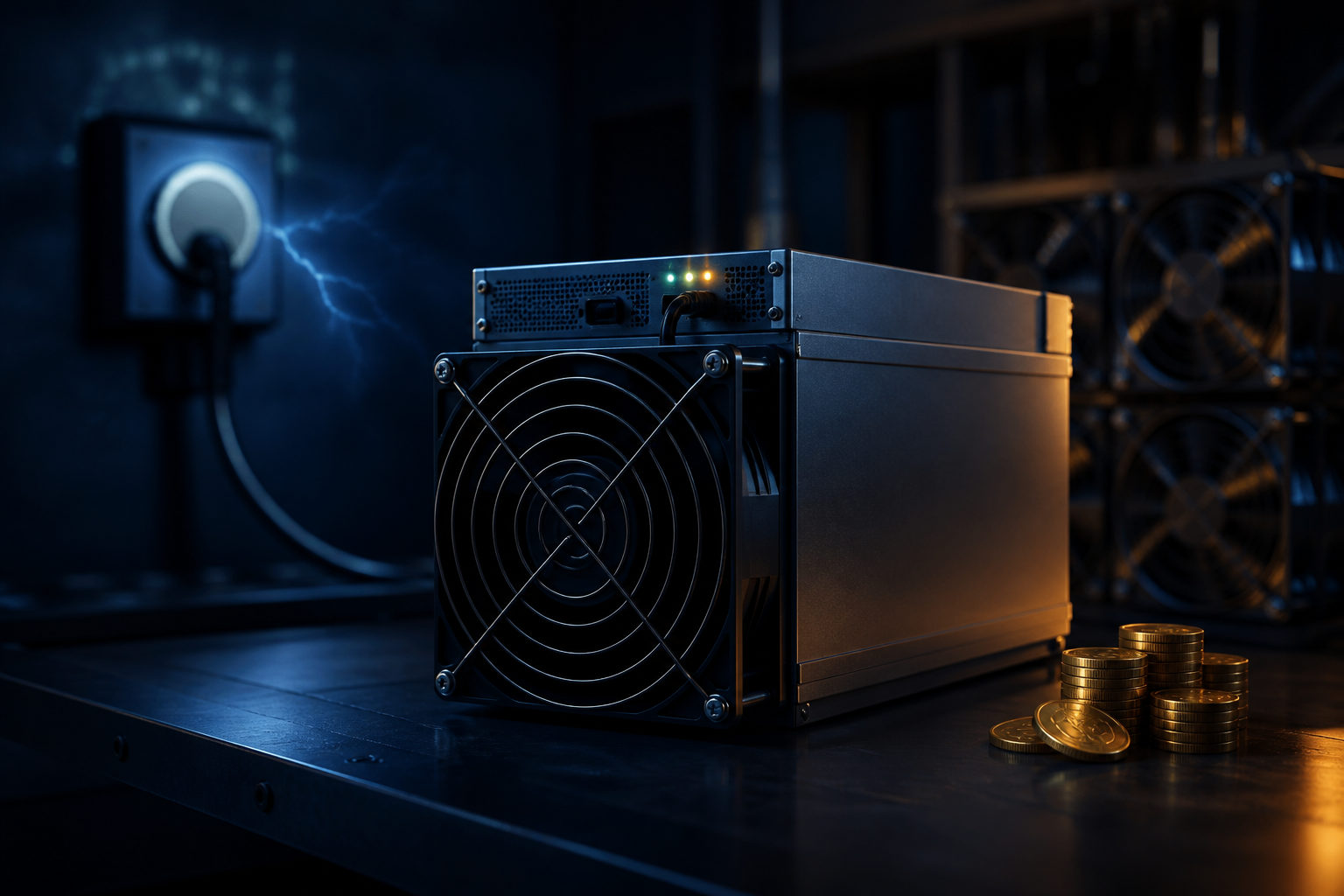
For most people, bitcoin mining in 2026 is not an easy path to profit. It can still make sense for individuals in the right setup, but the outcome depends less on hype and more on electricity costs, machine efficiency, cooling, and day-to-day operation.
Think of mining as a race to write the ledger
A simple way to understand bitcoin mining is to picture a public ledger that no single party controls. Miners compete to add the next page by performing specialized calculations, and the winner gets to package transactions into a new block.
Bitcoin started with the genesis block in January 2009, and the network produces a block about every 10 minutes. The miner that finds a valid block can receive the block reward plus transaction fees, which is why so much effort goes into hardware, uptime, and power management.
This is where many beginners get the wrong idea. Mining is not the same as installing software and watching passive income appear. It is closer to running a small technical operation with exposure to changing costs and strong competition.
Why individual miners face a hard reality
If mining were a simple hobby, a home setup would be enough. In practice, an individual miner competes with industrial operations, newer machines, cheaper power sources, and teams that know how to keep hardware running with minimal downtime.
That does not mean individuals have no chance. It means the margin for error is thin, and the basic questions are practical ones rather than theoretical ones.
- Electricity cost: This is usually the biggest ongoing expense. A setup that looks workable on paper can become unattractive if power is expensive.
- Hardware efficiency: Newer machines can produce more hash power for the same energy input. Older units may still run, but that is not the same as being economical.
- Cooling and noise: Mining equipment generates heat and often makes a lot of noise. Many homes are simply not a good fit.
- Operational skill: Network settings, firmware updates, dust control, fan health, and power stability all affect real output.
- Pool terms: Most individuals join a mining pool. Fee structure and payout rules matter because they shape what actually reaches your wallet.
So when people ask whether bitcoin mining is profitable for individuals in 2026, the real answer is tied to cost control. The market price of bitcoin matters, but personal mining economics often come down to details inside your own setup.
How individuals usually take part
Running miners at home
This is the most direct route and often the least understood. You need suitable electrical capacity, ventilation, stable internet access, and a tolerance for constant machine noise. For many households, those conditions are difficult to meet.
Home mining also turns you into the operator. If a machine stops, overheats, disconnects, or needs maintenance, the problem is yours to solve.
Joining a mining pool
Most individuals do not mine solo because finding a block alone is highly unpredictable at small scale. A pool combines the hash power of many miners and distributes payouts according to its rules, which makes income more regular even after fees are deducted.
That trade-off is important. You give up some independence, but you gain steadier results and a setup that is more realistic for a smaller participant.
Hosting equipment elsewhere
Some individuals buy machines but place them in a professional facility. That can reduce the headache of heat and noise at home, yet it adds another layer of cost and trust. You need to understand service terms, communication standards, and what happens when a machine goes offline.
Cloud mining needs extra caution
Cloud mining can sound convenient because it removes the hardware burden. Still, convenience does not remove risk. Contract language, fee deductions, payout formulas, and cancellation terms determine whether the arrangement is sensible.
If the offer is easy to understand only at the marketing level and hard to understand at the contract level, that is a warning sign. Individuals should be careful with any setup that makes mining sound effortless.
What to check before deciding in 2026
If you want a realistic answer to whether personal bitcoin mining is worth it in 2026, start with a checklist rather than a dream scenario. The goal is not to guess a perfect outcome. The goal is to avoid entering with the wrong assumptions.
- Map your full cost base: Look beyond electricity. Include hardware wear, replacement parts, maintenance time, internet reliability, and losses during downtime.
- Match mining to your environment: Your space needs airflow, acceptable noise tolerance, and electrical conditions that can handle continuous operation.
- Understand the post-halving setting: Bitcoin halves roughly every 4 years, or every 210,000 blocks. The recent halving years are 2012, 2016, 2020, and 2024. After a halving, inefficient setups usually feel pressure sooner.
- Compare the opportunity cost: The same budget could go into hardware, direct bitcoin exposure, or remain in cash for flexibility. Those choices come with very different risk profiles.
- Accept uncertainty: Mining results can shift with changes in transaction fee conditions, network difficulty, and market sentiment.
For a small operator, mining is usually viable only when several advantages line up at once. Cheap power alone is not enough if the machine is inefficient. Good hardware alone is not enough if the space cannot handle heat. A clean setup matters more than enthusiasm.
FAQ
Is it too late for an individual to start mining bitcoin?
Not automatically. The better question is whether your costs and setup make sense. A late start with good conditions can be more rational than an early start with poor power, weak ventilation, and no plan for maintenance.
Can a normal home computer still mine bitcoin?
In theory, any device that performs computation can try to participate. In real mining conditions, general-purpose home computers are not competitive against specialized ASIC hardware, and long runtimes can create extra wear.
Is solo mining better than using a pool?
Solo mining gives you the full block result if you find one, but that outcome can be extremely irregular for a small miner. Pool mining spreads the reward according to contribution, which is why it is often the more practical option for individuals.
What should individuals check first before buying mining hardware?
Start with electricity cost, then review hardware efficiency, then look at cooling, noise, and maintenance demands. Many people focus on bitcoin itself and forget that mining performance is shaped every day by operating conditions.
Is mining a good fit for someone without technical experience?
It can be a rough starting point if you are new to wallets, pool payouts, network configuration, and hardware care. Learning those basics first usually saves money and reduces the chance of making expensive mistakes.
Practical next step before spending anything
Before you buy a miner, write down your power rate, space limits, noise tolerance, ventilation plan, pool choice, and wallet storage method. If you cannot explain those points clearly yet, more research is probably worth more than rushing into a machine purchase.
Disclaimer: This article is for informational and educational purposes only and is not investment, financial, or legal advice. Crypto assets are highly volatile and you could lose your entire investment. Do your own research and decide carefully.