
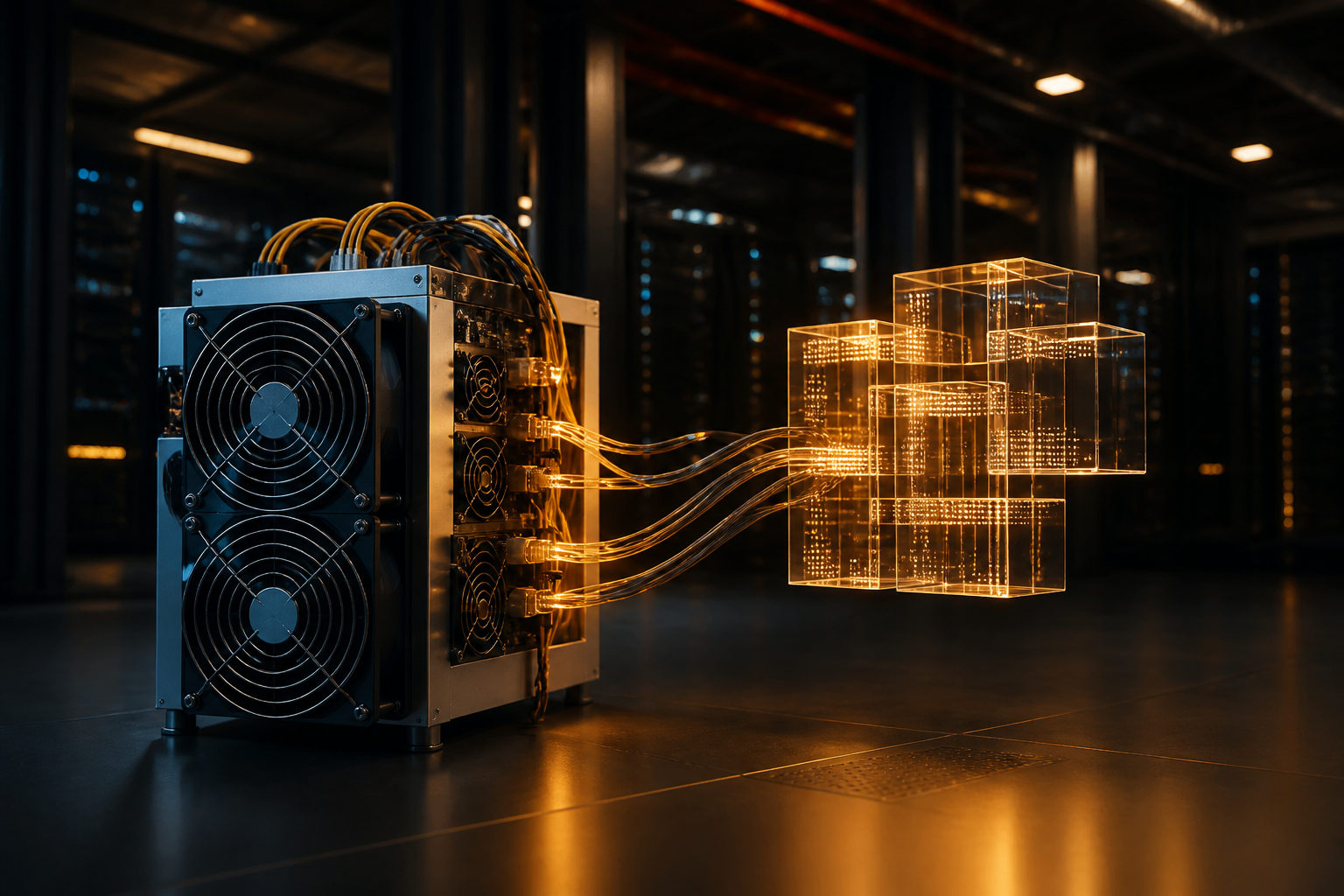
Bitcoin mining exists to keep Bitcoin running. It verifies transactions, adds new blocks, helps the network agree on one ledger, and releases new BTC under fixed rules.
Mining is not just a way to “get coins”
A lot of people hear the word mining and stop at the reward. Fair enough. Miners do receive newly issued bitcoin and transaction fees when they add a block. But if you leave the explanation there, you miss the main job.
Bitcoin has no central operator keeping the master database. No bank closes the books at the end of the day. No payment company gets the final word on which transfer counts. So the system needs another method to check transactions, order them, and make thousands of independent participants accept the same history. Mining is that method.
Miners gather valid pending transactions into a block. Then they compete through proof of work to add that block to the blockchain. The reward matters because it gives people a reason to spend money on machines, electricity, and operations. The point of the incentive is simple: keep security and record-keeping alive without handing control to one party.
What mining actually does inside Bitcoin
| Function | What miners do | Why users should care |
|---|---|---|
| Transaction validation | Check whether transactions follow protocol rules and carry valid signatures | Invalid transfers are less likely to enter the ledger |
| Block creation | Package a batch of transactions into a new block and broadcast it | Payments gain a public record others can verify |
| Network security | Use computational work to raise the cost of rewriting history | Confirmed payments become harder to reverse |
| Issuance | Receive newly issued bitcoin according to the protocol when a block is found | New supply enters circulation by rule, not by committee |
| Consensus support | Give distributed nodes a way to converge on one valid chain | The ledger stays more coherent across the network |
Put those together and the purpose of Bitcoin mining looks very different from the usual beginner summary. It is not a side activity attached to Bitcoin. It is part of the machine.
When you send bitcoin, what you see is a wallet interface and then a waiting period before confirmation. Under that surface, miners are doing the work that turns a broadcast transaction into a block that the network recognizes. Without that steady flow of new blocks, transactions could still circulate, but final record-keeping would be far weaker.
Why Bitcoin uses mining to reach agreement
Traditional payment systems rely on an administrator. That works because one entity controls the ledger and decides what counts as settled. Bitcoin tries to do something stranger: let anyone inspect the rules, let anyone run a node, and still stop random parties from editing balances at will.
That creates a hard problem. If many participants keep copies of the ledger, how do they settle on one shared version when there is no central referee? Bitcoin answers with proof of work. Miners must commit real-world resources to compete for the right to add the next block. That cost is not decorative. It is the barrier that makes fraud and history rewrites expensive.
If someone wanted to reverse old transactions or spend the same coins again, they would need to catch up with and overtake later blocks. In practice, the design is meant to make that attempt very costly. Expensive attacks are less attractive attacks.
Bitcoin also ties issuance to this process. A block is found about every 10 minutes. The block subsidy halves about every 4 years, or every 210,000 blocks. The total supply is capped at 21 million coins. So mining is doing two jobs at once: it helps defend the ledger, and it releases new bitcoin on a schedule that is built into the protocol rather than adjusted by a central authority.
The use of mining looks different depending on where you stand
| Point of view | Visible effect | Deeper meaning |
|---|---|---|
| Holder | A transfer can be confirmed | The asset move enters a shared ledger that is harder to tamper with |
| Merchant or receiver | Incoming payments leave a traceable public record | Settlement rests on open rules instead of one platform’s approval |
| Node operator | There is a regular flow of blocks and a common validation target | The network can converge on one valid chain more easily |
| Miner | Block rewards and fees are available | Economic incentives are used to buy security and record-keeping |
| The system as a whole | Security and issuance happen together | Ledger continuity, monetary supply, and resistance to tampering are linked |
From the outside, mining can look like an industrial contest for coins. Inside Bitcoin, it plays a more basic role. It is the process that keeps a decentralized ledger from turning into a messy pile of competing copies.
That is why the question “a quoi sert le minage de bitcoin” has a fuller answer than “it creates bitcoin.” New coins are only the visible output. The bigger result is ordered record-keeping backed by economic cost.
Common misunderstandings about Bitcoin mining
| Misunderstanding | Closer to reality |
|---|---|
| Mining is just making coins out of nothing | It also validates transactions, creates blocks, and helps protect the network |
| Miners can change transactions however they want | They still have to follow protocol rules enforced by nodes |
| Bitcoin can work the same way without mining | Transactions may spread, but dependable confirmations need ongoing block production |
| Mining only matters to miners | Anyone who uses Bitcoin depends on the security mining provides |
| Block rewards are only a profit tool | They are also the payment mechanism that keeps decentralized security in motion |
One more point matters here. Wallets, nodes, and miners do different jobs. A wallet manages keys and signs transactions. A node checks whether data follows the rules and relays it. A miner competes to place valid transactions into a new block. Mix those roles together and the purpose of mining gets blurry fast.
If you want the short version, here it is: Bitcoin mining turns real cost into network order. That is how a system with no central manager keeps updating its ledger and makes tampering harder.
FAQ
Is the main purpose of Bitcoin mining to create new bitcoin?
That is part of it, but not the full story. Mining also validates transactions, produces blocks, and keeps the ledger moving forward under shared rules.
What happens if miners stop mining?
Without ongoing block production, transaction confirmation becomes difficult and the network loses security. Bitcoin depends on proof of work to maintain its regular record-keeping process.
Why does a Bitcoin payment need confirmations instead of counting the moment it is broadcast?
Broadcasting means the transaction has been seen by the network. It does not mean it has been written into the shared ledger. Once it enters a block, the receiver has a clearer basis for treating it as recorded.
Why should ordinary users care what mining is for if they never mine?
Because every send and receive action depends on the confirmation process miners provide. Even passive holders rely on that security model when they trust the ledger state.
Are miners and nodes the same thing?
No. Nodes focus on validating and relaying rule-compliant data, while miners compete to add blocks. One participant can run both, but the roles are not identical.
When you judge whether Bitcoin mining is doing its job, look at the basics: blocks continue to be produced, transactions keep entering blocks, and the network keeps following the same rules. That tells you more than the reward headline ever will.