
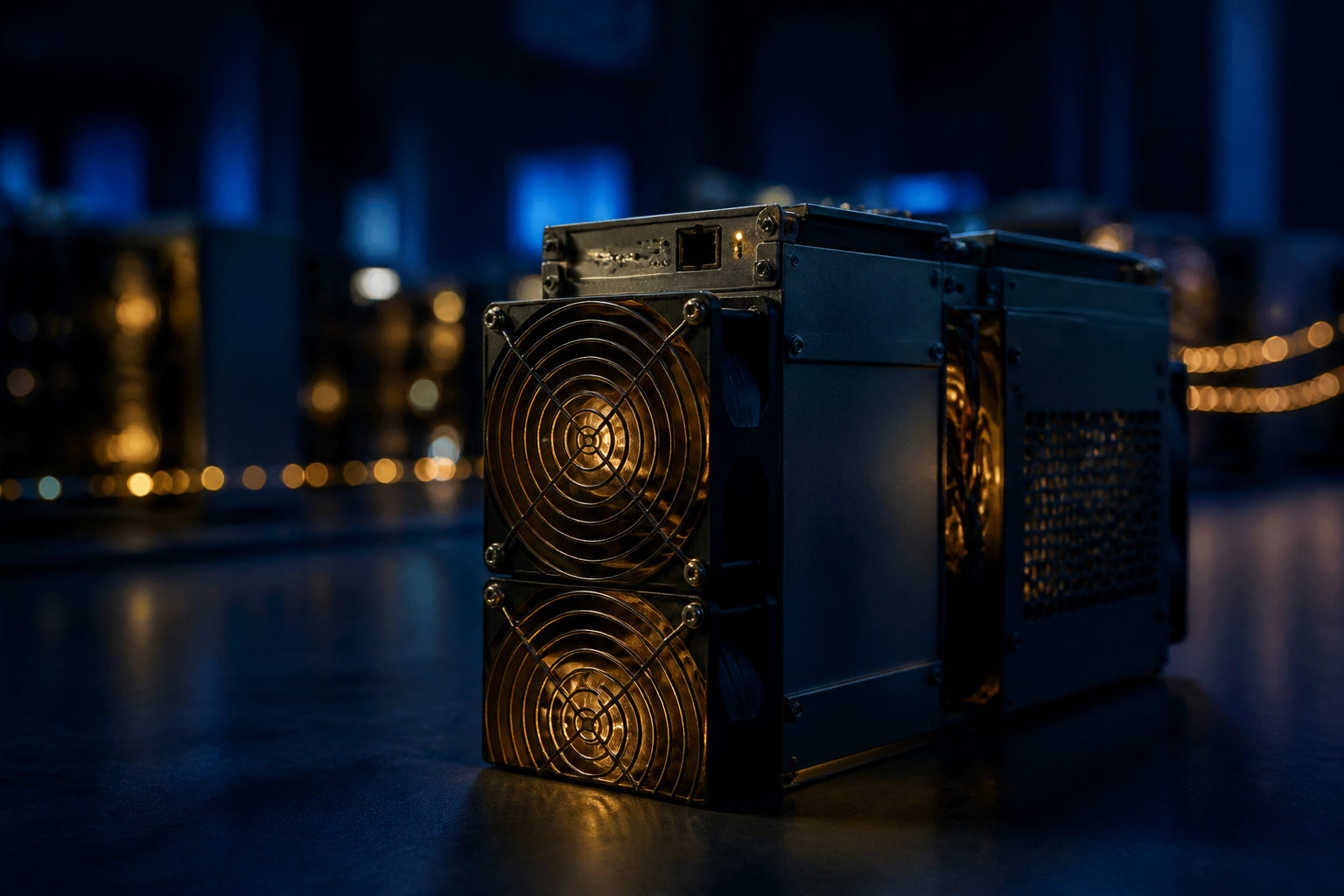
A guide to bitcoin mining starts with one clear point: mining is a competition to win the right to add a new block to Bitcoin’s public ledger, using computing power under fixed network rules.
What bitcoin mining actually does
The word “mining” can be misleading. Bitcoin miners are not digging coins out of the ground. They are competing to package transactions, validate them, and add a new block to the blockchain.
A simple way to picture it is a public bookkeeping race. People send bitcoin to each other, and the network needs a method to decide which valid set of transactions gets written into the next block. Miners supply that method by running specialized machines that perform repeated calculations.
The first miner to produce a result that fits the network’s target gets the chance to publish the block. Other participants verify it. If the block is accepted, the miner receives the block reward set by the protocol. That is how new bitcoin enters circulation while the network stays decentralized.
How the mining process works
Bitcoin produces a new block about every 10 minutes. Miners gather pending transactions into a candidate block and keep hashing until one machine finds a valid output. The system adjusts mining difficulty so blocks do not appear too quickly or too slowly over time.
Hashrate is the basic measure of mining power. In plain English, it tells you how much computational work a machine can try in a given span. A higher hashrate means more attempts and a better chance of finding a valid block before someone else does. That still does not mean a solo miner can expect regular success, because the network is highly competitive.
Bitcoin’s supply schedule is also part of the mining story. The maximum supply is capped at 21 million coins. The block subsidy is reduced by half about every 4 years, or every 210,000 blocks. The halving years so far are 2012, 2016, 2020, and 2024. This matters because mining economics change over time even if the basic process stays the same.
| Concept | What it means | Why it matters |
|---|---|---|
| Block | A packaged batch of transactions | Mining is a race to create the next valid block |
| Hashrate | The machine’s rate of computational attempts | It affects your relative position in the competition |
| Difficulty | The rule that adjusts block-finding conditions | It helps keep block timing near the intended pace |
| Block reward | The protocol’s payout to a successful miner | It is one source of mining income |
| Halving | A scheduled cut in new issuance | It changes long-term supply and miner expectations |
Ways people take part in bitcoin mining
There are several ways to join bitcoin mining, and they are not equal in control, complexity, or risk. The main paths are solo mining with your own hardware, pool mining with other participants, and cloud mining through a provider or contract-based service.
Solo mining gives you direct control over the machines and setup. You choose the hardware, manage the network connection, handle the cooling, and keep track of maintenance. The upside is visibility. You know what equipment you have and how it is running. The downside is that your chance of finding blocks on your own is tied to your hashrate against the full network.
Mining pools group many miners together. Instead of waiting for one machine to get lucky on its own, participants combine their computing power and share the results according to the pool’s payout rules. For smaller operators, this is the more practical route because rewards are usually distributed in a steadier pattern than solo block discovery.
Cloud mining removes the need to manage physical equipment, but it asks for extra caution. You may be buying a contract, a time-limited share of hashrate, or access to infrastructure you cannot inspect directly. If the provider is vague about machines, fees, downtime, or payout formulas, the convenience can come with much higher risk.
| Method | Best for | Main advantage | Main concern |
|---|---|---|---|
| Solo mining | People with hardware, space, and technical skill | High control over the operation | Hard to compete without significant scale |
| Mining pool | Most smaller miners | More regular distribution of results | Dependence on pool rules and service quality |
| Cloud mining | People who do not want to run hardware | No need to manage machines directly | Low transparency and contract risk |
The real barriers: hardware, electricity, heat, and operations
The largest mistake beginners make is treating mining as a software task. In current Bitcoin mining, the serious work is done by specialized ASIC hardware. A standard home computer is not built for this job in any practical sense. Even if it can run related software, it is not an effective setup for competing on the Bitcoin network.
Electricity is the next reality check. Mining machines run continuously, and their power use does not arrive as a one-time expense. It keeps showing up for as long as the machines stay online. Then come the less glamorous parts: heat removal, airflow, dust management, power stability, internet reliability, machine wear, replacement parts, and repair delays.
Noise matters too. Mining hardware is not subtle, and that is one reason home setups are often less realistic than they first appear. A location that looks acceptable on paper can turn into a poor fit once sound, temperature, and electrical limits are tested in daily use.
Some people use hosted facilities instead of running machines at home. That can solve part of the logistics problem, but it introduces a different checklist: contract terms, fee structure, uptime responsibility, visibility into your machines, and the quality of the operator’s reporting.
| Area | What to check | Frequent beginner error |
|---|---|---|
| Hardware | Whether the device is purpose-built for Bitcoin mining | Assuming an ordinary PC is enough |
| Electricity | Ongoing power cost and circuit stability | Focusing only on purchase price |
| Cooling | Ventilation, temperature control, dust handling | Ignoring heat until performance drops |
| Internet | Connection stability and low interruption risk | Treating outages as minor |
| Hosting | Contract clarity, service quality, operational visibility | Relying on marketing copy alone |
How to decide whether mining is right for you
If you are reading this guide to bitcoin mining to decide what to do next, start by separating curiosity from business intent. Those two goals lead to different choices.
If your goal is education, begin with the mechanics: wallets, transaction confirmation, block creation, pool payout methods, and the route from mined rewards to self-custody. That gives you a working picture of the system before you spend money on equipment or contracts.
If your goal is active participation, look at the full chain of responsibility. You need to think about hardware sourcing, power conditions, machine maintenance, hosting terms if you use them, and where mined bitcoin will be stored after payout. A wallet you control is part of the mining process, not an afterthought, because the end result is still an asset that needs secure custody.
FAQ
Can an individual still mine bitcoin today?
Yes, but the practical route is different from Bitcoin’s early years. Most individuals who want to participate now look at mining pools or hosted setups rather than trying to compete alone with limited hardware.
Can I mine bitcoin with a regular home computer?
In a technical sense, a computer can run software related to mining. In practical terms, an ordinary machine is not competitive against specialized ASIC hardware and is usually a poor fit for sustained Bitcoin mining.
Is pool mining better for beginners than solo mining?
For many beginners, yes. A pool can make participation more realistic because it spreads block-finding uncertainty across many miners, though you still need to study the pool’s payout rules and operating quality.
Why is cloud mining often treated with caution?
The main issue is transparency. If you cannot verify the hardware, understand the fee model, or see how downtime affects payouts, you are depending heavily on a provider’s promises.
Where should mined bitcoin be stored?
That depends on how you plan to hold it, but long-term control usually points toward a wallet you manage yourself. Leaving funds with a third party for convenience can also leave control with that third party.
Before you buy anything, map the full process from machine to electricity to payout wallet. For most people, understanding that chain is more useful than rushing into a mining setup.
Disclaimer: This article is for informational and educational purposes only and is not investment, financial, or legal advice. Crypto assets are highly volatile and you could lose your entire investment. Do your own research and decide carefully.