
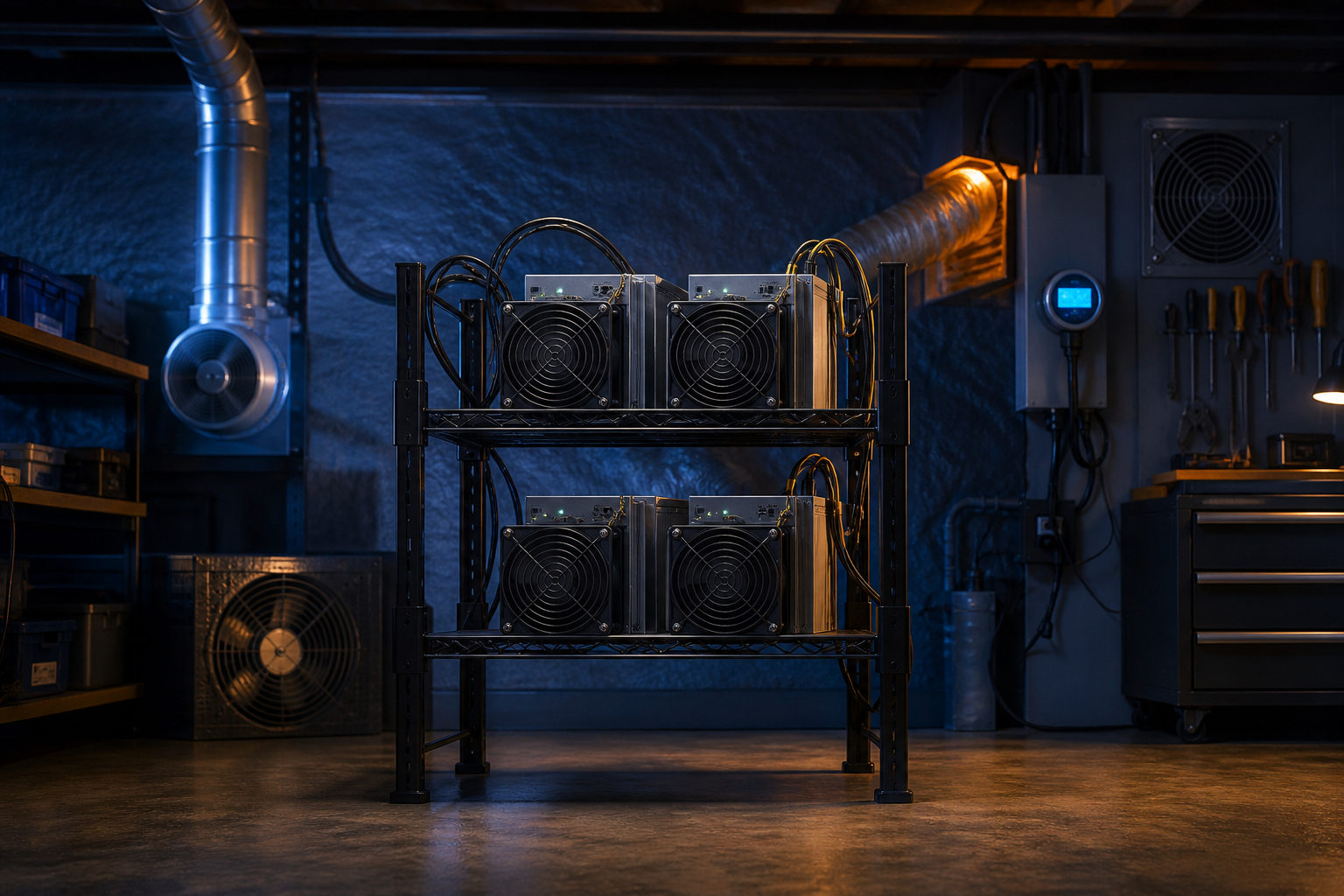
Small-scale bitcoin mining in 2026 can make sense for some people, but it is rarely profitable by default. The real question is not whether you can mine bitcoin at all; it is whether your electricity cost, hardware efficiency, cooling setup, and downtime risk leave any room after expenses.
A useful way to think about bitcoin mining is as a nonstop bookkeeping race. Miners around the world compete for the right to add the next block to the blockchain. The network produces a block about every 10 minutes, and the winner gets the block reward plus transaction fees. That sounds simple, yet the economics are not simple at all, especially for small operators.
Bitcoin mining is a bookkeeping contest, not a magic income machine
Bitcoin does not rely on a single company or administrator to verify transactions. Instead, miners use specialized hardware to perform hashing calculations and compete under a shared set of rules. If a miner finds a valid result first, that miner can publish the block and claim the reward.
For a small miner, the first thing to understand is probability. A single machine can run correctly and still go a very long time without finding a block on its own. That is why most small operators join mining pools. A pool combines the hashing power of many participants and distributes rewards based on each member's contribution, which makes results less erratic.
This is also why asking whether you can “mine one bitcoin” can lead you in the wrong direction. Mining is not a one-time lottery ticket. It is an ongoing operating business with hardware wear, constant power use, network competition, and repeated maintenance decisions.
What decides profitability in 2026
When people ask whether small-scale bitcoin mining is profitable in 2026, they often focus only on the bitcoin price. That is not enough. Price matters, but costs hit you every day, whether the market is strong or weak. If your cost structure is poor, a favorable market may still not save the operation.
For most small miners, the main factors are practical:
- Electricity cost: This is usually the largest ongoing expense. If your power rate is not competitive, the rest of the plan gets harder fast.
- Hardware efficiency: Newer or more efficient machines can produce more hashing power for the same or lower energy use. Older hardware may still run, but that does not mean it makes economic sense.
- Cooling and ventilation: Mining hardware generates a lot of heat. If you cannot remove that heat, performance may drop and hardware stress may rise.
- Noise: Many first-time miners underestimate this. Home mining may look easy on paper, then fail because the machine is too loud for daily life.
- Downtime: Every outage, connectivity issue, fan problem, or power instability cuts output. A machine that sits idle is still capital tied up.
- Pool fees or hosting fees: If you use a mining pool or a hosted setup, those charges reduce what you actually keep.
These factors also interact with one another. You may spend extra on cooling to protect the machine. You may reduce noise only by changing how the system runs. You may avoid household problems by using a hosting provider, but then you take on service risk and another layer of cost.
So, is small-scale bitcoin mining profitable in 2026? Sometimes, yes. Often, no. The answer depends less on a broad headline and more on whether your operating conditions are genuinely competitive.
Common ways to participate on a small scale
Small-scale mining does not always mean the same thing. Some people mean running one or a few machines at home. Others mean owning hardware that sits in a professional facility. The economics can look very different depending on the setup.
Home mining
Home mining gives you direct control over your equipment. You buy the machine, connect it to power and the internet, and handle the day-to-day operation yourself. The advantage is obvious: you keep physical control of the hardware and do not depend on a host for access.
The downside is just as obvious once the machine arrives. A normal living space is usually not designed for constant high-load industrial hardware. Heat, airflow, sound, dust, and electrical capacity all become real constraints. For many beginners, the toughest part is not starting the machine. It is keeping it running smoothly without creating problems at home.
Hosted mining
Hosted mining means placing your machine in a specialized facility that provides power, cooling, and basic maintenance. This can solve the heat and noise issues that make home mining difficult. It may also offer better operating conditions than a residential setup.
Still, hosting is not risk-free. You need to understand the fee structure, service terms, maintenance responsibility, equipment ownership records, and withdrawal or return procedures. A cheap hosting offer may not stay cheap once service quality, billing clarity, or downtime handling come into view.
Mining pools
For small operators, joining a pool is usually the normal path. Solo mining leaves you exposed to very uneven results, while a pool smooths out reward distribution over time. That does not remove risk, but it makes the business easier to evaluate.
Even here, details matter. Pool payout methods, fees, technical reliability, and account policies can all affect your final result. Theoretical output and what reaches your wallet are not always the same.
Why many small miners misjudge the economics
A common mistake is treating mining like a static spreadsheet exercise. On paper, you can list machine power draw, expected output, and a few operating costs. In reality, machines get dusty, fans wear out, internet links fail, rooms get hotter, and people simply do not have time to monitor equipment as closely as they expected.
Another mistake is confusing bitcoin mining with general-purpose computing. Modern bitcoin mining is dominated by specialized ASIC hardware, not ordinary consumer computers. A desktop or laptop may be able to perform hashing in theory, but that does not mean it is a sensible way to compete on the bitcoin network today.
Here are some of the main reasons a small mining plan can look workable at first and then disappoint:
- Power is too expensive: High electricity rates can erase any economic edge quickly.
- The hardware is already behind: Buying late into a hardware cycle can leave you competing against more efficient machines from day one.
- Environmental costs were ignored: Noise management, airflow changes, cleaning, and repairs all take money or time.
- Downtime was treated as minor: Lost hours add up, and mining rewards do not wait for your machine to come back online.
- Expectations were unrealistic: Participation in the network is not the same as dependable profit.
There is also the competitive side of the network itself. Bitcoin mining difficulty adjusts based on conditions across the network. In plain terms, if the overall competition becomes stronger, each individual machine may have a harder time earning enough to justify its costs. You are not entering a fixed game. You are entering an arms race in efficiency and operations.
A practical checklist before you try small-scale bitcoin mining in 2026
If you are seriously considering small-scale bitcoin mining in 2026, do not start by asking strangers whether it is “still worth it.” Start with your own constraints. Mining economics are local and operational before they are theoretical.
| Factor | What to check | What goes wrong if you ignore it |
|---|---|---|
| Electricity | Your power rate and whether your electrical setup can handle continuous load | Higher operating cost and possible safety or breaker issues |
| Hardware | Whether the machine is still competitive and serviceable | Output gets squeezed by more efficient equipment |
| Cooling | Whether heat can be removed from the room consistently | Lower performance, hardware stress, and more outages |
| Noise | Whether your location can tolerate constant machine noise | Home or workplace disruption that leads to shutdown |
| Maintenance | Whether you can handle dust, fan issues, network trouble, and restarts | Longer idle periods and weaker real-world results |
| Capital planning | Whether you see the machine as a high-risk operating asset, not a guaranteed return product | Pressure rises fast if the payback thesis breaks down |
If several of those areas are weak, the answer to “is small scale bitcoin mining profitable 2026” is likely less favorable than you hope. In that case, learning the mechanics first and studying operating conditions may be smarter than rushing to buy hardware.
FAQ
Can home bitcoin mining still make money in 2026?
It can, but only under the right conditions. Home miners usually struggle with power cost, heat, noise, and uptime, so the setup matters more than the simple fact that the machine is running.
Is small-scale bitcoin mining basically dead?
No, but it is much less forgiving than many newcomers expect. The challenge is not getting connected to the network. The challenge is running a cost structure that can compete over time.
Do I need to join a mining pool?
Not in an absolute sense, but most small miners do. Pool mining usually produces steadier results than solo mining, which makes it easier to judge whether the operation is working.
What should I check first before buying a miner?
Start with electricity cost, then hardware efficiency, then cooling, noise, and maintenance demands. Looking only at bitcoin price can lead to poor decisions because price is only one part of the equation.
Can I mine bitcoin with a normal computer instead of an ASIC?
A normal computer can perform hashing in theory, but that does not make it practical for bitcoin mining today. For this network, specialized hardware is the standard, and general-purpose machines are usually not competitive.
Before you try small-scale bitcoin mining in 2026, verify your power setup, work out how you will handle heat and noise, and read pool or hosting terms with care. If those basics do not hold up, buying hardware first and asking questions later is usually the expensive way to learn.
Disclaimer: This article is for informational and educational purposes only and is not investment, financial, or legal advice. Crypto assets are highly volatile and you could lose your entire investment. Do your own research and decide carefully.