
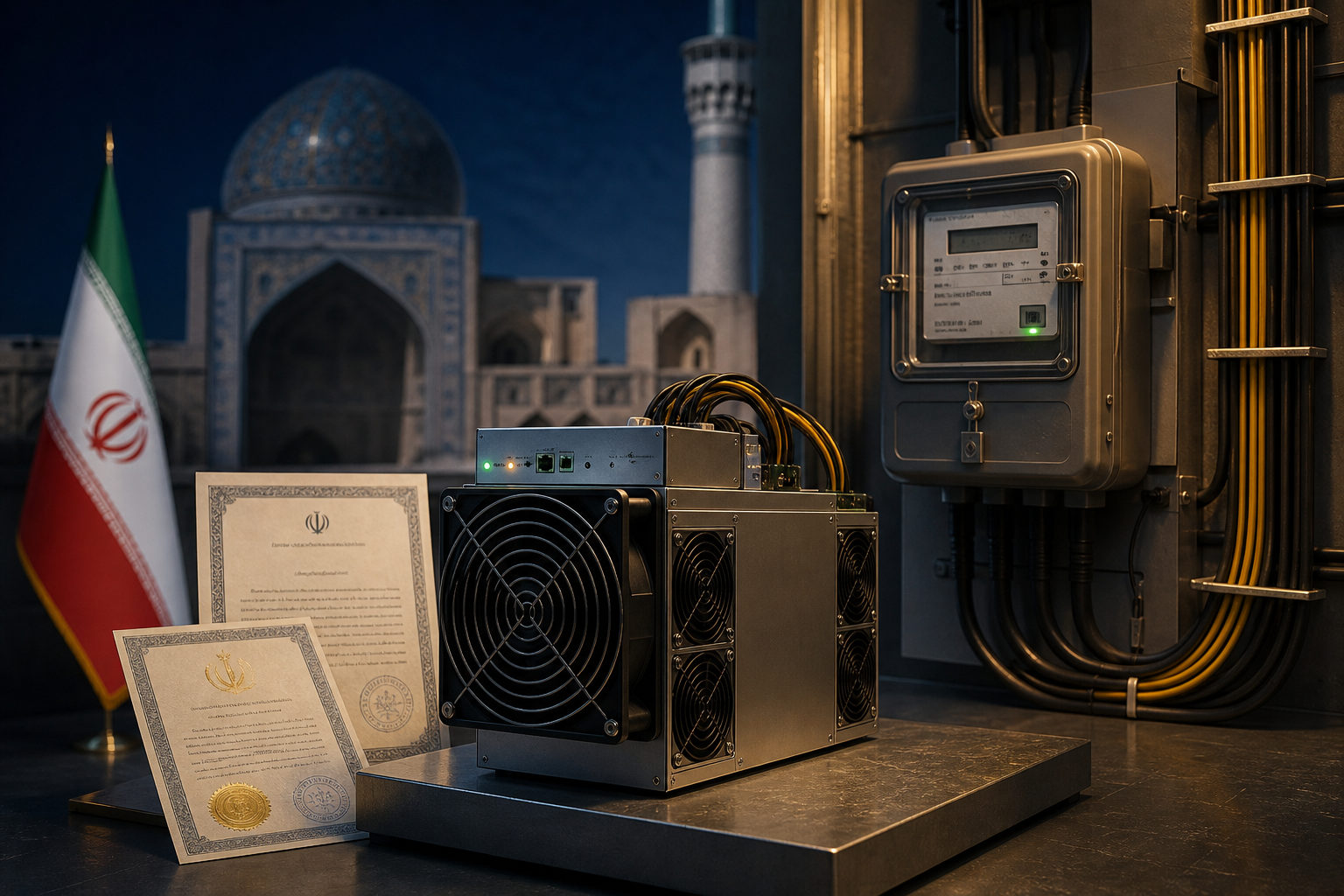
In 2026, bitcoin mining in Iran should not be treated as automatically legal just because mining exists there. The real question is whether a miner has the required permission, uses electricity in a compliant way, and operates under the local rules in force at that time.
That distinction matters. People often ask whether mining is legal as if the answer must be a simple yes or no, but in practice the issue is narrower and stricter: what kind of operation is being run, where the machines are installed, what type of power is being used, and whether the operator falls inside a licensing framework. Without checking those points, any broad claim is unsafe.
Start with the basic idea: mining is a race to record transactions
A simple way to picture bitcoin mining is to think of it as a nonstop bookkeeping contest. The Bitcoin network is a public ledger, and many machines around the world compete to package transactions into a new block. The machine or group of machines that finds a valid result under the protocol rules gets the right to add that block.
This is not manual approval by a company or a state office. It is an automated process based on cryptographic rules. About every 10 minutes, a new block is added, and miners keep running specialized hardware to make repeated attempts. That is why mining is not the same as installing a normal app and waiting for passive income.
Once that is clear, the legal question becomes easier to understand. Mining turns electricity, hardware, cooling, and network uptime into computational work. Governments often focus on mining because it can place a sustained load on power systems. If a miner uses residential electricity, subsidized power, or an undeclared setup where commercial activity is not allowed, the problem may have less to do with bitcoin itself and more to do with energy rules, permits, and enforcement.
How to think about whether bitcoin mining is legal in Iran in 2026
If someone searches for “is bitcoin mining legal in Iran 2026,” the useful answer is not a slogan. The useful answer is a checklist. In a country where energy policy and local enforcement can shape what is allowed in practice, legality usually depends on operating inside a permission-based structure rather than assuming private use is fine by default.
So the better framing is this: bitcoin mining in Iran may be allowed only under certain conditions, and those conditions matter more than general online chatter. A mining machine by itself does not make an operation legal. A warehouse does not make it legal. Access to electricity does not make it legal. The operation has to match the actual rules that apply to that place and period.
Two mistakes are common. The first is assuming that because mining has been discussed publicly in connection with Iran, any individual can run machines without issue. The second is assuming that if hardware can be bought or imported, running it must be lawful. Both shortcuts ignore the real pressure points: licensing, power classification, site use, declarations, and changing enforcement.
Key points to verify before calling it legal
- Licensing: Mining may be treated as a regulated industrial or commercial activity rather than a household one.
- Electricity source: Residential, subsidized, commercial, and industrial power are not the same from a compliance standpoint.
- Site type: A home, a storage unit, and an approved industrial site may face very different rules.
- Equipment declarations: Import, transport, installation, and operation can each raise separate compliance questions.
- Temporary restrictions: During periods of energy strain, enforcement can tighten quickly.
That is why the most careful answer is that bitcoin mining in Iran should be seen as a regulated activity with conditions attached, not as a free-form hobby that anyone can run wherever they want.
Why power use is at the center of the Iran mining question
The word “mining” can make the topic sound purely technical, but the day-to-day reality is mostly about energy and operations. Mining hardware runs at high load for long periods, produces heat, creates noise, and needs stable connectivity. In any country where power pricing, subsidies, grid stability, or industrial demand are sensitive policy areas, mining is likely to draw close attention.
From a regulator’s point of view, the concerns are easy to see. Authorities may want to prevent low-cost electricity from being diverted into power-hungry commercial activity. They may want to keep the grid from being burdened by unapproved demand. They may also want to know which entities are operating such equipment and under what legal status.
That is why “I only want to run a few machines at home” is not a safe assumption. A small setup can still create heat, noise, wiring stress, ventilation issues, and questions about the permitted use of the property. The fact that a mining setup is modest does not automatically make it compliant.
There is also a timing issue. Legal status is not something you check once and forget. Even if a setup appears acceptable at one moment, later policy changes, local notices, or power management measures can alter what is allowed. For anyone planning a cross-border or hosted operation, that uncertainty is a major operational risk.
Common ways people participate in bitcoin mining
Many beginners imagine that mining starts and ends with buying a machine. In reality, participation comes in a few different forms, and each raises different legal and practical questions. No matter which route a person considers, compliance still comes first.
Running your own site
This is the most hands-on path. It involves equipment sourcing, electrical setup, cooling, noise control, networking, maintenance, and site management. If the operation is based in Iran, the operator would also need to make sure the site use, electricity arrangement, and any required permits match local rules.
The appeal is control. The downside is that every weak point becomes your problem. New miners often focus on the machine purchase and ignore the operational reality after power-on. Long-term uptime is usually harder than the initial setup.
Hosted mining
Hosted mining means placing hardware in a third-party facility that provides power, cooling, internet access, and routine maintenance. This can reduce the burden of building a site yourself, but it does not remove legal risk. You still need to know whether the host is operating in a compliant way.
If the hosting provider lacks proper authorization or uses power in a way that violates local rules, the machine owner may still face practical and legal exposure. For foreign users, the hardest questions are often contractual: who controls shutdowns, who bears losses, and what happens to the equipment if local policy changes.
Joining a mining pool
A mining pool helps with reward variance, not legality. Because a single machine is unlikely to win blocks on a steady basis, miners often combine computing power in pools and share the outcome under pool rules. That makes earnings less erratic, but it does nothing to legalize an improper site or power setup.
This point is easy to miss. Pool participation is just a method of organizing mining output. It does not answer whether the machines themselves are allowed to run where they are located.
Do not focus only on the machine: the real issue is cost structure
Even without discussing profitability, bitcoin mining is a capital-intensive and maintenance-heavy activity. The machine is only the visible part. The harder part is maintaining a cost structure that can survive interruptions and policy shifts.
- Electricity: For most mining operations, power is the core operating expense.
- Cooling and ventilation: Heat management affects stability and safety.
- Repairs and spare parts: Fans, power supplies, and boards can fail over time.
- Network uptime: A machine that drops offline frequently loses effective operating time.
- Policy and shutdown risk: A forced pause can damage the economics of the whole setup.
That is why questions about “cheap mining” can be misleading. Lower apparent power cost does not mean a setup is sustainable if the electricity category is wrong, the site is unsuitable, or the operation can be interrupted without warning. Looking at one input while ignoring the legal frame produces weak conclusions.
Bitcoin’s own design adds another pressure point. Roughly every 4 years, the network goes through a halving, which occurs every 210,000 blocks. That event does not lower your electricity bill or your maintenance burden. It changes the competitive environment, which means hardware efficiency, uptime discipline, and operational control matter even more.
FAQ
Can I legally mine bitcoin from a home in Iran?
You should not assume that a home setup is legal by default. Residential power use, property rules, wiring limits, heat, and noise can all create compliance issues even for a small operation.
Does connecting to a mining pool make the activity legal?
No. A mining pool only combines hashpower and distributes outcomes under its own rules. It does not solve permit, electricity, property, or reporting requirements.
Is bitcoin mining completely banned in Iran?
That is too simple a way to frame it. A more careful view is that mining should be treated as a controlled activity whose legality depends on whether the operator fits the relevant permission and power-use rules.
What risk do new miners most often underestimate?
Many people confuse “the machine can run” with “the business can keep running.” In practice, electricity compliance, site suitability, maintenance demands, and sudden shutdowns are often bigger problems than the initial setup.
Is buying bitcoin the same thing as mining it?
No. Buying bitcoin is a market activity involving custody, execution, and price exposure. Mining is an operating business built around hardware, electricity, cooling, maintenance, and legal compliance.
What to check before doing anything
If you are seriously evaluating whether bitcoin mining is legal in Iran in 2026, do not start with hardware orders. Start with the current legal text, permit requirements, property use rules, electricity classification, equipment declarations, and shutdown obligations. If those points are unclear, treat the operation as unconfirmed and do not rely on forum posts or recycled social media claims as your compliance basis.
Disclaimer: This article is for informational and educational purposes only and is not investment, financial, or legal advice. Crypto assets are highly volatile and you could lose your entire investment. Do your own research and decide carefully.