
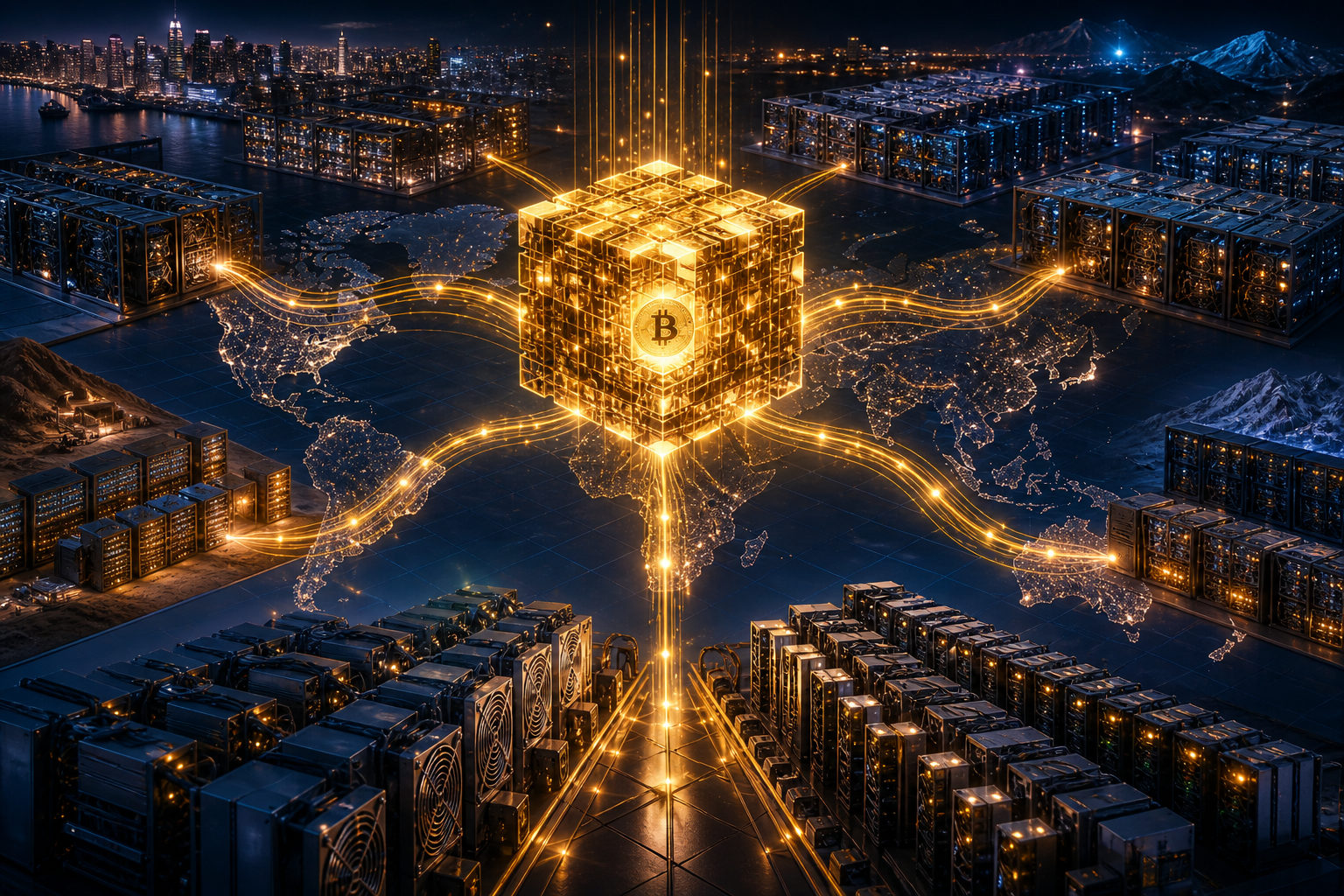
Where is Bitcoin mined? It is mined by specialized computers running in real-world locations across the globe, while the actual issuance of new coins happens through the network’s block creation rules.
Bitcoin mining is a record-keeping race
The word “mining” makes many beginners picture a physical deposit in the ground. Bitcoin does not work that way. There is no cave, field, or official site where coins are extracted. New bitcoin enters circulation when miners compete to add a valid block to the blockchain.
A simple way to think about it is a public bookkeeping contest. Miners gather pending transactions, run repeated calculations, and try to produce a block the network accepts. Bitcoin creates a new block about every 10 minutes, and the block reward is how newly issued coins appear.
So if someone asks where bitcoins are mined from, the technical answer is: from the block reward mechanism built into the protocol. If the same person means location, then the answer shifts to the places where mining machines are installed and kept running.
Where Bitcoin is mined in the physical world
In practical terms, Bitcoin is mined wherever mining hardware operates. That can be a large industrial mining farm, a hosted facility, or a smaller private setup. The key is not the country name by itself. The key is whether the site can support nonstop operation.
Mining machines need steady power, internet access, cooling, maintenance, and enough space to manage heat and noise. Because of that, miners tend to choose locations that make operations easier to manage over long periods. A place may look suitable on paper but still fail in day-to-day conditions if power quality, ventilation, or repair support is poor.
People also ask where most bitcoins are mined. That question is really about where a large share of mining power is located at a given time. There is no permanent answer because mining hardware can move, operating rules can change, and miners constantly adjust to costs and local conditions.
Common mining setups
- Mining farms: Large sites with many machines under one operation.
- Hosted facilities: Owners place machines with a professional operator.
- Home setups: Smaller operations, often limited by noise, cooling, and power issues.
- Distributed deployments: Machines spread across different locations to reduce single-site risk.
That is why Bitcoin does not come from one place. It comes from a global network, with hardware placed wherever real operating conditions allow mining to continue.
Mining machines, mining pools, and the network
Another point that causes confusion is the role of mining pools. A mining pool is not a place where bitcoin is created. It is a coordination method. Many miners combine their computing power, and the pool distributes rewards based on contribution under its own rules.
The machines still do the work, and the Bitcoin network still decides whether a block is valid. Pools simply make participation more predictable for many miners compared with mining alone. So if you ask where are bitcoins mined, the answer is not “inside a pool.” A pool is an organizing layer, not a physical source.
| Term | Main role | Why it matters here |
|---|---|---|
| Mining machine | Performs the required calculations | It must run in a real location |
| Mining farm | Hosts and manages many machines | It is a common physical mining site |
| Mining pool | Combines hash power and shares rewards | It is a participation model, not a place of origin |
| Bitcoin network | Validates blocks and transactions | It is where issuance rules are enforced |
This distinction matters. Bitcoin is created through protocol rules, but miners can only compete by running hardware somewhere in the physical world.
If you want to mine, location is only one part
Beginners often focus on where Bitcoin is mined and assume finding the right place is the main task. It is not. Operating costs, hardware selection, cooling design, repair plans, internet reliability, and power stability matter just as much.
Home mining sounds simple, yet it can be hard to manage in practice. Mining hardware runs hot, can be loud, and needs conditions that many ordinary spaces do not handle well. Even before thinking about joining a pool, you need to decide whether you can support the equipment safely and consistently.
There is also a basic reality check: mining is not the same as casually collecting bitcoin from a personal computer. Competition is ongoing, and participation is operational, not passive. For many people, learning wallet security and how Bitcoin transactions work is more useful than trying to set up mining hardware right away.
FAQ
Which country mines Bitcoin?
No single country owns Bitcoin mining. Machines can operate in many regions, and the distribution of mining activity changes as miners respond to operating conditions and local rules.
It is better to think in terms of shifting global participation than one fixed national source.
Can I mine Bitcoin with a normal computer?
You can study the process with ordinary hardware, but real Bitcoin mining usually refers to specialized machines. A standard computer is generally not what people mean when they talk about serious mining today.
Power use, heat, and continuous operation all become major issues very quickly.
Are most bitcoins mined by pools?
Many miners join pools because pools combine computing power and share results. That makes pools a common way to participate, but a pool is not where bitcoin originates.
New bitcoin is issued through the protocol when a valid block is added to the chain.
Is Bitcoin mined “from the cloud”?
Not by itself. Any real mining setup still depends on physical machines running in actual facilities. Cloud-style services, when they are genuine, sit on top of that hardware layer rather than replacing it.
That is why the physical location of machines still matters, even when a user never sees the equipment.
What should I check before trying to mine?
Start with power quality, cooling, noise limits, hardware maintenance, pool terms, and wallet security. Those factors affect real participation much more than simply asking which city or region sounds popular.
If your goal is only to own bitcoin, learning safe storage and transaction basics may be the more practical first step.
Before spending time on a mining plan, check whether you understand the difference between the network issuing new bitcoin and the real-world sites running mining machines; that one distinction clears up most confusion around where Bitcoin is mined.