
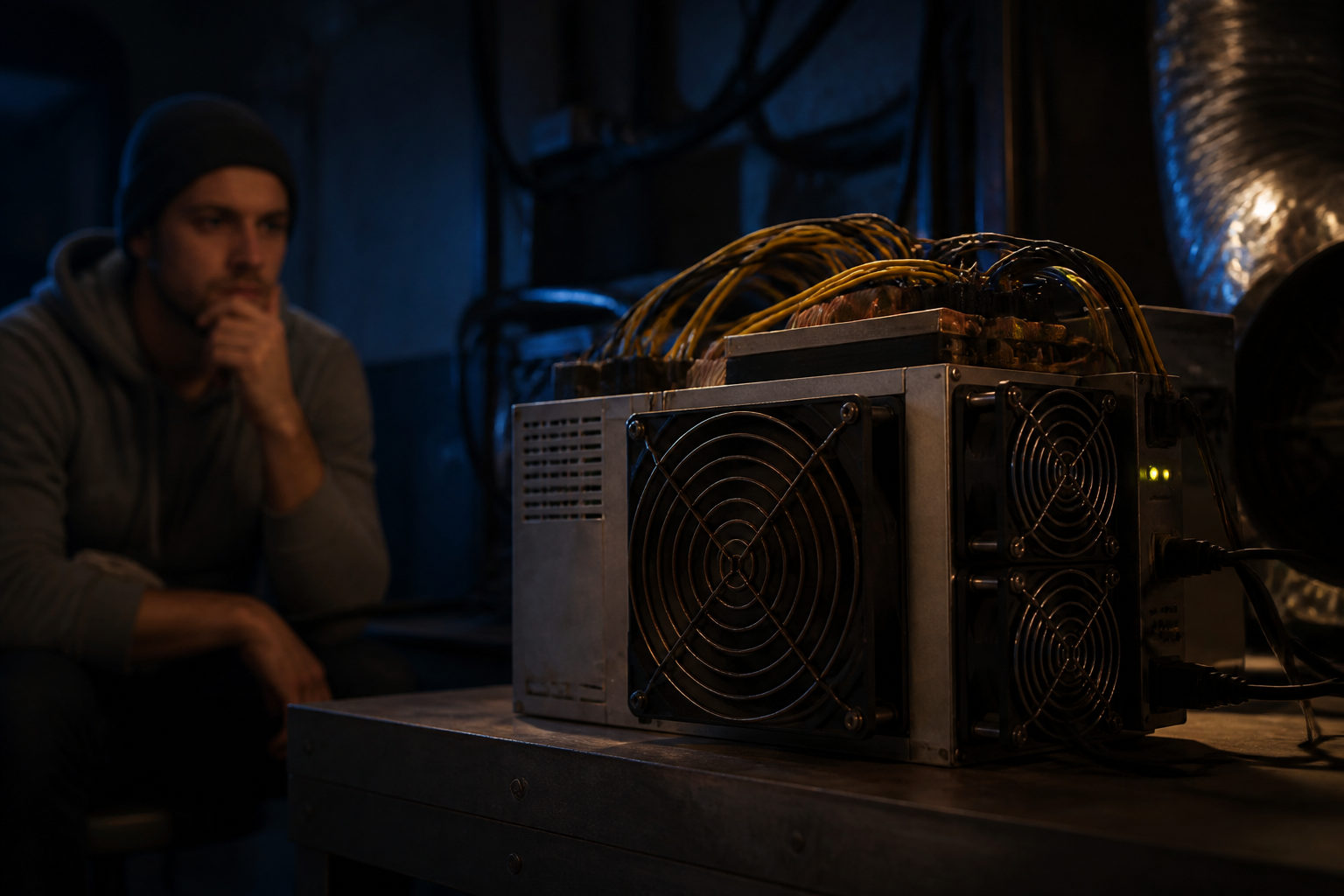
Yes, an average person can mine bitcoins, but the reality is closer to joining a competition than turning on a home computer and waiting for money to appear. Bitcoin mining is a race for the right to record the next block of transactions.
What the competition is actually about
The Bitcoin network groups transactions into blocks. Miners keep trying different combinations until one produces a result that meets the network’s rule set. The process is repeated over and over, so the key variable is not effort in the usual sense, but how much computing power can be spent on trial after trial.
That is why mining is hard to treat as a casual side activity. It draws power continuously, puts heat and noise into the room, and slowly wears down the hardware. If someone only focuses on the fact that mining is open to participation, they can miss the steady costs that make the activity harder to sustain.
Ways a normal person can take part
Running a machine at home
The most direct path is to buy dedicated mining hardware and connect it to a mining pool. Solo mining is possible in theory, but for most individuals it is not a realistic way to compete, so a pool is usually the practical entry point. Pooling combines many participants’ computing power and spreads block rewards according to contribution.
Home mining has more moving parts than the simple phrase suggests. You need space for the machine, a way to handle heat, a stable power setup, and a plan for noise. You also need to think about what happens when the machine fails, because downtime can erase any advantage very quickly.
Using hosted or cloud-style access
Another route is to place hardware in a hosting site or use a service that gives indirect exposure to mining. This can remove some of the hands-on work, but it adds a different problem: trust. You have to know whether the equipment is really running, how fees are charged, and what the contract says if something goes wrong.
For people who do not want a loud machine sitting at home, that can sound attractive. Still, extra layers do not make costs disappear. They only move the cost structure around, so electricity, hosting fees, and depreciation still need to be considered together.
The cost side matters more than most people expect
The biggest mistake is often to think only about the purchase price of the machine. Mining also brings electricity costs, cooling, repairs, network access, and hardware replacement over time. If electricity is expensive where you live, the room for a small-scale setup can shrink fast.
Competition also changes. As more miners join the network, the same amount of personal hardware represents a smaller share of total computing power. A setup that looks reasonable today may feel very different later, even if the machine itself has not changed.
It also helps to separate mining from simply owning bitcoin. Buying bitcoin is a direct asset decision. Mining is an operating business decision, because it asks you to manage equipment, energy, and downtime in exchange for a chance at block rewards. Those are not the same level of commitment.
Questions worth answering before you start
- Can you afford ongoing electricity costs, not just the upfront purchase?
- Do you have a place where heat and noise will not become a problem?
- Are you ready for hardware wear, failures, and maintenance?
- Do you understand how a mining pool pays out?
- Can you accept uneven results instead of treating mining like fixed income?
If several of those answers are uncertain, the better first step is to learn how Bitcoin mining works before spending money on gear. Understanding the rules is more valuable than buying hardware too early.
FAQ
Can an average person really mine bitcoin on their own?
Yes, they can participate, but participation is not the same as having a practical chance to win blocks alone. Most individuals join a mining pool because personal hardware usually cannot compete with large-scale operations.
Can a regular home computer mine bitcoin today?
Technically, you can try, but a normal computer is usually not competitive on the Bitcoin network. It is better suited for learning how mining works than for serving as a real strategy.
Do you have to buy your own mining machine?
No. You can also use hosting or mining-related services, though those options bring added fee and trust questions. The contract details matter a lot.
What should you calculate first?
Start with electricity, hardware wear, and downtime risk. Then decide whether home mining, a pool, or a hosted setup fits your situation.
If you want to explore mining seriously, make a cost list first and compare it with the amount of control you want to keep. That is usually the cleanest way to decide whether mining makes sense for you at all.
Disclaimer: This article is for informational and educational purposes only and is not investment, financial, or legal advice. Crypto assets are highly volatile and you could lose your entire investment. Do your own research and decide carefully.