
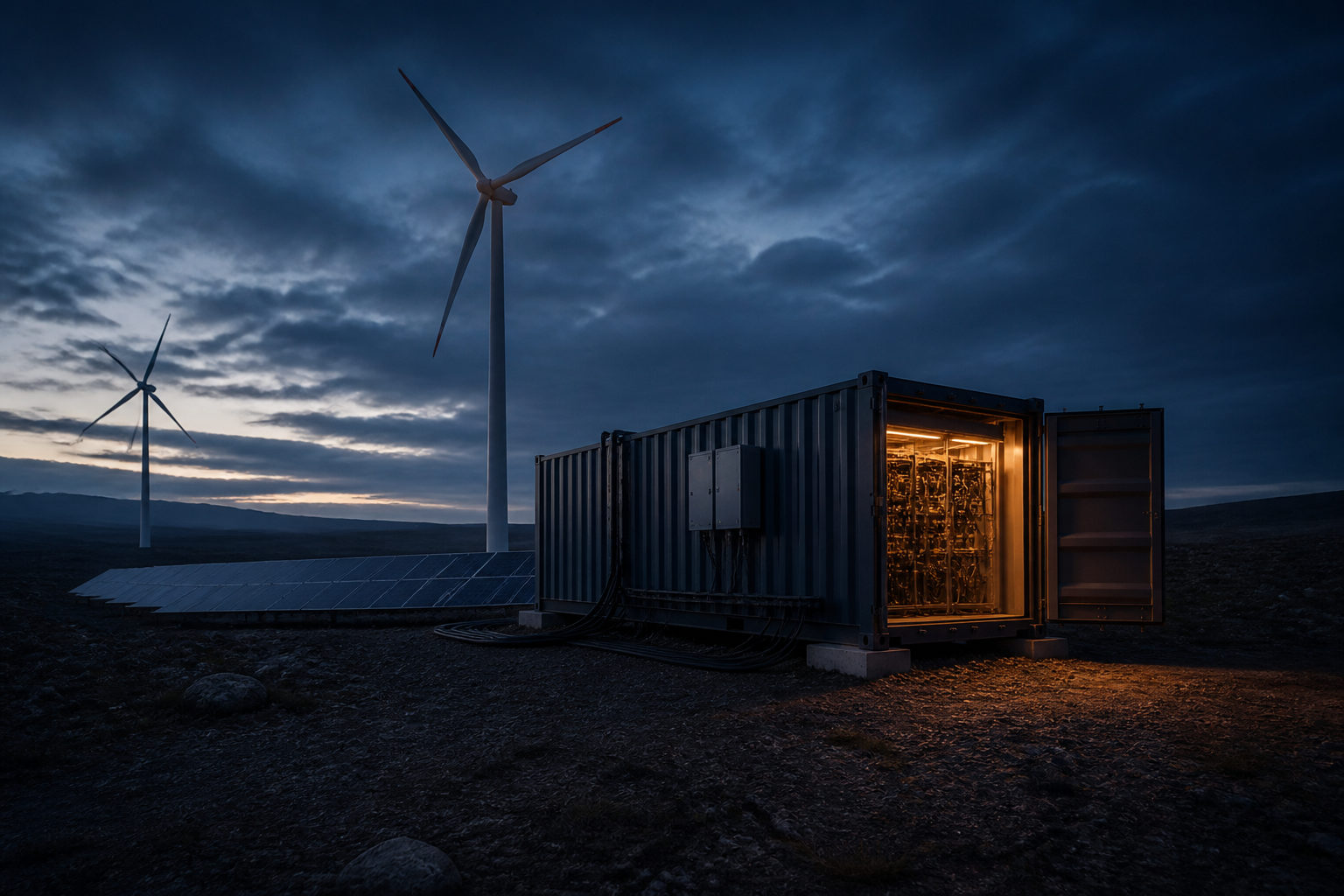
Bitcoin mining can incentivise renewable energy in some cases, especially when miners can use electricity that would otherwise be curtailed, stranded, or sold on weak terms. That link is real, but it is conditional rather than automatic.
Why mining and power projects end up in the same conversation
A simple way to frame Bitcoin mining is as a bookkeeping race. Miners run specialised machines to compete for the right to add the next block to the blockchain, and the process is driven by electricity. If power is too expensive or unreliable, mining becomes harder to sustain. That is why miners tend to look for low-cost energy and flexible operating conditions.
This matters for renewable energy because some wind and solar projects do not sell every unit of generation at equally attractive terms. A plant may produce electricity far from major demand centres, face transmission limits, or generate most strongly when local prices are weak. In those situations, a mine can act as an extra buyer that is willing to locate close to the source of power and adjust operations when supply changes.
The idea does not depend on Bitcoin being a climate solution by itself. It depends on mining being a form of flexible demand. If a renewable project has power that is hard to move, hard to sell, or hard to match with traditional industrial users, miners may give that project another commercial option.
How mining can create an incentive for renewable build-out
The incentive comes from revenue support, not from branding. When a power developer can monetise electricity that might otherwise go unused, project economics may improve. That extra demand can help raise equipment utilisation, smooth some periods of weak power pricing, and make a project easier to finance or operate.
Mining is especially relevant in settings where demand is inconsistent but generation is available. A mining site can power up more machines when output is strong and scale back when electricity is needed elsewhere or when generation drops. Many industrial loads do not like that kind of variability. Mining hardware is far from frictionless, but it is often easier to ramp than a factory built for steady consumption.
| Situation | Problem for the renewable project | How mining may help |
|---|---|---|
| Remote generation site | Power is produced far from strong demand | Mining can be placed near the source and consume electricity locally |
| Variable wind or solar output | Traditional buyers may want steadier supply | Mining load can be adjusted as generation rises or falls |
| Weak pricing periods | Some electricity has low marginal value | Miners may provide an extra buyer for those periods |
| Early-stage project planning | Cash flow assumptions may look thin | Mining can add another potential revenue path |
That said, mining does not improve every renewable project. If a solar or wind plant already sells its output on good terms, has strong grid access, and faces little curtailment, a mining operation may add complexity without much benefit. The value appears when there is a mismatch between power production and market access.
Who participates and what each side actually does
People often talk about this topic as if participation means buying a miner and plugging it in. In practice, the model usually involves several parties. A power producer may supply energy, a site operator may manage infrastructure, equipment owners may provide the machines, and specialist firms may handle monitoring, cooling, maintenance, and load control.
Whether mining truly incentivises renewable energy often depends on how these roles are split. A renewable developer wants to know if excess generation is persistent enough to justify the arrangement. The mining operator cares about uptime, power quality, cooling, maintenance, and curtailment rules. Equipment owners care about efficiency, hosting terms, and how often machines may be idled.
| Participant | Main role | Primary concern |
|---|---|---|
| Power developer | Supplies electricity or hosts load near generation | Whether there is enough underused power to justify the setup |
| Mining site operator | Runs the facility, power systems, cooling, and maintenance | Operational stability and downtime management |
| Machine owner | Provides or hosts the mining hardware | Energy cost, hosting terms, and machine efficiency |
| Technical service provider | Handles software, monitoring, and load adjustment | Whether the site can respond well to changing generation |
If you are evaluating a specific proposal, four questions usually matter early on. Is there recurring excess or low-value power. Can the operation tolerate variable supply. Are cooling and maintenance practical at that location. Do contracts clearly state who bears the cost when machines must shut down. If those answers are vague, the renewable angle may be more marketing than substance.
The hard limits: why the story is not automatically green
The biggest mistake is treating every renewable-linked mining site as an environmental win. The key question is what kind of electricity mining is actually using at a given time. If miners are soaking up power that would otherwise be wasted or heavily discounted, the case is stronger. If they are competing with other users during tighter conditions, the climate case becomes much weaker.
There are also operational costs that glossy narratives often skip. Mining requires buildings or containers, power equipment, cooling systems, network connectivity, repairs, noise management, and constant supervision. Renewable generation brings another layer of complexity because output can change quickly. Without good load control, a site may spend too much time cycling machines or operating below its intended efficiency.
| Common claim | Better way to read it |
|---|---|
| Mining with wind or solar is always clean | It depends on timing, grid conditions, and whether other demand is displaced |
| Cheap power is enough to make the model work | Cooling, maintenance, downtime, and infrastructure can change the picture |
| A mine next to a renewable plant must be using curtailed energy | Physical proximity does not prove how power is sourced or scheduled |
| Any renewable project can add mining | The fit is usually limited to certain locations and market structures |
Another point is often missed. Mining revenue conditions can change, while site buildout and hardware costs arrive early. A project that looks viable under one set of assumptions may look much worse when conditions shift. That makes renewable-linked mining a flexible commercial tool in some places, not a universal answer for the energy sector.
How to judge whether a renewable-mining pitch has substance
When you see claims that Bitcoin mining supports renewable energy, start with a basic test. What exact problem is the project solving: curtailment, weak local pricing, grid congestion, or remote generation with poor market access. If that is not clear, the rest of the pitch will usually be thin as well.
Next, ask whether the mining load can really respond to changes in generation. A credible setup should explain how machines ramp up or down, who decides when load is reduced, and what happens when electricity is needed elsewhere. It should also spell out which party handles maintenance, who absorbs downtime, and how power sourcing is verified. Those are practical questions, but they tell you far more than broad claims about sustainability.
One more caution helps. A site located near solar panels or wind turbines is not automatically powered by surplus renewable electricity at all times. In many cases the broader grid mix still matters. Geography alone is not proof.
FAQ
Can Bitcoin mining always make renewable projects more profitable
No. It can help when a project has electricity that is difficult to sell or move, but it is far less useful when the plant already has strong grid access and reliable buyers. The business case depends on local power market conditions.
Why is mining seen as a flexible electricity buyer
Mining machines can often be turned down or switched off more easily than many industrial processes. That makes them easier to pair with variable generation, even though frequent adjustment still carries operating costs.
Does a mine beside a wind or solar plant prove it uses excess renewable power
No. It shows proximity, not necessarily sourcing or scheduling. You still need to know how electricity is allocated, whether the site draws from the broader grid, and under what conditions machines are curtailed.
Does Bitcoin halving matter for this model
Yes. Bitcoin halves the block subsidy about every 4 years, or every 210,000 blocks, which changes mining economics over time. A project with little margin for downtime or power price swings may feel that pressure more sharply.
What should an investor or reader check first in these claims
Start with the power story: where the electricity comes from, when it is underused, and how the site responds when supply tightens. Then look at hosting terms, maintenance responsibility, and whether the project depends on overly simple assumptions.
If you want one practical filter, ignore the slogan and ask three things: where the power comes from, when that power is actually surplus, and who pays when the machines are forced offline. Those answers reveal far more than the label attached to the project.
Disclaimer: This article is for informational and educational purposes only and is not investment, financial, or legal advice. Crypto assets are highly volatile and you could lose your entire investment. Do your own research and decide carefully.