
Can individuals still mine Bitcoin profitably in 2026? Yes, some can, but the answer depends far more on electricity costs, ASIC efficiency, pool payouts, and uptime than on simply owning a machine.
A useful way to think about Bitcoin mining is a bookkeeping race. Miners compete to earn the right to add the next block to the blockchain. The winner is not chosen by status or reputation. The network accepts valid proof of work, so miners keep running calculations until someone finds a result that fits the rules. In theory, anyone can join. In practice, individual mining only makes sense when the full operating setup is competitive enough to survive against large-scale operators.
What an individual miner is actually doing
Bitcoin launched with its genesis block in January 2009, and its design was introduced in the 2008 white paper, Bitcoin: A Peer-to-Peer Electronic Cash System, published under the name Satoshi Nakamoto. The system uses proof of work to secure transaction ordering and block production. That means miners spend computing power and electricity to compete for block creation.
The network produces a new block about every 10 minutes. For an individual miner, that does not mean a personal machine will find a block on a regular schedule. It means the network as a whole keeps moving at that pace while participants compete inside it. The real question is not whether you can switch on hardware. The real question is whether your operation is efficient enough to earn a share of value after costs.
That difference matters. Many beginners hear that mining is still possible and assume that profitability naturally follows. It does not. Mining is an operating business with moving revenue conditions and stubborn expenses. If your setup is weak on power pricing, cooling, reliability, or hardware quality, the math can turn against you even when the machine is online.
How individuals still participate in Bitcoin mining
There are still several ways for an individual to participate. The common paths are running your own ASIC miners at home or in a small private space, hosting machines in a professional facility, or connecting your equipment to a mining pool. The old idea of mining Bitcoin on a normal home computer no longer matches current reality. For Bitcoin, dedicated ASIC hardware is the standard.
Running ASICs yourself
This is the most direct route. You buy a machine, supply power and internet access, connect it to a pool, and manage it on your own. Control is the main advantage. You choose when to run it, when to pause it, and how closely to monitor it. The tradeoff is that every practical problem lands on you as well.
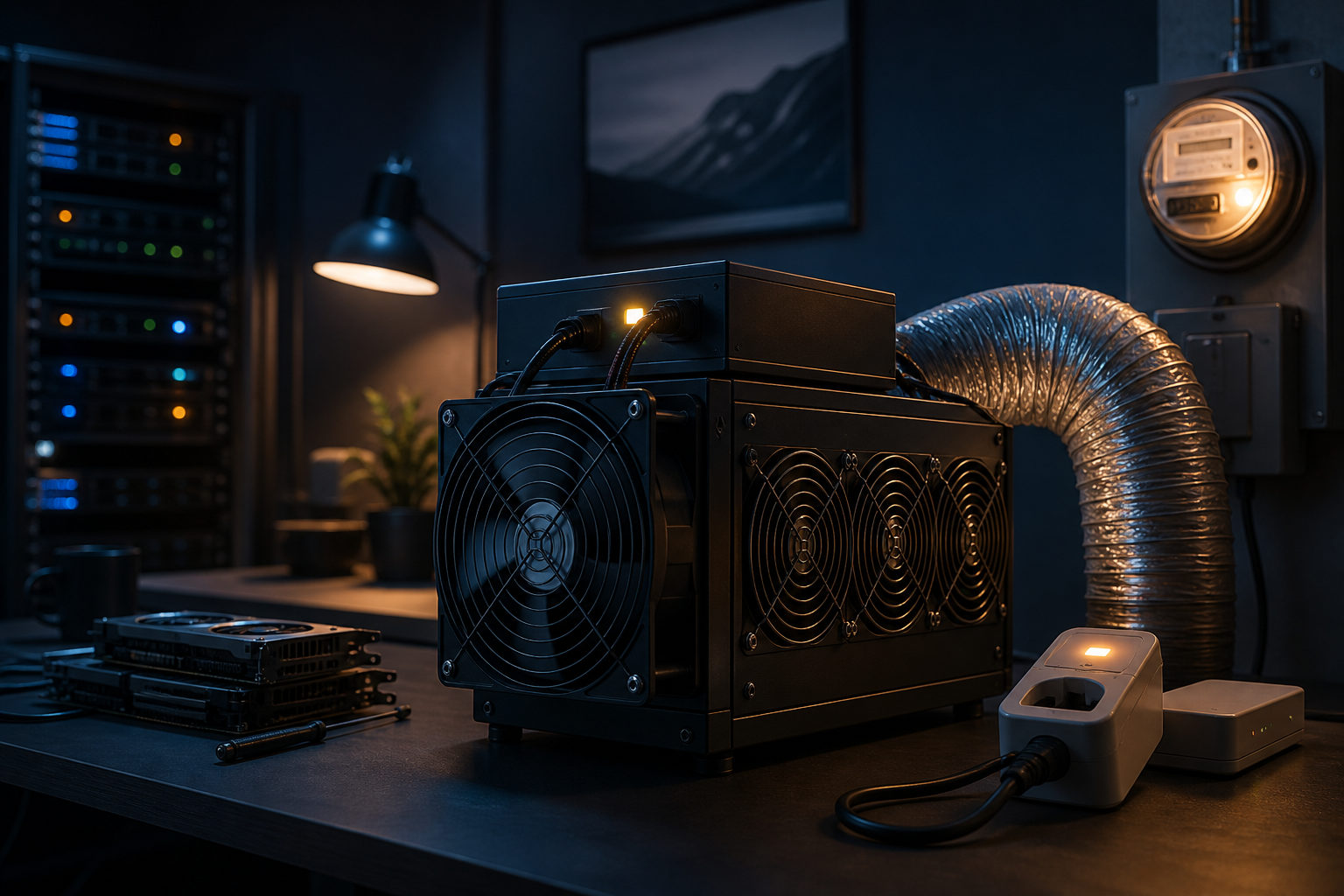
Noise is a common shock for new miners. Heat is another. These machines are built for sustained heavy work, not light household use. A room that seems acceptable at first can become difficult to manage once heat buildup, dust, airflow, and electrical load start affecting uptime. One of the biggest mistakes beginners make is treating a miner like a normal consumer device instead of a piece of industrial hardware.
Hosting in a facility
If your living space is not suitable, hosting can be an alternative. A third-party site may provide power, cooling, network access, and basic maintenance while you own the machine and receive the mining output assigned to it. This can remove a lot of practical stress, but it also introduces counterparty risk and less direct control.
Before using a host, an individual miner needs to understand what is actually being offered. Who records downtime? Who handles repairs? Can you verify machine status? Can you choose the pool? How easy is it to move or withdraw your equipment if the arrangement stops making sense? Those questions matter more than polished marketing language.
Joining a mining pool
For most individuals, a pool is the default choice. Solo mining exposes a small operator to extreme variance because the chance of finding a block alone is very low. A pool combines the work of many miners, competes as a group, and then distributes the resulting income according to its rules.
That smoother payout pattern is useful, but it should not be confused with guaranteed profit. Pool fees, payout models, minimum withdrawal settings, and account security all affect results. An individual miner should care about transparency and verifiability, not just headline claims about convenience.
What decides profitability in 2026
If someone asks whether individuals can still mine Bitcoin profitably in 2026, the honest answer comes down to cost structure and execution. The machine is only one part of the puzzle. A setup can look promising on paper and still fail because the operator ignored power conditions, downtime risk, or hardware quality.
Electricity is often the first filter
Mining turns electricity into hashing power. If power costs are high, the margin available to the miner gets squeezed quickly. This is why many individual miners struggle even when they understand the basics. They can buy hardware, but they cannot secure a competitive long-term power setup.
The posted electricity rate is not the only issue. Stability matters too. So do household circuit limits, peak pricing structures, and the effect of continuous high load on the site. A home environment may look workable until real operating conditions expose weak points.
ASIC efficiency matters more than many beginners expect
Bitcoin mining is a hardware efficiency race. A better ASIC can deliver more useful work under similar power conditions, while an older or weaker unit can lose ground fast. For an individual, that gap can be the difference between a setup that stays viable and one that is outdated too quickly.
Used machines deserve extra caution. A low purchase price does not automatically mean lower total cost. Hardware may have hidden wear, unstable power components, degraded cooling, or maintenance history that is hard to verify. Those problems often show up later as downtime, repair costs, and unstable performance.
Network competition keeps changing
Mining is not done against a fixed backdrop. The level of competition across the network changes over time, which affects how much value a given machine can capture. An operation that seems acceptable today may look much weaker later if competition rises or your hardware ages.
That is why profitability should never be judged from a single moment. An individual miner needs enough room to handle weaker conditions than the ones used in the original plan. Without that buffer, even small changes in operating reality can wipe out the expected edge.
Revenue is not static
Miner revenue comes from block subsidies and transaction fees. Bitcoin has a supply cap of 21 million coins, and the block subsidy is cut roughly every 4 years, or every 210,000 blocks. Halving years so far have included 2012, 2016, 2020, and 2024. Fees can also rise or fall based on network activity. That means the revenue side of mining moves over time even if your local operating costs do not.
There is another point that helps beginners frame scale. The smallest unit of Bitcoin is 1 satoshi, equal to one hundred millionth of a BTC. Mining payouts are often better understood when you stop thinking in whole bitcoins and start thinking in smaller units and percentage share. That does not solve the business problem, but it helps avoid unrealistic expectations about what a single machine can produce.
Operational discipline is a real edge
Mining is not passive once the machine is online. Internet interruptions, dust buildup, thermal issues, fan wear, power supply trouble, and bad settings can all reduce output. A miner that runs below target or keeps dropping offline can erode results quietly, day after day.
For an individual, this is where hands-on attention matters. Large operators may have teams, spare parts, and purpose-built environments. A small miner often has none of those advantages, so execution quality matters even more. Knowing how to monitor the machine, react to alerts, and keep downtime short is part of the business.
Who still has a chance, and who is likely to struggle
Individuals are not all starting from the same place. Some have access to suitable power, proper ventilation, technical comfort, and realistic expectations. Others enter mining because they saw the topic trending and assume the machine will do the hard work for them.
- More likely to have a workable setup: people with stable low-cost power, access to a suitable space, the ability to manage heat and noise, and the willingness to monitor hardware regularly.
- More likely to struggle: people trying to mine Bitcoin on ordinary PCs, buyers focused only on a cheap machine price, users who treat hosting contracts like fixed-income products, and anyone with no plan for repairs or downtime.
A very common mistake is assuming that daily pool payouts mean stable profit. They do not. They simply mean the pool is smoothing variance through its distribution method. Profit exists only when the value of what you receive stays above electricity, hosting, maintenance, and hardware depreciation over time.
What to check before you spend anything
If you are seriously evaluating whether you can mine Bitcoin profitably as an individual in 2026, do not start with social media opinions. Start with a checklist. The quality of your answers will tell you more than any excited pitch.
- Am I using a real Bitcoin ASIC, or am I assuming some other hardware can compete?
- Is my electricity cost stable enough for continuous high-load operation?
- Can my site handle heat, noise, dust, airflow, and electrical load safely?
- Do I understand the pool's payout method, fees, account protections, and reporting?
- If the machine fails, do I have time, access, and budget to deal with repairs?
- If network competition gets stronger or my hardware ages faster than expected, can the plan still survive?
If several of those answers are vague, the decision is not ready. Mining rewards preparation more than enthusiasm.
FAQ
Can I still mine Bitcoin at home in 2026?
Yes, it is still possible to mine at home, but home mining and profitable home mining are different things. Power cost, noise, cooling, and uptime usually decide whether a home setup is practical.
Is it too late for an individual to start mining Bitcoin?
It is not simply a question of being early or late. The real issue is whether your operating conditions are strong enough to compete after costs and downtime are considered.
Should an individual miner join a pool or mine solo?
Most individuals choose a pool because solo mining creates very uneven outcomes. A pool usually gives a steadier payout pattern, which makes it easier to track performance against costs.
Can a normal computer still mine Bitcoin?
A normal computer can perform calculations, but that does not make it competitive for Bitcoin mining today. In practical terms, Bitcoin mining now depends on dedicated ASIC hardware.
Is cloud mining a good option for beginners?
It may look simple, but simplicity on the surface can hide verification problems and counterparty risk. If you cannot clearly confirm what hardware exists, how payouts are calculated, and what rights you have, caution is the right stance.
Where should I check the live Bitcoin price before deciding whether to mine?
You can use major exchange interfaces or widely used crypto market data platforms to check the live price. Price alone is not enough, though. You also need to review electricity, hardware efficiency, pool terms, and downtime risk before making a decision.
If you want a practical next step, write down your power terms, ASIC model, pool rules, cooling plan, and downtime response plan in one place before buying anything. If one of those items is still unclear, you are not ready to treat mining like a business yet.
Disclaimer: This article is for informational and educational purposes only and is not investment, financial, or legal advice. Crypto assets are highly volatile and you could lose your entire investment. Do your own research and decide carefully.