
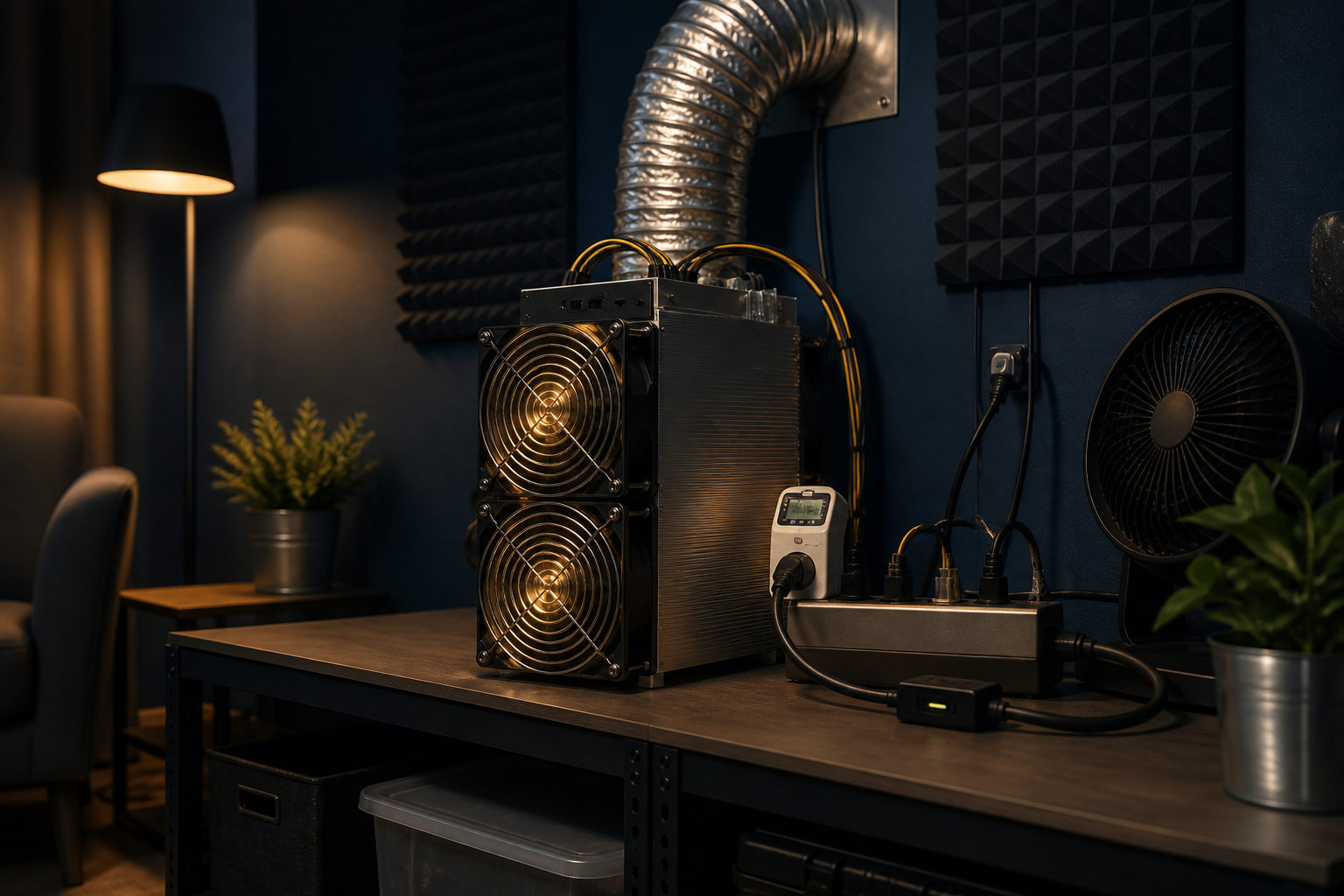
Can you mine bitcoin at home profitably in 2026? Yes, in some cases. For most people, though, profitability depends far more on electricity, machine efficiency, heat, noise, and maintenance than on the simple fact that a miner can be switched on at home.
Think of bitcoin mining as a nonstop race to win the next page of the ledger
A simple way to understand bitcoin mining is to picture a global contest for bookkeeping rights. Miners run specialized machines that perform repeated calculations. The participant that finds a valid result first gets the right to package a set of transactions into a new block and receive the block reward plus transaction fees under the network rules.
That process is not casual background computing. It is industrial-style competition built into a decentralized network. Bitcoin began with the genesis block in January 2009, and the system adds a new block about every 10 minutes. For anyone looking at a home setup, the real question is not whether mining is technically possible. It is whether your operating costs stay low enough for long enough to make the effort worthwhile.
That distinction matters because many beginners still imagine mining as something a regular PC can do quietly in the corner. In practice, bitcoin mining today usually means dedicated ASIC hardware, not a normal home computer.
What actually decides home mining profitability in 2026
Electricity cost is usually the first filter
Home mining lives or dies on power cost. A mining machine is designed to run continuously, so electricity is not an occasional expense. It is the main recurring expense. If your residential rate is high, profitability can disappear quickly even before you start thinking about other issues.
There is also a planning mistake that shows up again and again: people check the miner's specifications but ignore how their household power setup works in real life. Residential billing rules, usage tiers, and practical limits inside the property can change the economics a lot. A setup that looks acceptable on paper can feel very different once it is running every day.
Machine efficiency matters more than simply owning a miner
Buying hardware does not guarantee that a home operation makes sense. Bitcoin miners compete against participants around the world, including operators with tighter cost control and more optimized environments. What matters is how much effective hash power your machine produces for the electricity it uses.
Older hardware may still turn on, connect, and hash, but that does not mean it is competitive. A miner that is technically functional can still be a poor fit if it burns too much power for the work it delivers. Owning the machine gets you into the race; efficiency determines whether you can stay in it.
Heat and noise are not side issues
People often treat cooling and noise as secondary concerns until the machine arrives. That is backwards. A miner running full time produces steady heat and very noticeable sound. In a home, that can affect comfort, create tension with family or neighbors, and make the setup impractical even if the machine itself works as expected.
Heat control also affects uptime. If a room cannot move hot air away effectively, the device may throttle, report faults, or shut down. When that happens, a supposed profit machine starts spending more time underperforming than mining.
Maintenance time is part of the cost
Home bitcoin mining is not purely passive. The machine needs a stable internet connection, regular monitoring, and occasional troubleshooting. Power issues, networking problems, dust buildup, fan wear, and thermal conditions all affect real output.
That means your own time has value here. Someone who can diagnose problems quickly may keep a setup running near expectations. Someone who is uncomfortable with hardware or networking may face longer downtime and more frustration. Uptime matters because a miner only earns while it is running properly.
How people actually mine bitcoin at home
It is easy to ask whether home mining is possible. The harder and more useful question is what form that participation takes.
Running your own machine at home
This is the most direct route. You buy an ASIC miner, arrange power, internet, ventilation, and a place to put it, then connect it to a mining pool. The upside is control: the hardware is yours and the setup is under your supervision. The downside is that every practical problem is yours too.
For newcomers, the biggest shock is often environmental rather than technical. On a product page, a miner can look like a compact box. Inside a home, it behaves more like a piece of always-on equipment that demands planning and tolerance.
Joining a mining pool
For most home users, a mining pool is the realistic way to participate. A pool combines the hash power of many miners and distributes results based on the pool's payout rules. This does not improve your machine's efficiency, but it can make returns less erratic than trying to mine alone.
That said, a pool does not fix a weak cost structure. It will not lower your power bill, reduce your room temperature, or make outdated hardware competitive. It changes how rewards are shared, not the physical reality of your setup.
Separating technical possibility from household suitability
A machine can be capable of mining without being a good match for a home. That is an important distinction. A suitable home setup needs stable power, acceptable ventilation, tolerable noise levels, and an operator willing to handle routine issues.
In other words, home mining is not just a hardware question. It is a mix of living conditions, operating discipline, and cost management.
How to judge profitability without guessing numbers
Without live market data or your exact operating costs, no honest article can tell you whether your specific home setup will be profitable. What it can do is give you a decision framework. In 2026, home bitcoin mining is more likely to make sense when several conditions line up at the same time.
- Low electricity cost: This is one of the biggest requirements. If power is expensive, the margin can shrink very fast.
- Efficient hardware: A machine that is still competitive on power use has a better chance of staying viable.
- High uptime: Frequent shutdowns, disconnects, or overheating can eat into already thin margins.
- Manageable cooling and noise: If the environment cannot support the machine, profitability on paper may never show up in practice.
- Ability to maintain the setup: Faster troubleshooting usually means less downtime and a more realistic shot at decent performance.
If several of those conditions are missing, the idea of profitable home mining usually gets weaker fast. If most of them are present, the setup may be worth evaluating in detail.
There is also a broader network rule to keep in mind. Bitcoin has a maximum supply of 21 million coins. The block subsidy is reduced through halving events that happen about every 4 years, or every 210,000 blocks. Halving years so far include 2012, 2016, 2020, and 2024. For miners, that structure means sloppy operations tend to become harder to justify over time, because wasted power and downtime have less room to hide.
Who is usually a poor fit for home bitcoin mining
Home mining is often a bad match for people who expect silent, hands-off income. It is closer to running specialized equipment than to using a simple finance app.
It may be a poor fit if any of the following describes your situation:
- Your residential power is expensive: A high starting cost can undermine the whole plan.
- Your home cannot handle noise well: Comfort issues may end the experiment before economics do.
- You do not want hardware chores: Cleaning, monitoring, restarts, and troubleshooting are part of the job.
- Your internet or power is unstable: Repeated interruptions directly hurt output.
- You expect mining to feel like a fixed paycheck: That mindset usually leads to poor decisions.
If your main goal is simply to gain bitcoin exposure, mining is not the only path. For many people, learning about wallets, self-custody, and risk management may be more practical than bringing a miner into a living space. That does not make mining irrelevant; it just means the right choice depends on your costs, skills, and tolerance for operational hassle.
FAQ
Can a regular home computer still mine bitcoin?
In theory, any computing device can attempt the work. In practice, regular home PCs are not competitive for bitcoin mining today. The usual setup now involves dedicated ASIC hardware rather than consumer CPUs or GPUs.
What cost do home miners miss most often?
Many people focus on the machine purchase and overlook ongoing expenses such as electricity, cooling adjustments, noise management, and downtime. Those repeating costs often decide the outcome more than the initial purchase does.
Does joining a mining pool mean home mining will be profitable?
No. A pool can smooth out how rewards are distributed, but it does not repair a bad cost structure. If your power cost is high or your hardware is inefficient, pooling does not change that.
Is home bitcoin mining still worth trying in 2026?
It can be worth evaluating if you have low power costs, suitable space, and the ability to maintain the equipment. For many households, though, it makes more sense to do the cost work first and buy hardware second, not the other way around.
How should you check whether market conditions support mining?
Use major market data platforms or the market pages of large trading services to check the live bitcoin price. Then compare that information with your electricity cost, machine efficiency, likely uptime, and household limits rather than looking at price alone.
If you are seriously considering a home setup, start with three checks: whether your home power can support continuous operation, whether heat and noise are acceptable, and whether you are willing to treat maintenance as routine work. If any of those answers is weak, the profitability of mining bitcoin at home in 2026 can look much better in theory than it does in daily use.
Disclaimer: This article is for informational and educational purposes only and is not investment, financial, or legal advice. Crypto assets are highly volatile and you could lose your entire investment. Do your own research and decide carefully.