
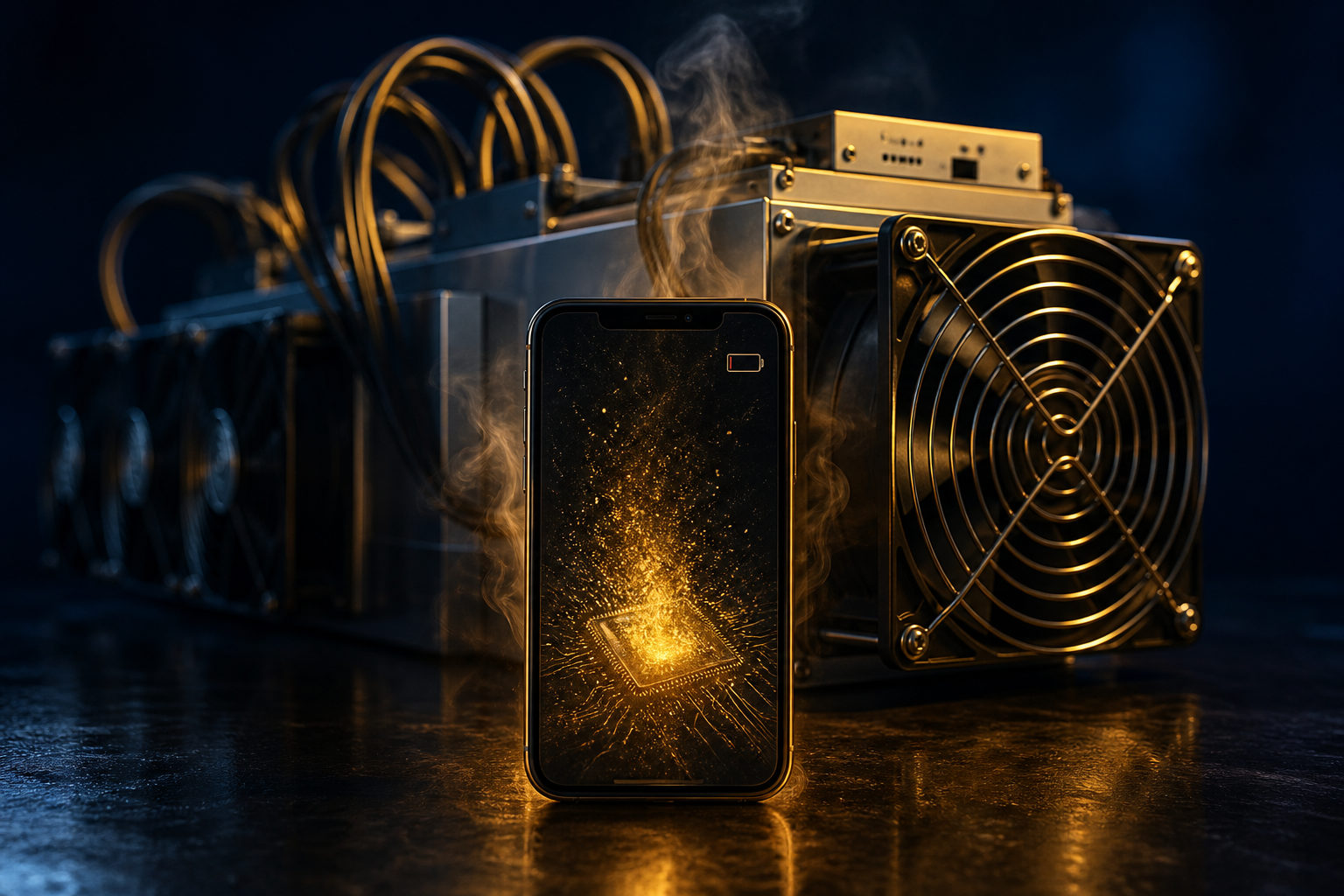
Can you mine Bitcoin on an iPhone? In practice, no. An iPhone may run mining-related calculations or monitoring apps, but it is not a realistic device for actual Bitcoin mining on the network.
A simple way to picture Bitcoin mining is to treat it like a nonstop bookkeeping contest. New transactions are waiting to be grouped into blocks, and miners compete to add the next block to the blockchain. The winner is the participant that finds a valid result under the network rules first. That sounds simple at a high level, but the real competition depends on speed, efficiency, cooling, and the ability to keep running without interruption.
Why an iPhone is the wrong tool for Bitcoin mining
Bitcoin uses proof of work. Miners keep trying hashes until one of them produces a result that meets the current target. The network produces a new block about every 10 minutes, so many machines around the world are effectively racing at the same time. An iPhone is built for mobile apps, photos, calls, media, and general computing on the go. It is not built to stay at full load for long stretches doing one repetitive task.
This is the core issue. A phone chip is designed around battery life, thermal limits, and broad usefulness. Bitcoin mining has moved toward specialized mining machines because they are tuned for one job. Even if a phone can perform the same type of calculation in theory, that does not mean it can compete in a meaningful way.
- Huge efficiency gap: iPhone chips are general-purpose processors, not devices optimized for Bitcoin mining.
- Tight thermal limits: a thin phone body cannot dissipate heat the way dedicated hardware can.
- Battery wear: sustained heavy workloads can stress the battery and reduce everyday usability.
- System constraints: mobile operating systems limit background activity and high resource use.
- Poor trade-off: the device takes the strain, while the practical mining value is negligible.
So if someone asks whether they can mine Bitcoin on an iPhone, the real answer is more precise than a plain yes or no. A phone can perform some related tasks, but it is not a realistic Bitcoin mining machine.
Running code is not the same as mining Bitcoin effectively
This topic creates confusion because people mix up two different ideas. One is whether a device can execute hashing code at all. The other is whether that device can produce useful work in the real Bitcoin network. Those are not the same thing.
Think of mining as a giant draw where everyone keeps submitting attempts under the same rules. A phone may be able to submit attempts, but what matters is how many attempts it can make, how efficiently it does so, and how long it can keep going. On those points, an iPhone is badly outmatched by specialized hardware.
That is why many so-called phone mining apps give the wrong impression. Some are educational tools that show how hashing works. Some are dashboards for mining pools or remote management apps for mining hardware. Others may connect to cloud services, where the actual computing happens somewhere else. Seeing the word mining in an app does not mean the iPhone itself is doing competitive Bitcoin mining.
Common situations people confuse with iPhone mining
- Demo apps: they illustrate the mining process or hash calculations for learning purposes.
- Cloud interfaces: the phone logs in and displays status, while the computing happens elsewhere.
- Mining pool tools: they are used for monitoring, alerts, and account management.
- Other token systems: some projects market “mobile mining,” but their mechanics are not Bitcoin mining.
This distinction matters. Without it, a user can believe an iPhone is mining Bitcoin when it is really just showing data from another service or participating in something unrelated to Bitcoin's proof-of-work process.
What miners are actually competing for
At the protocol level, miners are competing for the right to add the next block. A block is accepted only if it meets the proof-of-work requirement. That design makes it expensive to rewrite transaction history, which is a major part of Bitcoin's security model.
Bitcoin was introduced in the 2008 white paper Bitcoin: A Peer-to-Peer Electronic Cash System by the pseudonymous Satoshi Nakamoto, and the genesis block arrived in January 2009. Since then, mining has become more specialized. That shift is easy to understand: when a network reward is open to global competition, participants look for hardware that can do the job more efficiently. A smartphone simply does not fit that role.
There is another part of the design that shapes mining economics. Bitcoin has a fixed supply cap of 21 million coins. New issuance enters the system through block rewards, and that reward is cut roughly every 4 years, or every 210,000 blocks. The halving years so far are 2012, 2016, 2020, and 2024. As rewards decline over time, efficiency matters even more, which makes low-performance devices even less practical.
The takeaway is straightforward: mining is not just about having any device that can run calculations. It is about having hardware and operating conditions that make those calculations competitive. An iPhone fails that test.
If you are not mining on the iPhone, what can the phone still do?
For most people, the useful role of an iPhone in the Bitcoin mining world is not as the machine doing the work. It is better used as a learning tool, a security device, or a management screen. That gives you practical value without putting pointless stress on the hardware.
Learn how mining works
You can use an iPhone to read the Bitcoin white paper, study how blocks and hashes work, and follow block explorer data. It is a good device for reading, watching explainers, comparing services, and keeping notes. That is a much better fit than trying to force it into a full-load mining role.
Manage mining operations remotely
Many services offer mobile apps or mobile-friendly interfaces for checking miner status, viewing pool information, receiving alerts, and managing account security. In that setup, the phone acts like a control panel. It is the remote, not the engine.
Check live Bitcoin price information the right way
If your real question is tied to value rather than mining hardware, use major exchanges, market data aggregators, or blockchain data services to check the live Bitcoin price. Compare quotes from more than one source and make sure you are looking at the same market type and the same moment in time. Without fresh market data, no article should give a current number.
Focus on security instead of phone mining
If you use an iPhone for Bitcoin-related activity, security is where it matters most. Use strong passwords, enable two-factor authentication, review app permissions carefully, and avoid installing software from unclear sources. Those steps have real value. Trying to turn the phone into a miner usually does not.
What people often miss about cost and wear
Many readers ask this question because they are looking for a low-cost entry point. That instinct makes sense. A phone is already in your pocket, so it feels natural to ask whether you can put it to work. The problem is that hardware already owned is not automatically free to use for any task.
Heavy, continuous workloads can increase heat, shorten battery comfort during daily use, and push the device into thermal throttling. Once throttling starts, performance drops to protect the hardware, which makes mining attempts even less useful. So the phone is taking the downside while giving you little or no realistic mining benefit.
There is also a misunderstanding around the phrase “mine on my iPhone.” If the phone only opens an account, shows a dashboard, or sends alerts from a mining pool, that is not the same as using the phone's own chip as productive mining hardware. The difference is easy to miss, especially when apps are marketed with broad language.
FAQ
Can my iPhone mine Bitcoin at all?
It can run certain calculations or demo software, so the answer is not an absolute technical no. But in the real Bitcoin network, an iPhone is not a practical mining device because it lacks the efficiency, cooling, and sustained performance needed to compete.
Why do some apps say you can mine Bitcoin on an iPhone?
Some apps are educational, some are remote monitoring tools, and some connect to services where the actual computing happens elsewhere. The label can be misleading if you assume the phone itself is doing competitive mining work.
Will mining software damage my iPhone?
Long periods of high load can lead to heat, faster battery drain, and added wear on the device. Modern phones have protections such as throttling, but that does not make this a sensible long-term use case.
Can I join a mining pool with an iPhone?
You can use an iPhone to access a mining pool account, check reports, or receive alerts. That is different from contributing meaningful Bitcoin mining power from the phone itself.
What should I do instead if I want exposure to the mining side of Bitcoin?
Use the phone to learn the basics, monitor services, and secure your accounts. If you are researching mining, start by understanding proof of work, block rewards, halvings, and the role of specialized hardware before trusting any “mobile mining” claim.
If all you have is an iPhone, the practical move is to use it for learning, account security, monitoring tools, and live price checks from reliable market sources. If a service suggests that your phone can easily mine Bitcoin, check where the hash power actually comes from, what the device is expected to do, and what trade-offs are being left out.
Disclaimer: This article is for informational and educational purposes only and is not investment, financial, or legal advice. Crypto assets are highly volatile and you could lose your entire investment. Do your own research and decide carefully.