
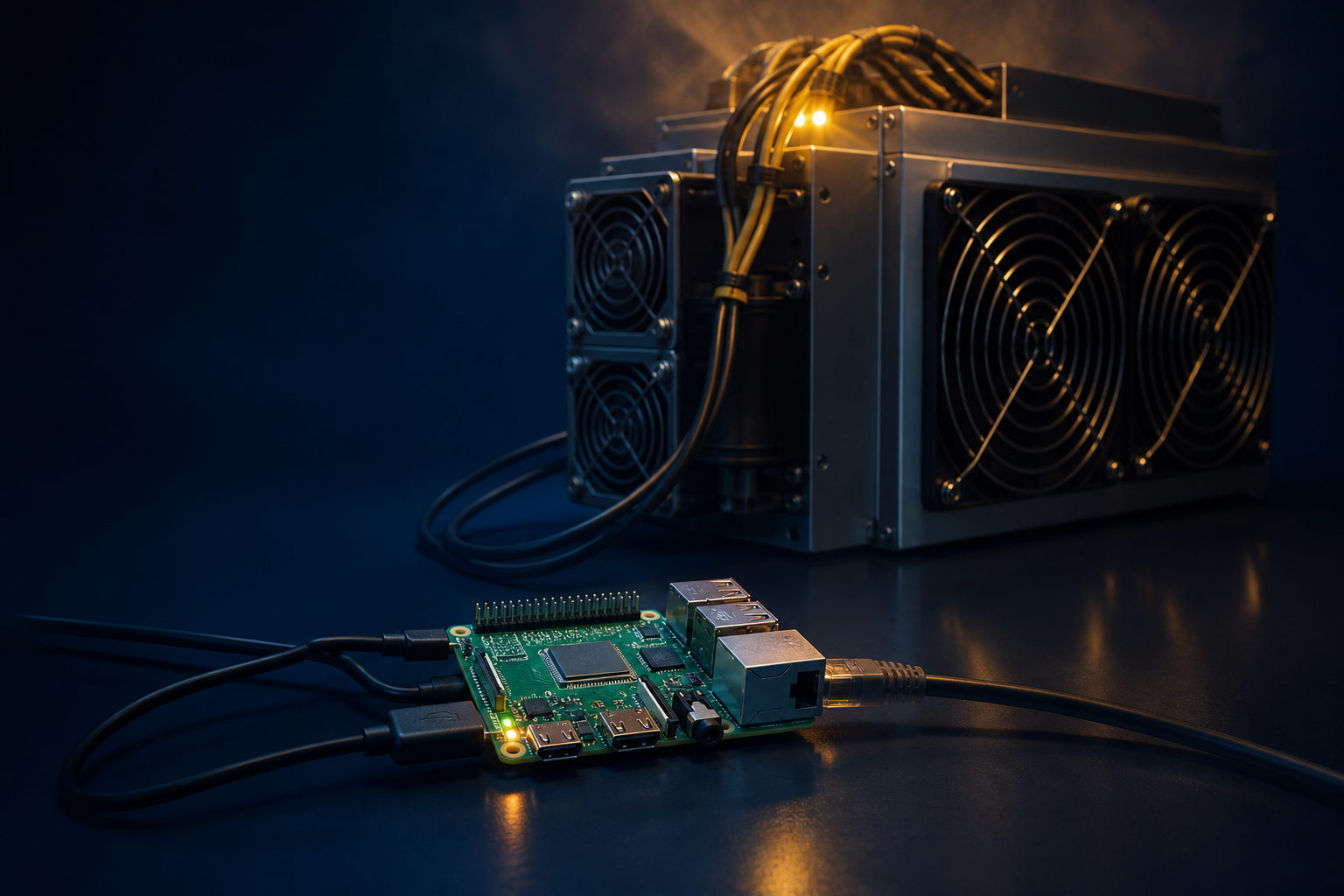
Can a Raspberry Pi mine bitcoins? In a narrow technical sense, yes, it can run software related to mining. In any real competitive sense, no, a Raspberry Pi on its own is not a practical way to mine Bitcoin.
A simple way to think about Bitcoin mining is as a nonstop bookkeeping race. The network produces a new block about every 10 minutes, and miners keep trying calculations until someone finds a result that meets the network rules. The winner gets the right to add the block and may receive the block reward plus transaction fees. The catch is that this race is built around raw, specialized computing efficiency, and that is where a Raspberry Pi falls far behind dedicated mining hardware.
Why a Raspberry Pi is not suited to direct Bitcoin mining
A Raspberry Pi is a small, low-power single-board computer. It is great for learning Linux, running home services, automating tasks, and building lightweight projects. Bitcoin mining asks for something very different. It is not just about whether a device can launch a program. It is about whether that device can perform the required hashing work at a level that gives it a real chance in a global competition.
Bitcoin uses proof of work. Miners repeatedly compute hashes until one output satisfies the current difficulty target. That work strongly favors hardware built for this exact task. Over time, mining moved away from general-purpose chips and toward specialized machines designed for one job: efficient hash computation. A Raspberry Pi uses a low-power processor meant for flexibility and education, not for high-volume, repetitive hashing under intense competition.
That distinction matters. Many beginners see that a Raspberry Pi can run command-line tools and assume it can therefore function as a miner in a meaningful way. It can participate in the process at the software level, but that does not mean it can compete. Running code is not the same as having effective mining hardware.
What a Raspberry Pi can do in the Bitcoin ecosystem
The better question is not only whether a Raspberry Pi can mine bitcoins, but also what role it can realistically play. In practice, it is much more useful around Bitcoin infrastructure than as the main machine doing the mining work.
Running a Bitcoin node
A Raspberry Pi can be used in a node setup, helping you verify blocks and transactions for yourself instead of depending fully on outside services. That is a very different role from mining. A node checks and relays data. A miner competes to create a block. People often mix up those functions, but the hardware needs are not the same.
For many users, a personal node is more valuable than an unrealistic mining experiment. It supports self-verification, gives you more control over how you interact with the network, and can be a solid way to learn how Bitcoin works beneath the wallet app layer.
Acting as a controller for mining hardware
Another practical use is to run management and monitoring tools for external ASIC miners. In that setup, the Raspberry Pi is not performing the heavy hash computations itself. It is handling coordination, scripts, logs, alerts, and local network tasks while the specialized machine does the mining.
This use case fits the Raspberry Pi much better. It is efficient at lightweight services, long uptime, and automation. Those strengths are valuable in mining operations, but they are support functions rather than the core mining role.
Serving as a learning platform
If your goal is education, a Raspberry Pi can be excellent. You can use it to understand wallets, nodes, transaction broadcasting, system maintenance, remote access, and network configuration. That knowledge is useful whether you stay focused on Bitcoin self-custody or later decide to study mining in more detail.
This is where many people get more value than they expect. A Raspberry Pi may not be a serious Bitcoin miner, but it can still be a very good Bitcoin lab.
Why mining became a specialized hardware business
Bitcoin adjusts mining difficulty so that blocks keep arriving at roughly the same pace, about every 10 minutes. As stronger machines enter the network, the overall competition rises. That means older or weaker hardware becomes less effective, even if it can still perform the same basic type of computation.
The result is straightforward: mining is no longer about whether a device can hash at all. It is about how efficiently it can hash compared with purpose-built machines. A Raspberry Pi is not designed to win that contest. Low power draw does not solve the problem, because mining is judged by useful work done under competitive conditions, not by power use alone.
Another source of confusion is the phrase “mining with a Raspberry Pi.” Sometimes it means a teaching demo. Sometimes it means using the Pi to manage an ASIC. Sometimes it means trying to run a miner directly on the board. Those are very different situations. Without that distinction, the idea sounds more promising than it really is.
What to consider before trying it
If you still want to experiment, be clear about your goal from the start. Are you trying to understand the mechanics of mining software, or are you looking for a realistic path to mine Bitcoin? Those are not the same project.
If the goal is learning, a Raspberry Pi makes sense. You can explore system setup, software configuration, wallet interaction, and node behavior. You can also get comfortable with backups, remote administration, and basic operational security. Those are real skills and they translate well to broader Bitcoin use.
If the goal is actual mining, focus first on the real requirements: specialized hardware, reliable power, cooling, stable operation, and pool participation. The Raspberry Pi may still fit into that environment as a controller or monitoring device, but not as the main source of mining power.
You should also avoid carrying over assumptions from other crypto networks. Hardware expectations differ across systems. A device that might be useful for testing or participating elsewhere does not automatically make sense for Bitcoin. Bitcoin mining has its own hardware reality.
Common mistakes people make
- Confusing “can run” with “can compete”: A Raspberry Pi can run related software, but that does not make it competitive hardware.
- Mixing up nodes and miners: A node validates and relays blockchain data. A miner competes to produce new blocks.
- Overvaluing low power use: Efficiency in mining is about competitive output, not just using less electricity.
- Assuming software tweaks can close the gap: The main limitation is hardware architecture, not a missing setting.
- Treating a learning setup as an income plan: A useful experiment is still just an experiment unless the full mining setup makes sense.
FAQ
Can you mine bitcoins with a Raspberry Pi alone?
You can try it for educational purposes and to understand how mining software works. As a standalone machine for real Bitcoin mining competition, it is generally not practical.
Does joining a mining pool make a Raspberry Pi useful for mining?
A mining pool changes how rewards are shared among participants, but it does not fix weak hardware. Without external specialized miners, the Raspberry Pi still serves mostly as a learning tool.
Is a Raspberry Pi better for a node than for mining?
Yes. A Raspberry Pi is far better suited to node-related tasks, monitoring, and automation than to direct Bitcoin mining. Those jobs match its strengths much more closely.
Is running a node the same as mining Bitcoin?
No. A node verifies and relays data across the network, while mining is the proof-of-work competition to add blocks. Both matter, but they require different hardware expectations.
What should a beginner do first if they already own a Raspberry Pi?
Start with realistic goals. Use it to learn node operation, wallet support, backups, remote management, and system maintenance before thinking about any dedicated mining setup.
If you already have a Raspberry Pi, the most sensible move is to treat it as a Bitcoin learning and infrastructure device, not as a serious miner. Use it to run a node environment, manage services, and build operational skills that remain useful even if you never buy mining hardware.
Disclaimer: This article is for informational and educational purposes only and is not investment, financial, or legal advice. Crypto assets are highly volatile and you could lose your entire investment. Do your own research and decide carefully.