
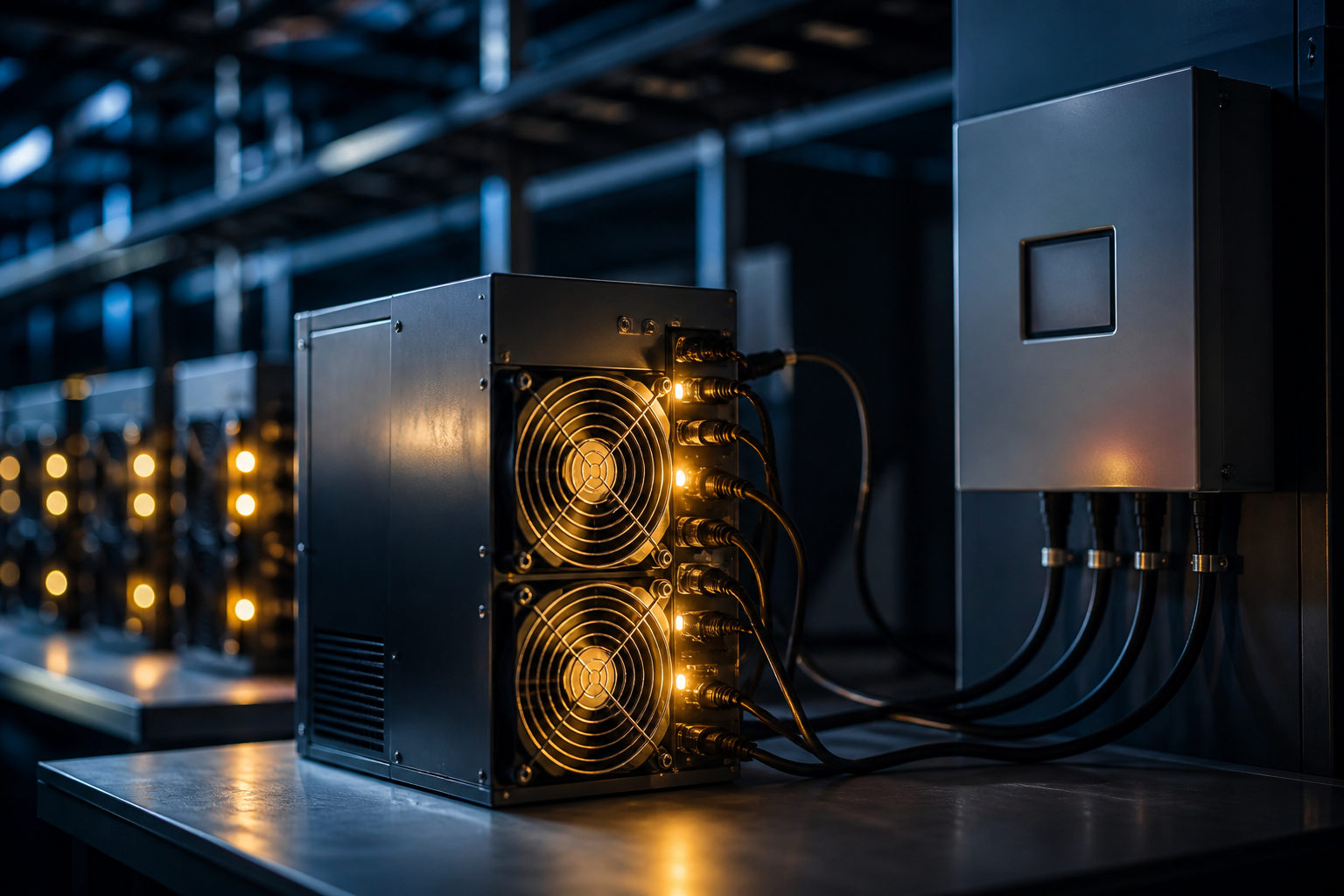
Yes, you can really make money mining bitcoins, but only under the right conditions. Bitcoin mining is a nonstop accounting race, and profit depends on whether your share of block rewards and fees can stay ahead of power, hardware, and operating costs.
Why bitcoin mining can pay at all
A simple way to picture bitcoin mining is to imagine a public ledger that needs new pages added all day long. Miners compete to package transactions into a valid block, and the miner that finds a block first gets to add that block to the chain and receive the block reward plus transaction fees.
This system has been running since Bitcoin’s genesis block on 2009-01-03. The network targets roughly 10 minutes per block, and the block reward is cut in half every 210,000 blocks, or about every 4 years. Those halvings took place on 2012-11-28, 2016-07-09, 2020-05-11, and 2024-04-19. After the 2024 halving, the current block reward is 3.125 BTC. With about 144 blocks per day, the network issues about 450 BTC daily, but that figure belongs to the entire network, not to any one person or mining company.
That is the first point many beginners miss. There is real value being distributed on-chain, so mining can produce revenue, yet the reward schedule is fixed while the level of competition keeps changing.
The answer changes based on how you participate
When people ask whether mining bitcoins is profitable, they often mix very different setups into one bucket. Solo mining, pool mining, hosted mining, and cloud mining all expose you to different kinds of risk.
| Method | How it works | Who it fits | Main reality check |
|---|---|---|---|
| Solo mining | You run your own hardware and try to find blocks on your own | Operators with strong technical and cost advantages | Very uneven results because block discovery is rare at small scale |
| Pool mining | You contribute hashpower to a pool and receive a share under pool rules | Most real-world miners | Pool fees and payout rules affect your results and cash flow |
| Hosted mining | Your machines run at a third-party facility | People who cannot host equipment themselves | You depend on the host’s competence, uptime, and contract terms |
| Cloud mining | You buy contract exposure to mining output | People seeking indirect exposure | Opacity is a major issue, and many offers are hard to verify |
Being able to enter the race is not the same as being likely to earn a profit. A machine that is online and hashing has only cleared the first step. The harder question is whether the full cost structure leaves any margin after the network takes its share through competition.
What actually decides whether mining is profitable
Bitcoin has a hard cap of 21,000,000 BTC, expected to be fully issued around 2140. New issuance keeps declining by design, which means mining becomes more about efficiency and disciplined operations over time.
| Variable | Why it matters | What to examine |
|---|---|---|
| Hardware efficiency | More efficient machines produce more useful hashpower for the same electricity draw | How much effective output you get for ongoing power use |
| Electricity cost | Mining runs continuously, so energy cost can define the whole business | Long-term power pricing, not a short-lived discount |
| Network competition | Stronger competition makes each slice of reward harder to capture | Whether your hashpower is meaningful against the network |
| Pool terms | Payout method changes income timing and variance | Fee model, payout schedule, and rule clarity |
| Equipment depreciation | Mining machines age, fail, and can be replaced by better models | Service life, repairability, and resale options |
| Site conditions | High-load hardware needs airflow, cooling, and stable power | Heat, noise, ventilation, and outage risk |
Depreciation is where many rough calculations break down. Someone may focus on coins received while ignoring that the machine is losing value, aging under constant load, or becoming less competitive against newer hardware.
Another common misunderstanding comes from the daily issuance number. About 450 BTC per day sounds large in isolation, but it is shared across the entire network. If more efficient miners are competing for that fixed stream, your own portion can shrink even if the network keeps producing blocks on schedule.
Is home bitcoin mining a good idea for most people now?
For most ordinary users, home bitcoin mining is usually a poor fit if the goal is profit. Noise, heat, power availability, space, maintenance, and machine management can turn a simple idea into an ongoing operational problem.
If your goal is education, that is a different case. Learning how blocks are produced, how pools work, why halvings matter, and how block rewards are issued can be useful even if you never run a serious mining operation. If your goal is income, you need to evaluate mining like a capital-heavy business.
| Your goal | What matters most | Practical takeaway |
|---|---|---|
| Learn the system | Understanding blocks, rewards, and network validation | Study the white paper and observe how mining pools operate |
| Try the process | Wallet setup, payout flow, and operational basics | Learn the rules before spending on equipment |
| Seek profit | Power cost, machine efficiency, uptime, and replacement planning | Treat it like an operating business, not a casual side hobby |
This is why stories about people making money from mining often sound simpler than they are. What you hear is the outcome. What you do not hear enough about is procurement, setup, cooling, repairs, downtime, and exit planning.
FAQ
Is bitcoin mining still profitable after the 2024 halving?
It can be, but the margin is tighter because the block reward fell to 3.125 BTC on 2024-04-19. That pushes more weight onto electricity pricing, machine efficiency, and operational discipline.
How much bitcoin can one person mine in a day?
There is no fixed answer. The network produces about 450 BTC per day in total at the current reward rate, but any individual share depends on hashpower, mining method, and the level of competition at that time.
Can a normal home computer mine bitcoin profitably?
A home computer can help you understand software and process, but that is very different from running a profitable mining setup. Real competition today centers on specialized hardware, stable power, and sustained operations.
Does joining a mining pool make profits easier?
A pool can smooth payouts by sharing results across many participants. It does not remove the core business problem, which is whether your total costs stay below what your share of rewards and fees can support.
Is cloud mining a safe shortcut?
It should be treated with caution. If you cannot clearly verify the equipment, contract terms, payout logic, and termination conditions, then you are taking on risk that may be hard to measure in advance.
A practical way to decide whether mining fits you
Before you think about buying hardware, check four things in order: access to stable low-cost power, a place that can handle heat and noise, the ability to manage equipment over time, and a plan for what happens when the machines are no longer competitive. If those points are unclear, mining should not be viewed as an easy path to income.
Bitcoin mining can make money, but the real question is whether you have an actual cost advantage in this accounting race. If you cannot explain your edge in plain terms, you are not ready to treat mining as a profit plan.
Disclaimer: This article is for informational and educational purposes only and is not investment, financial, or legal advice. Crypto assets are highly volatile and you could lose your entire investment. Do your own research and decide carefully.