
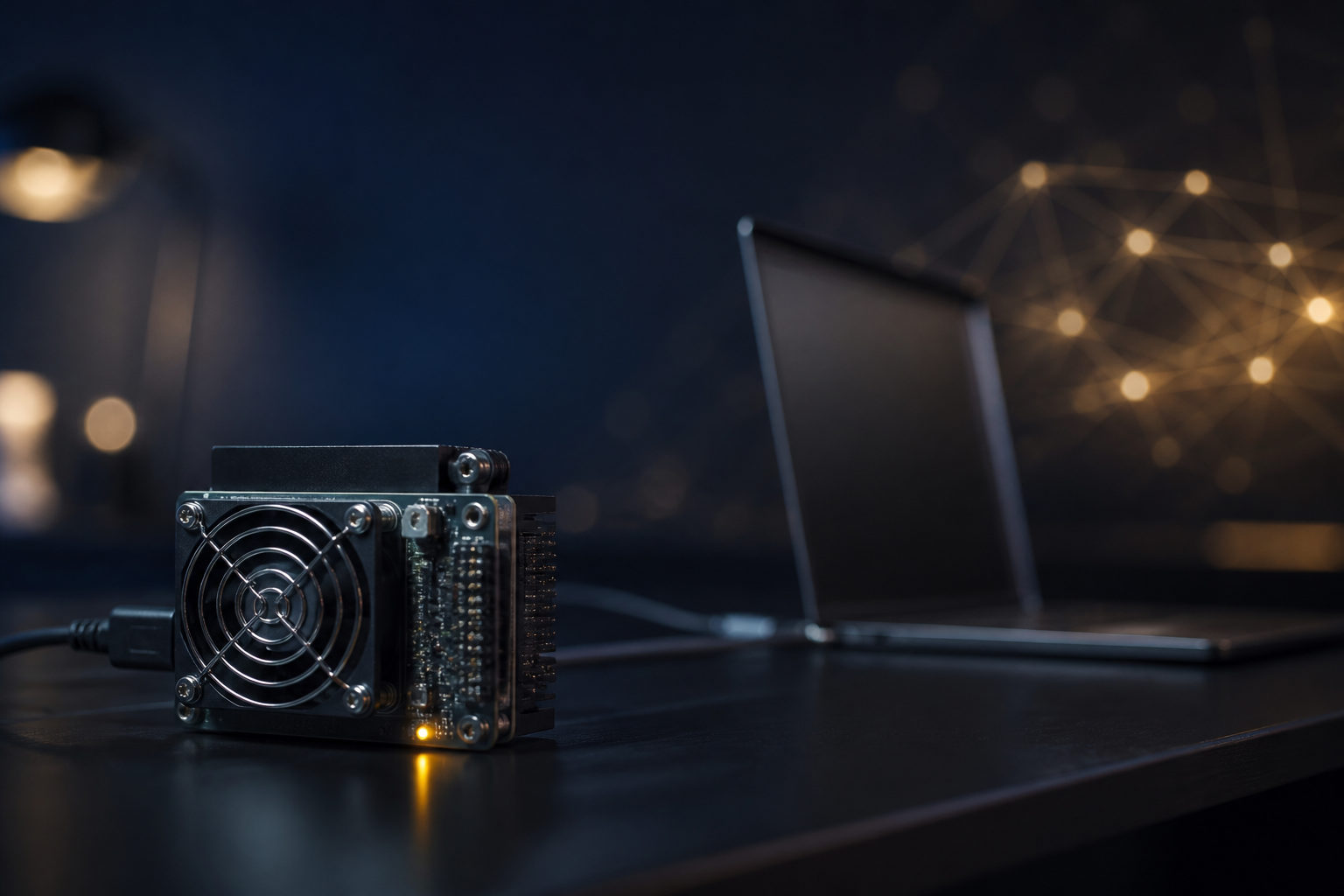
Yes, Bitaxe can still mine Bitcoin. The practical answer is that it can participate in real Bitcoin mining, but a small home device has a very low chance of finding a block on its own, so most users should treat it as a learning and hobby machine first.
Bitaxe is doing real Bitcoin mining
A lot of confusion starts with the size of the device. Because Bitaxe is small and often discussed by hobbyists, people assume it is some kind of simulation box or educational toy. It is not. A Bitaxe miner performs the same basic job as any other Bitcoin mining machine: it hashes candidate block data again and again, trying to find a result that meets the current network difficulty target.
That distinction matters because it answers the core search intent directly. If you are asking whether a Bitaxe is still connected to the actual Bitcoin network and still eligible to discover a valid block, the answer is yes. The network does not care whether the hardware is sitting in a giant mining farm or on a desk at home. If the machine produces a valid result and that result is accepted, it has done real mining work.
The harder question is whether that possibility should shape your expectations. Bitcoin mining is a global competition. A small device can join the race, but joining the race is very different from having a realistic chance of consistent results. That gap between technical possibility and economic expectation is what most buyers need to understand before they plug one in.
Why a Bitaxe can mine Bitcoin and still be a poor tool for steady income
Bitcoin creates a new block about every 10 minutes. Every miner connected to the network is competing for that event, and the odds are tied to share of total hashpower. A Bitaxe can submit valid work just like larger machines, yet its slice of the global competition is tiny. That makes solo success possible in theory and highly uncertain in practice.
For that reason, a Bitaxe is better understood as a probability machine than an income machine. You may run it correctly for a long time and still never see a solo block. That does not mean it failed. It means the result you want is rare relative to the scale of competition.
Many first-time users also focus too narrowly on the phrase “mine Bitcoin.” Mining outcomes depend on more than whether the device powers on. Uptime matters. Cooling matters. Network stability matters. If the miner drops offline, overheats, or keeps restarting, its effective participation is lower than its nominal capability suggests. With small hardware, these practical issues can make a big difference to the overall experience.
What Bitaxe is actually good for
Bitaxe makes the mining process visible. That is one of its biggest strengths. Large industrial miners are built for scale and efficiency, but they are far removed from how most individuals learn. A small open-source device lets you see the moving parts of Bitcoin mining in a way that is much easier to grasp.
Learning how mining works
Reading about hash rate, work templates, and pool shares is one thing. Watching a miner connect, receive work, report status, and react to changing conditions is another. Bitaxe gives users a direct way to understand the mechanics behind terms that often stay abstract in articles and videos.
Exploring open-source hardware and firmware
Many people buy Bitaxe because they want something they can inspect and tune. Open-source projects attract users who like to experiment with firmware, configuration, monitoring, and hardware behavior. Even if the device never finds a solo block, it can still deliver a lot of value as a hands-on technical platform.
Connecting mining with node operation
Some users use Bitaxe as a path into broader Bitcoin infrastructure. Running a miner often leads to questions about how nodes validate blocks, how block templates are created, and how miners interact with the wider system. That makes the device useful far beyond the narrow goal of chasing a reward.
Three ways people usually use a Bitaxe
The same hardware can serve very different goals. Problems start when users pick one setup but expect results that belong to another.
Solo mining for the small chance of a full block
This is the most direct reading of the keyword. You run the device in a setup that allows independent mining and hope that one day it finds a valid block on its own. The appeal is obvious: if it happens, you know your machine did it. The trade-off is uncertainty. You should approach this as a long-shot experiment, not a routine payout model.
Pool mining for smoother rewards
Many users connect Bitaxe to a mining pool. In that setup, your device contributes hashpower to a larger group, and rewards are divided according to the pool’s rules. That approach usually makes more sense for users who want feedback that the machine is working and prefer less extreme variance. It also changes the story you tell yourself. You are still mining Bitcoin, but you are not waiting for your device alone to win an entire block.
Running it as a lab device
Some owners care less about payout and more about observation. They want to watch temperatures, tune settings, inspect logs, test firmware, and understand failures. For that group, Bitaxe works like a compact lab for Bitcoin mining. Its value comes from visibility and control, not from scale.
What affects the real-world experience
People often ask whether a Bitaxe can still hit Bitcoin, but a better question is whether they can keep the device running well enough to participate continuously. Small miners are still miners. They have the same need for reliable power, stable networking, and acceptable thermal conditions.
| Factor | Why it matters | What to watch |
|---|---|---|
| Power quality | Unstable power can trigger errors or restarts | Use a dependable power source and avoid frequent fluctuation |
| Cooling | Heat affects stability and sustained operation | Keep airflow clear and clean dust before it builds up |
| Network connection | Mining depends on receiving new work without interruption | Check local network reliability and reduce dropouts |
| Firmware and tuning | Configuration changes can improve or hurt stability | Understand rollback options before changing settings |
| Monitoring | Status pages and logs help you spot real problems | Learn how to read errors instead of watching only output |
One of the most common mistakes is judging the device by a short test. A miner that runs for a few minutes is not the same as a miner that runs cleanly over time. Intermittent disconnects, thermal throttling, and poor configuration can quietly reduce effective work even when the machine appears active.
Who should and should not buy a Bitaxe
If your main goal is to understand Bitcoin mining from the inside, Bitaxe makes a lot of sense. If you enjoy open-source hardware, tinkering, and direct interaction with the mining process, it can be a rewarding project. If you want a compact machine that makes the network more tangible, it fits well.
If your main goal is dependable mining income, expectations need to be much lower. A small miner does not stop being real hardware just because it is modest, but its scale still shapes the result. Buying one with the mindset of a hobbyist, learner, or builder is usually a better fit than buying one with the mindset of a production operator.
FAQ
Can a Bitaxe really find a Bitcoin block by itself?
Yes. It participates under the same network rules as larger mining machines, so solo success is possible. The issue is probability: the chance is very low relative to the total competition on the Bitcoin network.
Does pool mining still count as mining Bitcoin?
Yes, because the device is still performing Bitcoin hashing work. The difference is that rewards are split by the pool’s payout rules instead of waiting for your machine alone to discover a full block.
Is Bitaxe a good choice for beginners?
It can be, especially for people who want to learn by doing. You should still be ready to deal with setup details such as power, cooling, local networking, and reading the device interface.
Is Bitaxe better for education or for profit?
For most people, education is the stronger case. It can teach you how mining behaves in the real world, while profit expectations are much harder to justify with small-scale hardware.
Where should I check the live Bitcoin price?
Use a major market data site or exchange interface that shows BTC spot pricing and market depth. If your reason for checking price is to judge whether to buy a Bitaxe, look at operating conditions and your purpose as closely as you look at the price screen.
If you plan to run a Bitaxe, start by deciding what success means for you. Then keep it online in a stable environment, watch the status page and logs, and judge it by sustained operation rather than wishful thinking about a rare solo hit.
Disclaimer: This article is for informational and educational purposes only and is not investment, financial, or legal advice. Crypto assets are highly volatile and you could lose your entire investment. Do your own research and decide carefully.