
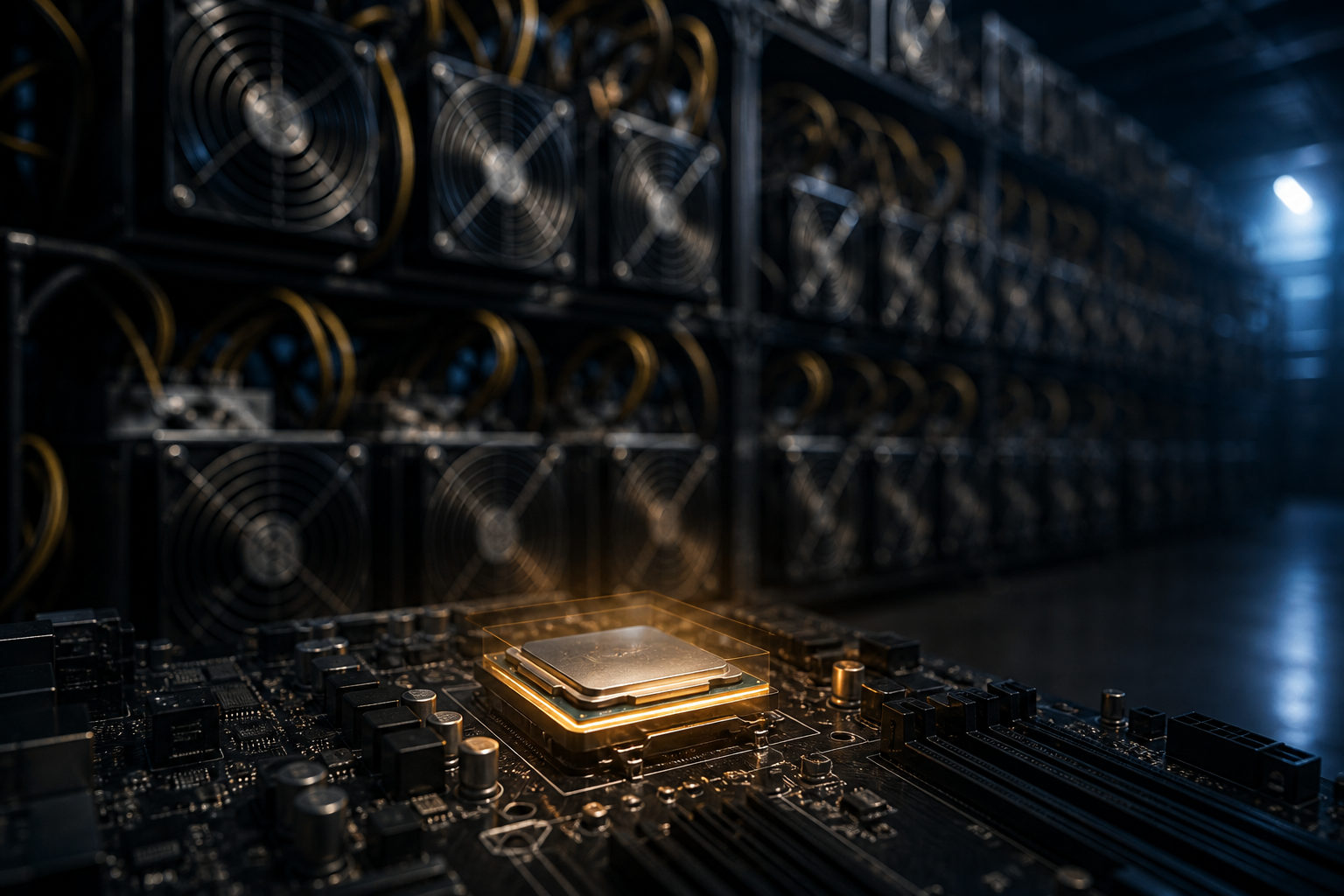
In 2026, CPU mining Bitcoin is usually not profitable. A CPU can still perform the required calculations, but Bitcoin mining is a nonstop bookkeeping race, and general-purpose processors are rarely competitive against dedicated mining hardware.
A simple way to picture it is a giant contest to win the right to write the next page of a public ledger. Miners across the network keep trying possible answers to the same puzzle. Whoever finds a valid one first gets the block added, while everyone else starts over on the next round.
Why Bitcoin mining works like a bookkeeping race
Bitcoin is a decentralized system, so it needs a way for strangers on the internet to agree on which transactions are valid and in what order they should be recorded. The network uses proof of work for that job. Miners collect transactions into a block candidate and keep hashing until one participant finds a result that meets the network's current target.
This is less like solving a clever riddle and more like buying a huge pile of lottery tickets through computation. The main edge comes from doing the same specialized task faster and more efficiently than the next participant. That point matters because CPUs were built for broad computing workloads, not for one narrow function running at full intensity all day.
The network produces a new block about every 10 minutes. So the race does not pause for long, and a home computer is not competing in isolation. It is competing against operations built around machines designed specifically for Bitcoin hashing.
A CPU can mine Bitcoin, but that is not the same as being profitable
Many beginners mix up technical possibility with economic sense. Yes, a CPU can in principle run mining software and perform hash calculations. That does not mean the activity is likely to produce a positive result after costs are counted.
The key problem is hardware specialization. A CPU is meant to handle many different kinds of tasks: operating system processes, office apps, browsing, media, coding, gaming, and background services. Bitcoin mining rewards a very different profile. It favors hardware tuned for one repetitive operation and optimized for output per unit of power.
That difference creates several practical disadvantages for CPU miners:
- Lower efficiency: A CPU is flexible, but flexibility is not the same thing as mining performance.
- Power draw: Sustained heavy usage means electricity costs continue to build while the machine runs.
- Heat and noise: High load increases cooling demand, fan noise, and thermal stress.
- Wear and tear: Constant operation can add pressure to fans, cooling systems, and the host computer.
- Opportunity cost: A machine tied up for mining may be less useful for work or personal tasks.
So if someone asks whether CPU mining Bitcoin will be profitable in 2026, the honest answer starts with this distinction: being able to participate is not the same as being able to compete.
Why profitability is hard for CPU miners in 2026
Even without quoting any live market numbers, the logic is clear. Bitcoin mining has matured into a highly competitive environment. Over time, that kind of environment tends to push out slower and less efficient hardware.
The easiest comparison is a race between a commuter bike and a purpose-built track machine. Both can move forward. Only one is designed for that specific event. A CPU is the general-purpose machine in that comparison. It can process the work, but it usually cannot do so on terms that make economic sense once electricity and hardware strain are included.
Bitcoin's difficulty adjustment reinforces this reality. The network aims to keep block production near one block every 10 minutes. When a lot of computing power is active, mining difficulty adjusts upward over time to keep issuance on schedule. That mechanism helps stabilize the network, but it also means extra competition does not simply create more easy wins for small CPU miners.
Block rewards also become tighter over time. Bitcoin has a maximum supply of 21 million coins, and the subsidy is cut in half on a fixed schedule. Halving years include 2012, 2016, 2020, and 2024. You do not need a price chart to see why that matters: if the reward side becomes leaner while hardware competition stays fierce, inefficient setups face even more pressure.
Then there is the home-mining reality that many people underestimate. They think, “I already own the computer, so using it costs nothing.” That is rarely true. The machine consumes power, generates heat, needs cooling, adds noise, and takes time to configure and monitor. Even before discussing mining returns, those are real costs.
If profit is not the goal, CPU mining can still teach you something
Not every person asking about CPU mining is trying to build a business. Some simply want to understand how Bitcoin works at the network level. In that setting, using a CPU can still be useful as a learning tool, as long as expectations stay realistic.
Use it to understand proof of work
Running mining-related software in a controlled setting can help you see what proof of work feels like in practice. You can watch resource usage, notice how constant hashing affects a machine, and understand that mining is based on repeated attempts rather than one elegant calculation.
Learn the difference between solo mining and pool mining
Solo mining means competing directly against the entire network on your own. Pool mining combines the work of many participants and distributes rewards according to the pool's rules. A pool can reduce income variance, but it does not change the underlying efficiency of your hardware.
Separate owning bitcoin from mining bitcoin
A lot of people are not really interested in mining as an operating activity. They just want exposure to Bitcoin. Those are different decisions. Buying and holding bitcoin is an asset decision; mining is a hardware, electricity, and operations decision.
Do a cost checklist before you try anything
Before running a machine for mining, list the costs you can identify clearly: electricity, cooling, noise, hardware wear, setup time, wallet security, and system stability. If those items are missing from your thinking, any conclusion about profit will be incomplete.
What most people should check instead of chasing a simple yes-or-no answer
The phrase “is cpu mining bitcoin profitable 2026” sounds like it should have one universal answer, but in practice the better question is whether your setup can compete after total costs. That means looking at hardware type, local electricity pricing, cooling conditions, tolerance for noise, and whether you are learning or chasing income.
If your goal is education, a short experiment may be worthwhile. If your goal is profit, you need to be much stricter. In Bitcoin mining, the network does not reward effort in a vague sense. It rewards valid work found under intense competition. That is why general-purpose hardware usually falls behind dedicated systems.
For live price checks, use a reputable market data source or major exchange interface rather than guessing from old articles. For mining viability, focus on current hardware conditions and full operating costs, not just on whether software launches successfully on your computer.
FAQ
Can a home PC still mine Bitcoin with a CPU?
Yes, in a technical sense, a home CPU can still perform Bitcoin mining calculations. The problem is competitiveness: in real network conditions, that setup is usually too inefficient to make economic sense.
Does joining a mining pool make CPU mining profitable?
A pool changes how rewards are shared and can smooth out variance. It does not turn weak hardware into efficient hardware, so it usually does not solve the core profitability issue for CPU mining.
Is CPU mining useful if I only want to learn how Bitcoin works?
It can be. As a learning exercise, CPU mining can show you how proof of work behaves, how mining software interacts with hardware, and why specialized machines dominate this field.
What is the main difference between a CPU and an ASIC miner?
A CPU is built for general computing across many tasks. An ASIC miner is built for one narrow purpose, which is why it usually has a major edge in Bitcoin mining.
If I do not want to buy mining hardware, how else can I study Bitcoin?
You can learn a lot by studying wallets, private key management, node behavior, transaction confirmation, and mining pool structure. Those topics give you a much stronger foundation than assuming mining is the default path into Bitcoin.
If you are deciding what to do next, start by being precise about your goal. If you want education, try a limited and safe experiment. If you want profit, do not treat CPU mining Bitcoin as a reliable plan unless you have already worked through the full cost picture and understand the competitive reality.
Disclaimer: This article is for informational and educational purposes only and is not investment, financial, or legal advice. Crypto assets are highly volatile and you could lose your entire investment. Do your own research and decide carefully.