
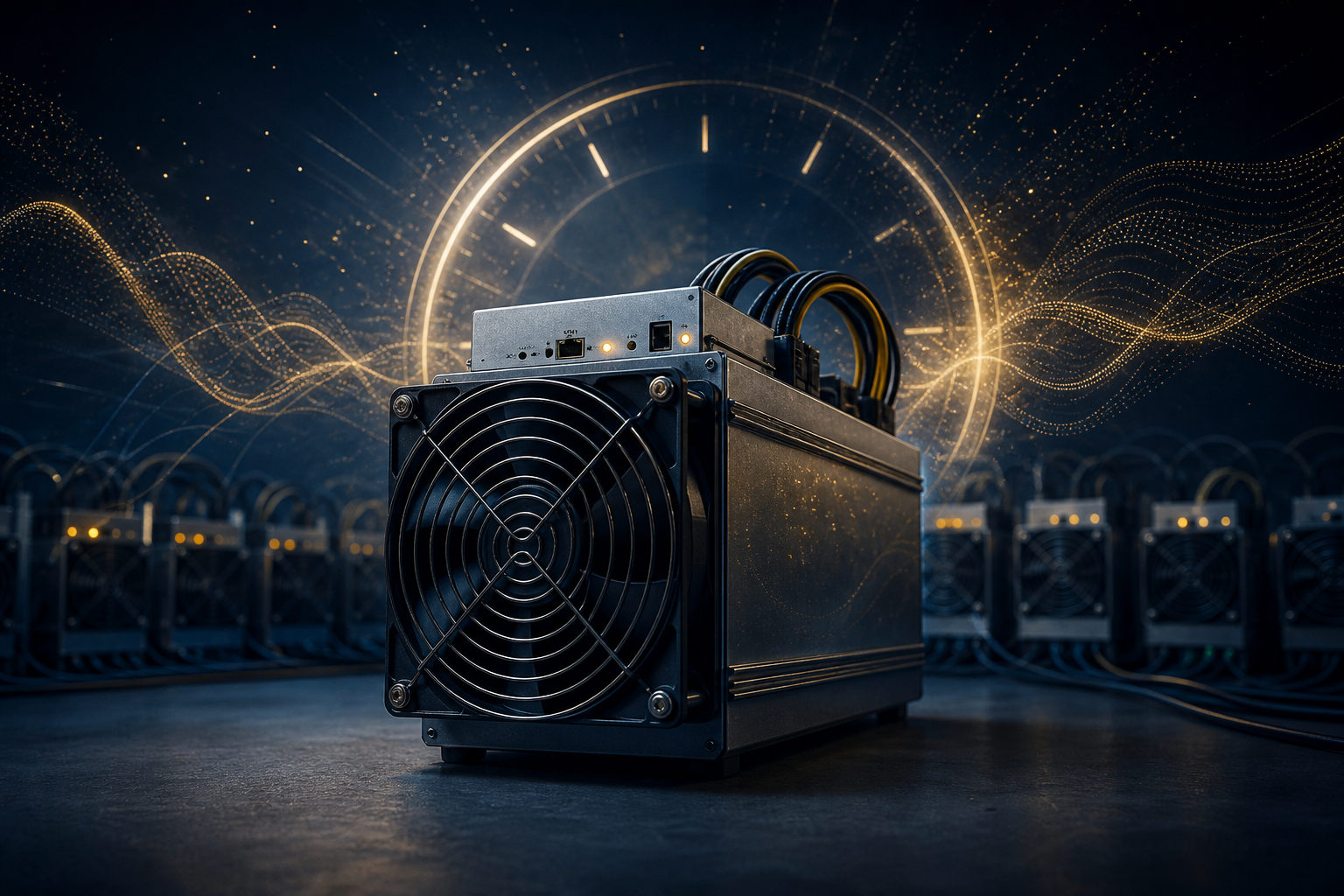
There is no fixed answer to how long it takes to solo mine 1 Bitcoin. Solo mining is a probability game inside a network-wide block race, not a clock you can run until one coin appears. The real variables are your share of hash power, network difficulty, hardware reliability, and how long you can keep operating without a payout.
A simple way to picture it is a bookkeeping contest. Miners across the network are trying to be the first to produce a valid block. If you mine solo, you compete on your own instead of combining your hash rate with a pool. If you win a block, the reward is not split with other pool participants. The trade-off is obvious: the wait can be extremely long, and it is never smooth.
Why there is no fixed timeline
Many people asking this question are really wondering whether one machine can slowly work its way toward a full Bitcoin. That is not how Bitcoin mining works. Solo mining does not pay like hourly labor. You are not earning a steady slice every day. You are repeatedly entering a race for the next block, and most rounds end with nothing for you.
The Bitcoin network produces a block about every 10 minutes on average, but that figure applies to the whole network, not to one miner. Your own expected wait depends on how much hash power you control relative to everyone else. A small share of network hash power can mean a very long wait, with huge variance around any estimate.
That is why the better answer is about odds, not dates. You can talk about probability, but you cannot schedule the day you will mine a block. Two people with somewhat similar setups can still have very different outcomes because each block race is uncertain at the individual level.
Think of solo mining as a race for the next block
Bitcoin uses proof of work. Mining hardware keeps making hash attempts, looking for a result that satisfies the current network target. You can think of it like trying keys over and over until one fits. The first miner to find a valid block gets the right to add that block to the chain.
The network adjusts mining difficulty so that blocks continue to appear about every 10 minutes on average. If more miners join or more powerful machines come online, competition usually gets tougher. If conditions shift the other way, the pressure can ease. Still, for a solo miner, the key question stays the same: what fraction of the total hash power is actually yours?
This is also where solo mining and pool mining split apart. In a mining pool, many miners combine their hash rate and share rewards according to the pool’s rules when a block is found. In solo mining, you carry the full waiting period yourself and only get paid when your own setup finds a valid block. Pool mining tends to smooth outcomes. Solo mining keeps the full volatility.
Why nonstop uptime does not mean you are “close”
New miners often assume that if a machine has been running for a long time, it must be getting closer to a reward. That is not how it works. Mining is not a progress bar. Hash attempts are repeated trials, and a long dry spell does not create a special credit that makes the next attempt more likely to succeed.
Better hardware, stable electricity, and strong cooling can improve your long-run position because they increase effective operating time and total hash attempts. Even so, they do not turn block discovery into something you can time with confidence.
What really affects the time to solo mine 1 Bitcoin
If you want to assess the wait, it helps to break the question into parts rather than look for one universal estimate. Several factors matter far more than simply counting the days your machine stays on.
- Your hash rate: More hash power means more attempts over time, which raises your chance of finding a block.
- Network difficulty: The same machine can face very different odds as the broader mining environment changes.
- Whether you are truly mining solo: Some people think they are solo mining when they are actually connected to a pool or a hosted service.
- Uptime and stability: Overheating, connection drops, restarts, and hardware faults reduce effective participation.
- Power and cooling conditions: Mining hardware needs sustained operation, and poor conditions can hurt both performance and lifespan.
- Halving cycles: Bitcoin’s block subsidy is cut roughly every 4 years, or every 210,000 blocks, which changes the reward structure miners compete for.
Another detail matters here. People ask about mining “1 Bitcoin,” but miners do not only receive newly issued coins. Block rewards can also include transaction fees. Even so, it is a mistake to think of solo mining as a guaranteed path where enough waiting automatically adds up to one full coin. In practice, it is an uncertain event layered on top of ongoing costs.
What it takes to participate in solo mining
From a practical standpoint, solo mining is more than buying a machine and plugging it in. A complete setup usually involves specialized hardware, mining software, wallet management, network connectivity, and often a direct understanding of how Bitcoin nodes validate data.
- Get specialized mining hardware: In today’s Bitcoin environment, the conversation usually means purpose-built mining devices rather than standard personal computers.
- Configure mining software: The software handles work assignment, result submission, and communication with your chosen setup.
- Understand node interaction: True solo mining is tied to direct participation in block validation and network rules, not just hardware operation.
- Prepare a secure wallet: You need to control your receiving address and protect private keys with proper backups.
- Monitor the system: Temperature, fan behavior, connection quality, and error logs all matter over time.
Guides can make this sound short and simple, but the hard part is often maintenance. Mining hardware produces heat and noise, and it needs a stable environment. If your power setup is weak or your cooling is poor, the machine may spend less time mining effectively. If your wallet practices are weak, a successful block does not automatically mean a safe result for you.
If your goal is educational, solo mining can be a useful way to understand proof of work, block production, and node validation. If your goal is simply to acquire Bitcoin in a steadier way, the decision is harder. It is not only about whether solo mining is possible. It is about whether you can accept long stretches with no return while still paying for the operation.
The cost reality most beginners miss
When people ask how long it takes to solo mine 1 Bitcoin, they often focus on the reward and ignore the waiting period. That waiting period is where the real pressure sits. Costs continue whether or not you find a block.
Electricity is the most obvious ongoing expense because mining hardware runs under sustained load. Hardware wear also matters. Machines are not immune to heat stress, dust, unstable power, or routine failures. Then there is the practical side of running the setup at home or in a small space: noise, ventilation, and day-to-day supervision all become part of the equation.
There is also opportunity cost. The time, attention, and money you put into a solo mining setup could have been used in other ways. That does not mean solo mining is pointless. It means the question should be framed honestly. For most people, solo mining is not the easiest route to obtaining Bitcoin. It is a high-variance technical activity with a steep patience requirement.
That is why many participants who start by looking into solo mining end up choosing a pool, or simply buying Bitcoin directly. The issue is rarely that solo mining is impossible in theory. The issue is that the volatility, maintenance burden, and long periods without any result do not fit what most individuals actually want.
FAQ
Can one miner at home eventually mine a full Bitcoin?
It is possible in theory, but there is no fixed schedule for it. Solo mining does not slowly accumulate a guaranteed daily amount. You are repeatedly competing for blocks, and the outcome depends on probability.
If your share of the total network hash rate is very small, the wait can be very long. For many people, the hardest part is not getting started but accepting that nothing may happen for a long time.
Is solo mining better than joining a mining pool?
They serve different goals. A mining pool usually offers a steadier payout pattern because rewards are shared across participants according to pool rules.
Solo mining gives you full exposure to the upside of finding a block yourself, but it also leaves you with the full variance. For beginners, a pool is usually easier to understand in practice.
Can a regular computer mine Bitcoin?
In a basic technical sense, any device that can perform hashing can participate. In real-world Bitcoin mining, though, a regular computer is not a practical choice.
Bitcoin mining is highly specialized. When people talk about mining Bitcoin today, they usually mean dedicated mining hardware rather than a home desktop or laptop.
If I mine a block, do I get the Bitcoin right away?
You need the reward to be directed to a wallet you control, and your wallet setup has to be correct and secure. In practice, wallet security and private key backups are part of mining, not something to think about later.
If your storage setup is weak, success at the mining stage does not remove the risk of losing access later. Security and mining operations have to be treated together.
Where should I check the live Bitcoin price?
You can check major market data platforms or large exchange interfaces for live quotes. Prices can differ slightly across venues, so it helps to look at liquidity, quote timing, and how each platform displays the market.
If you are asking because you want to evaluate solo mining, do not focus on price alone. You should also look at your power setup, hardware conditions, maintenance capacity, and tolerance for uncertainty.
If you want to try solo mining, start with the basics before buying hardware: confirm your power and cooling conditions, set up wallet backups, understand how your software and node arrangement work, and decide whether you are doing it to learn the system or to pursue a much more demanding operational path.
Disclaimer: This article is for informational and educational purposes only and is not investment, financial, or legal advice. Crypto assets are highly volatile and you could lose your entire investment. Do your own research and decide carefully.