
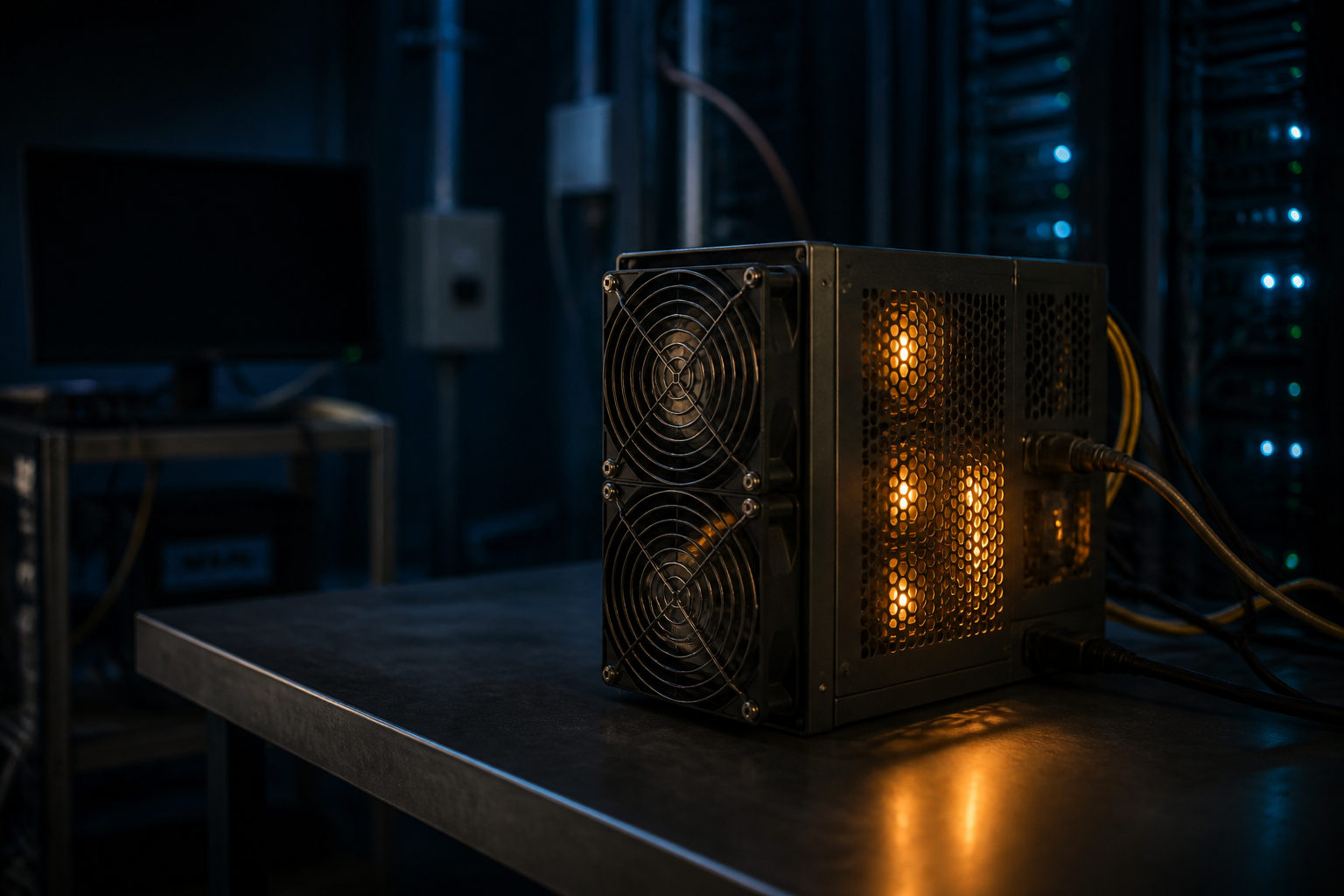
Solo bitcoin mining is only worth considering if you can accept long periods with no block found and still keep your hardware running reliably. For most individuals, it is a high-variance setup rather than a steady income model.
Why there is no single yes-or-no answer
In solo mining, your machine competes directly for the next Bitcoin block. You only receive the block reward and fees if you actually find a block. Bitcoin targets about 10 minutes per block, and after the 2024-04-19 halving, the current block subsidy is 3.125 BTC. On a network-wide basis, that works out to roughly 450 BTC issued per day, but that figure applies to the whole network, not to any one miner.
That distinction matters more than many beginners expect. The question of whether solo bitcoin mining is worth it is really a question about variance, waiting time, and your ability to absorb uncertainty. Even if your setup is technically sound, your results can stay flat for a long time because block discovery is not distributed evenly across individual miners.
Solo mining and pool mining solve different problems
| Category | Solo mining | Pool mining |
|---|---|---|
| How income appears | Mainly when a block is found | More frequent payouts based on contributed hashpower |
| Variance | Very high | Lower and easier to track |
| Hashpower requirement | Higher in practical terms | Lower barrier to participation |
| Cash flow pattern | Irregular | More predictable |
| Impact of downtime | Can mean missing rare opportunities | Still harmful, but easier to see in payout records |
| Typical appeal | Independence and full control | Smoother income distribution |
People often frame this as a simple choice between “bigger upside” and “smaller upside.” That misses the practical difference. A mining pool combines the work of many miners and spreads the outcome across participants. Solo mining keeps the full variance on your side. The two models can use similar hardware, yet the day-to-day experience is completely different.
If your main goal is regularity, a pool usually matches that goal better. If your main goal is independence, direct receipt of a block reward, or reducing reliance on a pool operator’s payout rules, solo mining has a separate kind of appeal. That appeal is real, but it should not be confused with a promise of smoother economics.
The main factors that decide whether solo bitcoin mining is worth it
Your share of network hashpower
Bitcoin uses proof of work, so miners compete to produce the next valid block. The smaller your fraction of total network hashpower, the less predictable your waiting time becomes. The network may average about one block every 10 minutes, but your own machine does not follow that schedule.
This is why network issuance figures can be misleading when taken out of context. Roughly 450 BTC per day does not mean a solo miner earns a small daily slice in a smooth line. It means the network as a whole adds that amount across all miners combined. A solo operator can go a long time without seeing any direct result at all.
Operating costs go far beyond electricity
Electricity is the first thing people mention, but it is rarely the only factor that decides viability. Cooling, ventilation, noise, network stability, spare parts, troubleshooting time, and the basic suitability of your location all shape the real outcome. A machine that exists on paper is different from a machine that runs cleanly for long periods.
| Cost or condition | Why it matters | Common blind spot |
|---|---|---|
| Power reliability | Supports continuous operation | Home setups may not handle long high-load use well |
| Cooling and airflow | Affects stability and hardware life | Heat problems often appear after deployment, not before |
| Network stability | Helps submit valid work consistently | Short dropouts can still cut effective uptime |
| Noise control | Determines whether the setup is livable | Residential environments are often a poor fit |
| Maintenance skill | Reduces recovery time after faults | Minor issues can become long outages |
| Capital flexibility | Helps absorb uncertain payback timing | Cash flow pressure can arrive before any reward does |
Solo mining is especially sensitive to interrupted uptime. Your opportunities are already sparse. If your machine is often offline, overheating, or failing to run at full effectiveness, the gap between theoretical and actual performance can become the whole story.
Halving changes the reward background
Bitcoin cuts the block subsidy every 210,000 blocks, roughly every four years. The halvings took place on 2012-11-28, 2016-07-09, 2020-05-11, and 2024-04-19, with the next one expected around 2028. The current subsidy is 3.125 BTC. For a solo miner, those dates are not trivia. They define the reward schedule built into the system.
Each halving reduces the fixed subsidy attached to a successful block. If your model already depends on rare success events to cover continuing expenses, a lower subsidy tightens the margin for error. The protocol is predictable here, but your personal timing of success is not.
Your objective matters more than excitement
Some people choose solo mining because they want direct participation, control over their own setup, and the experience of operating without a pool. Those are valid reasons. They are also different from saying the setup is financially attractive in a broad sense.
A clear objective makes the decision easier. If you are testing a technical setup, exploring Bitcoin’s mining process, or valuing independence for its own sake, you can judge the effort by those standards. If you need smoother cash flow, solo mining usually works against that need.
Risks that are easy to underestimate
| Risk | How it shows up | Why it matters |
|---|---|---|
| Extreme variance | Long stretches with no block found | Creates both financial and emotional pressure |
| Downtime | Power loss, heat issues, hardware faults, network failure | Misses rare mining opportunities entirely |
| Difficulty changes | Network competition keeps adjusting | Makes static expectations age badly |
| Fee variability | Total block revenue is not identical every time | Adds another layer of uncertainty |
| Hardware depreciation | Efficiency and resale value both change | Paper models drift away from reality |
| Cash flow mismatch | Costs continue while income may not appear | Can force an exit before any success arrives |
The variance point deserves extra emphasis. Many people can tolerate a lower-than-hoped return. Fewer are prepared for the possibility of no meaningful feedback for a long time. Solo bitcoin mining can feel inactive even when your system is working exactly as designed.
Another mistake is treating technical success as business success. A wallet can be configured correctly, a node can run properly, and the miner can stay online, yet the setup may still be a poor fit for your budget and risk tolerance. Operational competence does not cancel probability risk.
A restrained framework for deciding
| Question to ask yourself | If the answer is weak | What that suggests |
|---|---|---|
| Can I handle a long period without finding a block? | You may quit early | Solo mining may be a poor match |
| Do I have stable power, cooling, and internet? | Downtime risk is high | Theoretical returns may never become real |
| Can I diagnose hardware or network problems myself? | Recovery time may be slow | Effective uptime will shrink |
| Do I need regular cash flow? | Ongoing costs may become stressful | High variance works against your needs |
| Am I seeking independence or steady payouts? | Your standard is unclear | You may judge the setup by the wrong metric |
If your strongest preference is predictability, solo mining often fails that test. If you understand the uncertainty and still value autonomy, then the decision can make sense on those terms. The important part is to avoid mixing those two standards together.
One more stable fact belongs in the background of any mining discussion: Bitcoin has a hard cap of 21,000,000 BTC, and issuance is expected to continue until around 2140. That tells you the supply schedule is bounded. It does not tell you when a solo miner will personally hit a block.
FAQ
Can a home miner realistically solo mine bitcoin?
It is possible, but possibility is not the same as suitability. Home environments often struggle with noise, heat, power delivery, and internet stability, all of which matter more when your payoff depends on rare success events.
Does solo mining pay more than pool mining?
Not in any simple guaranteed sense. Solo mining keeps the full variance, while pool mining spreads outcomes across participants, so the difference is as much about payout shape as about reward size.
Does the 2024 halving make solo bitcoin mining less attractive?
The current block subsidy is 3.125 BTC, so each successful block now carries a lower fixed subsidy than before the halving. Whether that makes solo mining unattractive depends on your cost structure, uptime quality, and ability to endure long dry spells.
Why can the network issue roughly 450 BTC per day while I might mine nothing for a long time?
Because that figure refers to total network issuance, based on about 144 blocks per day at 3.125 BTC each. A solo miner only gets paid after finding a block, and that outcome does not arrive in smooth daily increments.
Is solo mining still meaningful if my goal is learning rather than income?
Yes. It can be useful as a hands-on way to understand mining mechanics, node operation, and direct participation in Bitcoin’s block production. That value is educational and operational, which is different from treating it as a reliable income plan.
If you want a grounded answer, write down your goal first, then test it against uptime demands, operating conditions, and your tolerance for uneven outcomes. If any of those inputs are weaker than they need to be, solo bitcoin mining is better viewed as a high-uncertainty experiment than a dependable earning method.
Disclaimer: This article is for informational and educational purposes only and is not investment, financial, or legal advice. Crypto assets are highly volatile and you could lose your entire investment. Do your own research and decide carefully.