
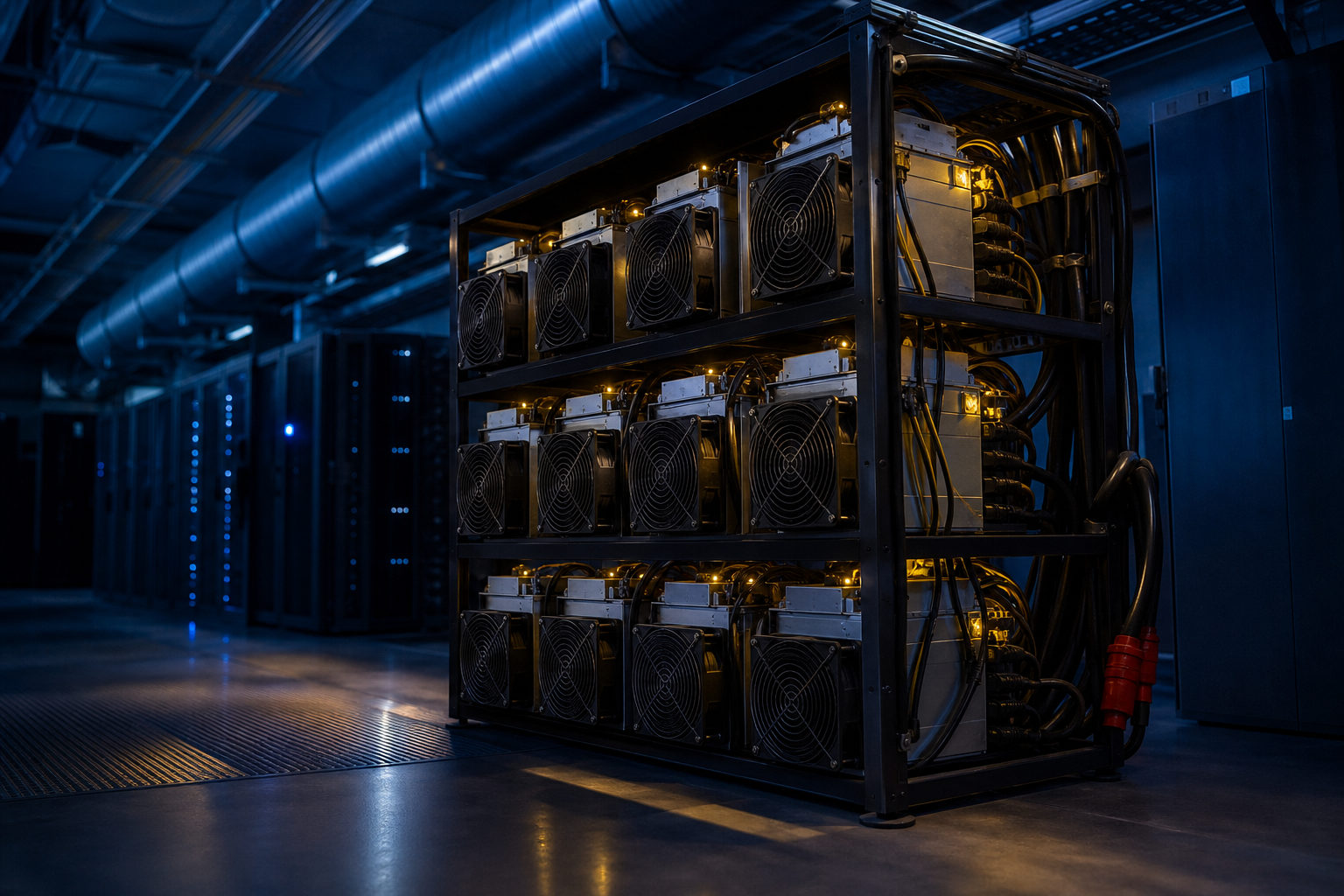
Yes, data centers can mine Bitcoin, but only if the facility is set up for mining hardware, heavy power use, cooling, and constant maintenance. A standard server room or cloud platform is often the wrong fit, even if it sounds similar on paper.
Think of mining as a nonstop race to write the next page of the ledger
Bitcoin mining exists because the network needs participants to verify transactions and package them into blocks. Miners compete to produce a valid result under Bitcoin's rules, and the winner earns the right to add the next block to the chain.
That race runs continuously. A new block is produced about every 10 minutes, so mining is less like occasional computing and more like a permanent industrial process. Hardware stays on, fans keep moving air, and operators watch for faults because downtime matters.
This is where data centers enter the picture. A mining facility gives large numbers of machines stable power, predictable cooling, network access, and people who can fix equipment when something fails. If a data center can provide those conditions, it can mine Bitcoin.
What kind of data center actually works for Bitcoin mining
People often use the term data center loosely. In practice, a traditional enterprise data center and a Bitcoin mining site can look similar from outside while serving very different needs inside. One may focus on hosting applications, storage, databases, and client workloads. The other is arranged around specialized machines running one task all day.
Bitcoin mining today is built around ASIC miners, which are purpose-made devices for a specific hashing algorithm. They produce heat, noise, and sustained power demand in a way that does not match many general server environments. A building with racks and networking gear is not automatically a good mining site.
Facilities that support mining usually pay close attention to a few practical areas:
- Power delivery: enough stable electricity for machines that stay under load for long periods.
- Cooling design: airflow, heat removal, dust management, and room layout all affect uptime.
- Physical operations: technicians need ways to inspect, swap, repair, and restart machines quickly.
- Space planning: mining layouts care about rig density and heat paths more than office-style server use.
So when someone asks whether data centers mine Bitcoin, the more precise answer is that mining happens in data-center-like facilities that are designed or adapted for that purpose.
Why ordinary cloud servers are usually a poor choice
A common follow-up question is whether renting cloud instances counts as mining through a data center. From a strict technical view, any machine that can run code can attempt to participate. That does not mean it makes sense in the real world.
Cloud servers are built for flexible computing. They support websites, business software, testing environments, media processing, research jobs, and many other workloads. Bitcoin mining rewards efficient execution of a single task, and specialized mining hardware is built around that one task. General-purpose servers and ASIC miners are solving different problems.
There is also a policy and operations side. Many cloud platforms do not want tenants running sustained mining workloads because of resource strain, thermal behavior, or compliance concerns. Even where it is technically possible, the setup often clashes with how those services are priced and managed.
That is why the phrase “data center” can mislead beginners. A cloud region full of virtual machines and a mining site full of ASIC rigs both involve buildings, networking, and hardware, yet they belong to different operating models.
How people participate through data centers
If your real question is how a person or business can use a data center to mine Bitcoin, there are several paths. They differ in control, responsibility, and operational burden.
- Own the miners and use colocation. You buy the machines, and a hosting provider supplies space, power, cooling, and local support. This gives you direct exposure to the hardware side, but you still need to review repair terms, downtime handling, access rules, and billing details.
- Build your own site. This is the heaviest approach. It involves site preparation, electrical work, airflow planning, equipment monitoring, noise management, and regular hands-on service. It looks more like running an industrial facility than installing software on a computer.
- Buy mining-related hosted services or contract-based products. These can appear simple, but the key issue is transparency. If you cannot verify the machines, the facility conditions, or the rules around shutdowns and fees, the risk is harder to judge.
Anyone considering these options should start with a realistic view of competition. Bitcoin mining takes place against professional operators running specialized hardware at scale. Interest alone does not close the gap; infrastructure matters.
The hard part is not starting, but keeping machines running well
Newcomers often focus on getting hardware, then discover that long-term operation is where the real pressure sits. Mining rigs turn large amounts of electricity into heat. If that heat is not removed efficiently, machines may throttle, fail, or go offline. Dust, poor airflow, unstable power, and weak maintenance routines all reduce reliability.
Costs also come from places that are easy to overlook at first glance. A mining operation may need cable management, electrical safety work, spare parts, physical monitoring, cleaning routines, and staff who can respond when a board or fan fails. Noise is another practical issue. Mining rigs are usually unsuitable for homes and many office spaces because of their sound levels and thermal output.
Bitcoin's issuance rules add another layer to this reality. The total supply is capped at 21 million coins, and the block reward halves about every 210,000 blocks, roughly every four years. The halving years so far have been 2012, 2016, 2020, and 2024. That structure pushes operators to care deeply about efficiency, uptime, and power cost because the competitive environment changes over time even when the protocol rules stay public and fixed.
How mining sites differ from normal server operations
A standard data center business usually concentrates on availability for applications, customer isolation, software compatibility, and network performance. A Bitcoin mining site is organized around turning power and cooling capacity into continuous hashing. The priorities are related, but they are not the same.
Bandwidth still matters, yet extremely high throughput is often less central than stable connectivity and fast fault response. If machines overheat, lose power, or develop hardware faults, someone on site needs to diagnose and act. Without that operational muscle, a facility may carry the data center label while still being a weak place for mining.
One more basic point helps frame the subject. Bitcoin began with the genesis block in January 2009, and its smallest unit is 1 satoshi, equal to one hundred millionth of a BTC. Because the system is open and the rules are known in advance, mining has developed into a contest over hardware choice, energy use, and operational discipline rather than a permission system run by a central operator.
FAQ
Can regular servers in a data center mine Bitcoin?
They can run mining software in a technical sense, but that is different from being competitive or efficient. Bitcoin mining is dominated by specialized ASIC hardware, so general servers are usually a weak fit.
Does hosting my own miner in a colocation facility count as mining through a data center?
Yes. Your machine is participating in the network while the facility supplies power, cooling, networking, and local support. The important step is checking the hosting terms for repairs, downtime, and access.
Why is cooling mentioned so often in Bitcoin mining?
Mining rigs run at sustained load and convert much of their electrical input into heat. If a site cannot move that heat away effectively, performance and reliability both suffer.
Is home mining the same thing as data center mining?
No. Home setups may help someone learn the basics, but they usually face limits in power, heat, noise, and maintenance. Data-center-based mining is built around infrastructure that can support many machines over long periods.
What should I check before using a mining host?
Look at power stability, cooling design, service procedures, physical access rules, and how equipment failures are handled. If those details stay vague, you are being asked to accept more risk than you can measure.
If you want a quick rule for judging whether a data center can mine Bitcoin, focus on three things: whether it is built for mining rigs, whether it can deliver stable power at sustained load, and whether it has real on-site maintenance. If those pieces are missing, the label on the building does not mean much.
Disclaimer: This article is for informational and educational purposes only and is not investment, financial, or legal advice. Crypto assets are highly volatile and you could lose your entire investment. Do your own research and decide carefully.