
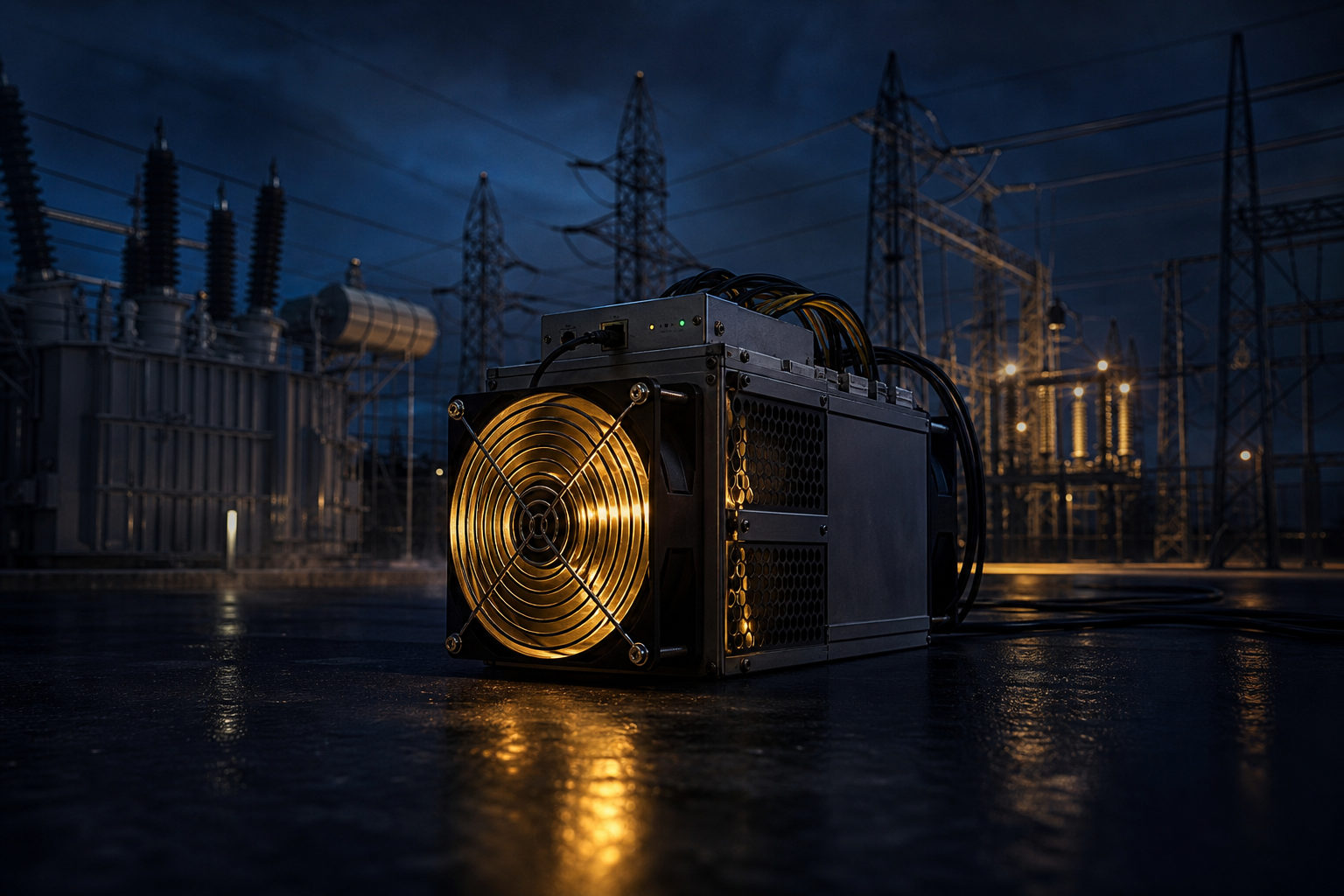
De Vries 2026 bitcoin's growing energy problem joule is really about one thing: why Bitcoin keeps using electricity as part of its security model, and why that fact remains disputed.
What this debate is actually about
At first glance, the issue looks simple. Does Bitcoin use a lot of energy or not? The harder question is why that energy use exists in the first place and what the network gets in return. That is where most serious arguments begin.
Bitcoin runs on proof of work. Instead of trusting one operator to maintain a ledger, the system lets miners compete to add new blocks. You can think of it as a public race with strict rules. Miners keep trying computations, and the winner gets the right to publish the next block and receive the reward allowed by the protocol.
That competition is not a side effect. It is part of the design. The electricity and hardware costs make attacks expensive, which is why supporters say the energy use buys security. Critics answer with a different question: even if security matters, does it need to be achieved this way?
Why Bitcoin keeps consuming power
A normal payment database is usually controlled by a company, a bank, or a government body. Bitcoin does not work like that. Its ledger is shared across a network, and no central party can rewrite records at will. To stop cheap manipulation, the system ties block production to real-world costs.
That is the basic logic of proof of work. If someone wants to alter transaction history, they would need to spend real resources to compete with the rest of the network. In simple terms, the energy cost acts like a barrier. It does not guarantee perfection, but it raises the cost of cheating.
This is also why energy discussions can get confusing. People often treat Bitcoin's power use as if it were only a technical inefficiency. In practice, it is bound up with incentives, miner behavior, machine efficiency, and electricity sourcing. Once those pieces move, estimates and opinions can move with them.
A plain-English way to understand the concern
A useful analogy is a nonstop lottery where machines keep trying new tickets. Most attempts do not win, yet the repeated effort is what makes the process hard to fake. That is why outside observers sometimes say the computation looks wasteful, while supporters answer that the effort itself is the security filter.
For a casual reader, it helps to separate three different questions. One is total network energy use. Another is how people assign that energy use to individual transactions. A third is where the electricity comes from. Those are related topics, but they are not the same topic.
Mixing them together often leads to bad conclusions. Someone may criticize total power demand. Someone else may focus on carbon intensity. Another person may be asking whether proof of work is justified at all. If those positions are treated as interchangeable, the debate starts sounding louder than it really is.
Three common mistakes
- Mistake one: assuming each extra transaction adds a fixed amount of energy use. Bitcoin's security costs do not map neatly to one transaction at a time.
- Mistake two: assuming better mining hardware ends the controversy. Efficiency can improve, but competition can still rise.
- Mistake three: treating one estimate as the final answer. Different assumptions and system boundaries can produce very different results.
How to read articles tied to Joule or De Vries
If an article mentions Joule or De Vries, start with the framework, not the headline. Ask what exactly is being estimated. Is it total mining demand, emissions, hardware turnover, or a policy effect? Many pieces use the phrase “energy problem,” but they may be describing different things.
Then look at the assumptions. Does the argument treat miner behavior as fixed, or does it allow for changes in incentives and operating choices? Miners respond to expected returns, equipment quality, and electricity conditions. A model that ignores those adjustments may still be useful, but readers should know its limits.
One more step matters. Check whether a short-term pattern is being presented as a permanent rule. In Bitcoin, conditions can shift because the network is competitive by design. That does not make criticism invalid. It just means readers should be careful before turning a snapshot into a sweeping claim.
For most people, the best takeaway is not a single dramatic line. It is a method. First, understand proof of work. Next, see how incentives keep miners active. After that, examine what a given article is measuring. That approach makes De Vries 2026 bitcoin's growing energy problem joule far easier to interpret.
FAQ
What is the Bitcoin energy problem people are referring to?
They usually mean Bitcoin's ongoing electricity use under proof of work. The dispute is not only about whether that use exists, but whether the security benefits justify the cost.
Why can't Bitcoin mining work like ordinary software and use less power?
Because the computation is part of the trust model, not just routine processing. Removing that cost would change how the network defends itself against manipulation.
When I read a Joule article on Bitcoin, what should I check first?
Start with the object of the estimate, then the assumptions, then the conclusion. A lot of disagreement comes from different modeling choices rather than total factual opposition.
Can Bitcoin's energy use be directly assigned to each transaction?
Not in a simple one-to-one way. The network spends resources to maintain overall security, so dividing total energy by a count of transactions can be misleading.
What if I only want to know the live Bitcoin price?
You can check a major market data platform for the real-time quote. Price tells you about market demand, while the energy debate is about proof of work, miner incentives, and electricity inputs.
How to sanity-check the next article you read
The next time you see De Vries 2026 bitcoin's growing energy problem joule, run a quick check. Does the piece explain proof of work? Does it separate total energy use from per-transaction claims? Does it present an estimate as one model or as settled fact?
If you keep those questions in mind, you will be in a much better position to judge the argument on its merits instead of reacting to the headline alone.
Disclaimer: This article is for informational and educational purposes only and is not investment, financial, or legal advice. Crypto assets are highly volatile and you could lose your entire investment. Do your own research and decide carefully.