
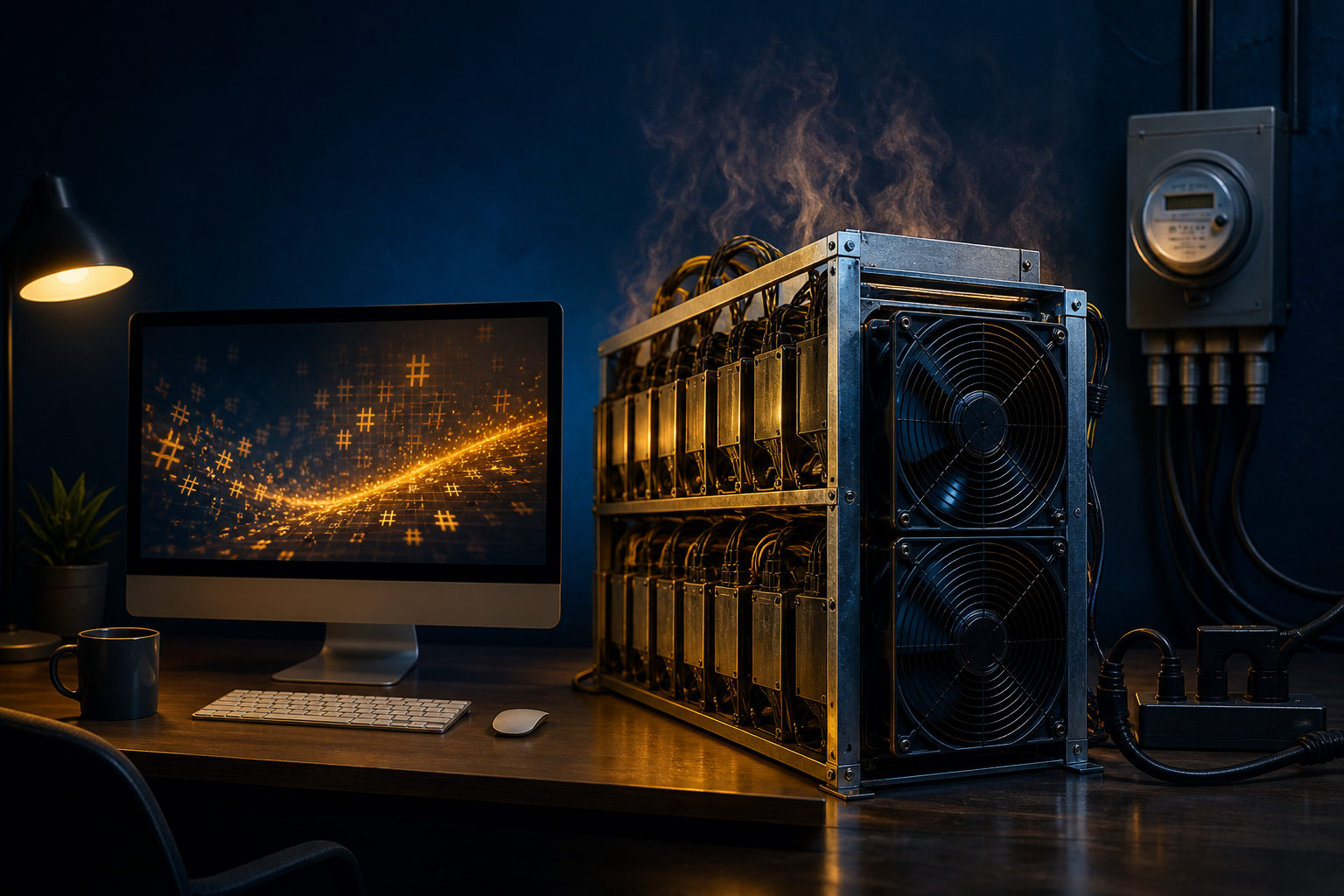
Yes, your PC can mine Bitcoin in a technical sense, but that does not mean it can compete well. A home computer can join the mining process, yet mining Bitcoin with a regular PC is usually impractical once you look at hardware efficiency, power use, and heat.
Think of mining as a bookkeeping race
Bitcoin mining helps keep the network's ledger in order. People on the network collect transactions, verify them, and try to produce the next block by solving a proof-of-work task.
A simple way to picture it is a public race to earn the right to write the next page of the ledger. Roughly every 10 minutes, a new block is added, and miners across the network compete at the same time. The more efficient the machine, the better its chance in that race.
Bitcoin began with the genesis block in January 2009, and its supply is capped at 21 million coins. The block subsidy is also reduced about every 4 years, or every 210,000 blocks, through halving events. That design makes mining a business of efficiency rather than a casual background task for most people.
Why a PC can mine Bitcoin but still be a poor fit
If the question is simply, “can my pc mine bitcoin,” the answer is yes. If your computer can run mining software, stay connected, and perform the required calculations, then it can take part.
The real issue is competitiveness. Bitcoin mining started in a period when general-purpose hardware had a larger role, but the field is now dominated by specialized machines built for this exact kind of work. A normal desktop, office PC, or even a strong consumer computer usually cannot match that level of efficiency.
It is a bit like showing up to a professional race in a road car. You are allowed on the track, but the rest of the field is using equipment designed for one job only.
How people use a PC to take part
People often ask whether they can use a personal computer to mine Bitcoin when they really mean one of two things: can they participate at all, and can they do it in a way that makes sense. Those are different questions.
Solo mining
Solo mining means your machine competes on its own and keeps the full result if it ever finds a valid block. The catch is obvious: with a regular PC, the chance of finding a block by yourself is extremely small in today's environment.
Mining through a pool
A mining pool combines the work of many participants. Instead of waiting for one small machine to get lucky on its own, the pool shares the effort and distributes results according to its rules.
That can make participation feel more consistent, but it does not turn a home PC into competitive mining hardware. It changes how results are shared, not how powerful your computer actually is.
Using a PC as a learning tool
For many beginners, a PC is most useful as a way to understand how Bitcoin works. Running software, learning what a node does, seeing how blocks are produced, and understanding why hash power matters can be more valuable than chasing unrealistic expectations.
The practical costs people overlook
Most beginners focus on whether the software will run. The better question is what happens after it starts running day and night.
- Hardware efficiency: A machine may be able to mine and still be far too inefficient to make sense.
- Electricity cost: Mining depends on continuous operation, so power use matters right away.
- Heat and noise: Sustained heavy load pushes fans harder and raises temperatures.
- Component wear: Long periods at high load can add stress to consumer hardware.
- Software risk: Unknown mining tools can expose your wallet, account, or operating system to serious problems.
Another common mistake is assuming a fast gaming or editing PC must also be good for Bitcoin mining. General performance and mining efficiency are not the same thing.
How to decide whether it is worth trying
If you are wondering, “can i mine bitcoin on my pc,” start with your goal. That one step clears up most confusion.
- Define the goal: If you want to learn, a PC may be enough. If you want to compete with professional miners, expectations need to change fast.
- Check the type of machine: A standard home computer is better for experimentation than for serious mining.
- Review power and cooling: Continuous operation means your setup needs stable power and decent airflow.
- Protect your wallet and system: Use reputable software, keep backups, and avoid mixing unknown mining tools with important personal files.
- Accept how specialized Bitcoin mining has become: This is the point many people miss.
It also helps to know a few basics before doing anything. Bitcoin's smallest unit is 1 satoshi, which is one hundred millionth of a BTC. Halving years include 2012, 2016, 2020, and 2024. Learning these rules gives better context than staring at CPU usage alone.
FAQ
Can I mine Bitcoin with a regular desktop PC?
Yes, you can participate with a desktop PC. That said, a regular desktop usually lacks the efficiency needed to compete with specialized mining hardware.
Is a laptop a good choice for Bitcoin mining?
Usually no. Laptops are built for portability and balanced daily use, so constant heavy load can lead to excess heat, throttling, and added wear.
Does joining a mining pool make my PC competitive?
A pool can make results feel steadier because work is shared among many participants. It does not remove the underlying hardware gap between a home PC and dedicated mining machines.
Is it still worth trying if I only want to learn?
Yes. A PC can be a practical way to understand wallets, nodes, block production, and the basic logic behind Bitcoin mining.
If my computer is powerful, is that enough?
Not by itself. A powerful consumer PC may feel fast in games or creative work while still being a poor fit for Bitcoin mining.
Before you start, do this first
Back up your wallet information, use software from sources you trust, and make sure your computer has enough cooling before you test anything. If your goal is to understand how Bitcoin blocks are produced and how network security works, a PC can help you learn; if your goal is to compete seriously, the hardware gap is the first fact to face.
Disclaimer: This article is for informational and educational purposes only and is not investment, financial, or legal advice. Crypto assets are highly volatile and you could lose your entire investment. Do your own research and decide carefully.