
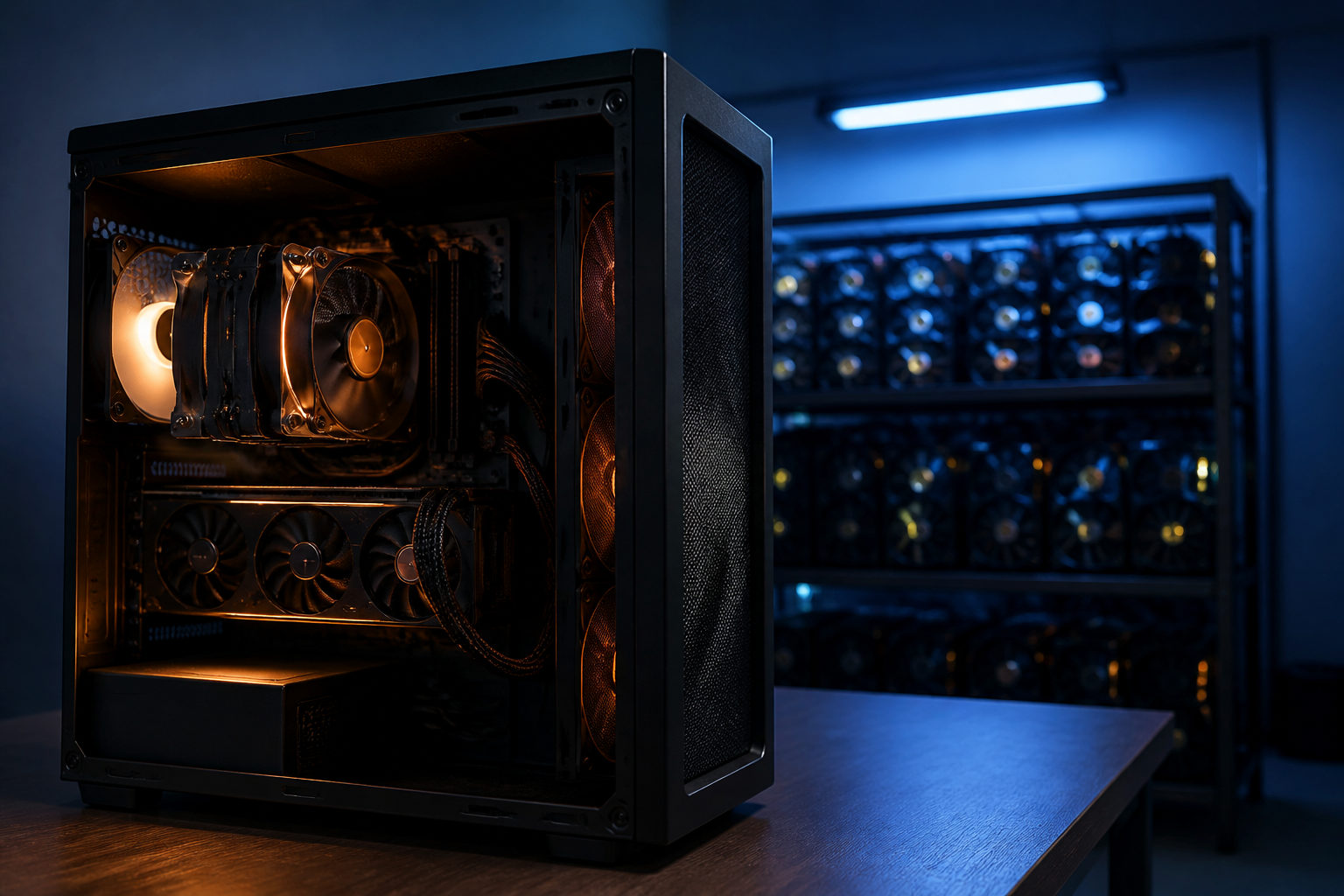
Yes, you can use your computer to mine Bitcoin, but for most people a home PC is not an effective way to compete on the Bitcoin network. The real question is less about whether the software can run and more about whether your hardware can keep up in a mining race built around specialized machines.
What Bitcoin mining is actually doing
A simple way to picture Bitcoin mining is to think of it as a public bookkeeping contest. The Bitcoin network needs someone to package recent transactions into a new block, but that right is not assigned by a central company or server. Instead, miners compete by running repeated calculations until one of them finds a result that fits the network rules.
That winner gets the chance to add a new block to the blockchain and receive the block reward plus transaction fees. This is part of Bitcoin's proof-of-work system. It helps decide who writes the next page of the ledger and makes past records harder to alter because changing history would require repeating a huge amount of work.
Bitcoin produces a new block about every 10 minutes. The network adjusts mining difficulty so that block production stays near that pace even as more or fewer miners join. That means the contest never stands still. If stronger hardware enters the network, weaker hardware falls behind.
So when people ask whether a computer can mine Bitcoin, the answer has two layers. A computer can participate. Competing well is a different matter.
Why a regular computer is usually not enough
Many beginners assume that if a desktop or laptop can install mining software, it should be able to mine Bitcoin in a practical sense. That idea misses how much the hardware side has changed. Bitcoin mining began as something general-purpose computers could try, but competition pushed the industry toward application-specific equipment built only for this task.
Today, dedicated Bitcoin miners are designed to perform the exact calculations required by the network far more efficiently than a home computer. A normal PC has to balance many jobs: operating system tasks, cooling limits, noise, daily use, and power draw. A mining machine is built with one purpose in mind.
| Factor | Home computer | Dedicated Bitcoin miner |
|---|---|---|
| Main purpose | General computing, work, gaming | Bitcoin mining only |
| Setup | Usually easier to start with | More technical to deploy |
| Mining competitiveness | Usually low | Usually much higher |
| Heat and power pressure | Heavy load can strain the system | Built for continuous load |
| Impact on daily use | Can slow other tasks and add wear | Usually not used as an everyday computer |
This is why the right question is not only “can I use my computer to mine bitcoins” but also whether doing so has any practical value. For most casual users, it is better seen as a learning exercise than a serious way to mine on the main network.
Ways people participate in mining
Not everyone approaches mining with the same goal. Some people want to understand the process from the inside: wallets, mining pools, blocks, and proof of work. Others want to take part as active miners. Those paths look very different once costs and equipment enter the picture.
| Approach | Best for | What you learn or do | Main limitation |
|---|---|---|---|
| Local testing or educational setup | People learning the basics | Wallet setup, nodes, mining logic, block creation | Useful for study, not proof of competitiveness |
| Joining a mining pool with a computer | People who want hands-on experience | Pool accounts, mining software, payout settings | Low hardware efficiency for Bitcoin |
| Using dedicated miners or hosted setups | People ready to assess full costs | Power planning, cooling, maintenance, uptime | Higher upfront and ongoing commitments |
If your goal is education, a regular computer can still be useful. You can learn how a wallet receives payouts, what a mining pool is doing, why proof of work matters, and how hardware load affects performance. That kind of direct experience can make Bitcoin's design much easier to understand.
If your goal is real participation on the Bitcoin main network, the conversation changes. You need to think beyond the software install and look at electricity, cooling, noise, maintenance, hardware wear, pool rules, and the chance that your setup simply is not efficient enough to make sense.
The practical costs people often overlook
Electricity
Mining pushes hardware hard for long periods. That raises power use, and power cost becomes one of the first reality checks. Even if you are not trying to estimate profit, you should still ask whether your electrical setup can handle sustained load and whether you are comfortable paying for that use over time.
Heat and noise
A home computer under constant heavy load runs hotter and louder. Fans spin faster, room temperature can rise, and the machine may become annoying to keep nearby. In a small apartment or shared workspace, that practical friction matters as much as the technical side.
Hardware wear
Running a PC at high load day after day puts stress on cooling parts, power delivery, and other components. Laptops are especially poor candidates for this because they have less thermal headroom than desktop systems. If the same machine is also needed for work or school, the trade-off gets even worse.
Software safety
Mining software often requires broad system access. If you download tools from unreliable sources, you risk installing malware, remote control tools, or software that quietly redirects your computing power to someone else's wallet. Wallet seed phrases, private keys, and pool login details should be protected separately and handled with care.
| Issue | Why it matters | Common mistake |
|---|---|---|
| Power cost | Affects ongoing expense | Only thinking about hardware price |
| Cooling | Changes stability and lifespan | Assuming one extra fan solves everything |
| Noise | Affects comfort at home or work | Ignoring constant fan sound |
| Security | Protects access to funds and devices | Installing unknown software |
| Maintenance | Downtime still needs attention | Treating mining as fully hands-off |
Set your goal before you start
If you want to learn how Bitcoin mining works, using a spare computer for limited testing can make sense. Start with a wallet you control, read the settings carefully, understand what a mining pool is asking for, and pay attention to system temperature and permissions. That gives you a much clearer view of the process without pretending a home PC is equal to dedicated mining hardware.
If you are thinking about mining as a real operating activity, include exit costs in your planning. Ask what happens if the machine is too loud, too hot, too slow, or no longer useful for anything else. The decision is not only about getting started. It is also about whether stopping later would be costly or inconvenient.
For most people, a computer is good for learning Bitcoin mining and poor for competing in it. Before installing anything, decide whether your goal is education, experimentation, or a serious hardware commitment.
FAQ
Can I mine Bitcoin on a laptop?
You can run mining software on a laptop, but that does not mean it is a good idea for long sessions. Laptops have tighter cooling limits, so heat, throttling, and wear show up faster.
Does joining a mining pool make a regular computer viable?
A mining pool lets you contribute hash power as part of a group, which helps you experience the process in a more consistent way. It does not change the fact that a normal computer is usually weak compared with dedicated Bitcoin mining equipment.
Can a GPU mine Bitcoin effectively?
People often connect mining with GPUs because some other cryptocurrencies have been more GPU-friendly. Bitcoin mining today is dominated by specialized machines, so lessons from GPU mining do not transfer well here.
What should I prepare if I only want to test the process?
Use a wallet you control, verify that the software source is trustworthy, and learn the basic pool settings before you start. Focus on understanding workflow, system load, and security prompts rather than expecting meaningful mining output.
Are there ways to participate without buying a miner?
Some people look at hosted arrangements or other indirect options, but you still need to understand who controls the hardware, how payouts work, and what fees apply. If you cannot verify the setup clearly, caution is the better default.
If you decide to try it, use a machine that does not hold important files, watch temperatures and system behavior closely, and stop if the load starts affecting stability or safety.
Disclaimer: This article is for informational and educational purposes only and is not investment, financial, or legal advice. Crypto assets are highly volatile and you could lose your entire investment. Do your own research and decide carefully.