
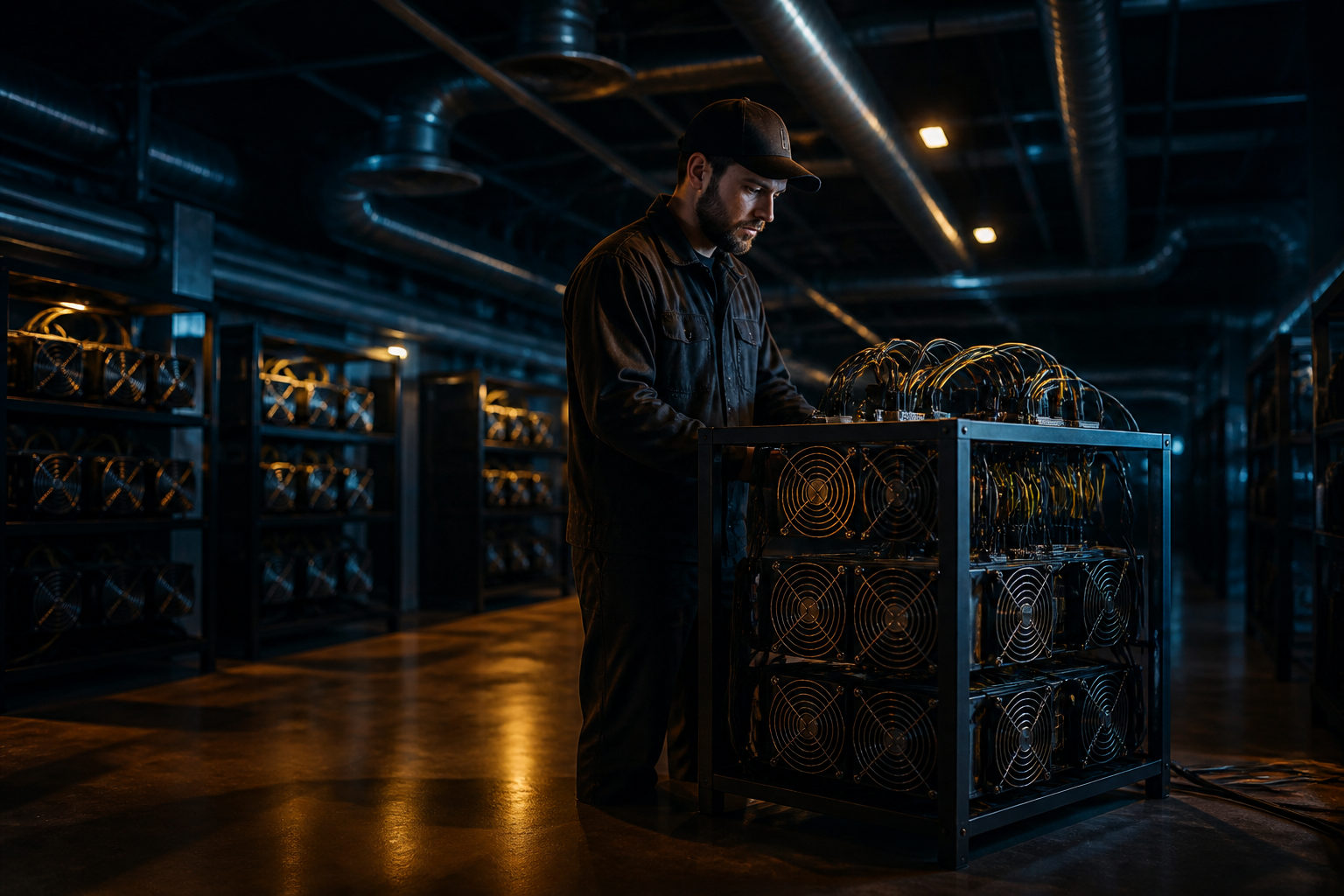
A single proprietorship bitcoin mining setup means one owner buys the machines, pays for power, manages the site, and takes on the operating risk. You can do it, but it works more like a hands-on business than a passive income button.
What single proprietorship bitcoin mining actually means
Think of Bitcoin mining as a nonstop bookkeeping race. New transactions enter the network, miners assemble candidate blocks, and machines keep making guesses until one finds a valid result under Bitcoin's rules. The miner that wins gets to add the block and collect the block reward plus transaction fees.
Bitcoin targets roughly 10 minutes per block. After the 2024-04-19 halving, the current block reward is 3.125 BTC, and that stays in place until the next halving, expected around 2028. Across the whole network, about 450 BTC are newly issued per day. That figure describes the network as a whole, not what any one solo operator or small business can expect to mine.
In a single proprietorship model, ownership and responsibility stay with one person or one business owner. You choose the machines, arrange power and networking, monitor uptime, and deal with failures yourself. If a machine goes offline, there is no separate operator to absorb that problem for you.
Why running your own mining operation is hard
The first barrier is not starting. It is staying online, staying efficient, and handling uncertainty over time. Bitcoin has a hard cap of 21,000,000 BTC, with issuance expected to continue until about 2140. The block subsidy is cut in half every 210,000 blocks, roughly every 4 years. The halving dates so far are 2012-11-28, 2016-07-09, 2020-05-11, and 2024-04-19.
That schedule shapes the economics of mining. Each cycle pushes operators to care more about machine efficiency, reliable uptime, cooling quality, and electricity terms. A small owner-operated setup is competing against participants that often have better infrastructure, stronger purchasing power, and tighter operational discipline.
| Factor | What it means for a sole owner | Practical effect |
|---|---|---|
| Hardware | You need purpose-built ASIC miners | Standard PCs are not a realistic way to compete on Bitcoin mining |
| Power | Mining needs continuous electricity | High power costs reduce your room for error |
| Cooling | ASICs generate sustained heat | Poor cooling can hurt stability and hardware life |
| Noise | Mining machines are loud | Home environments are often a poor fit |
| Maintenance | You handle outages, firmware, and monitoring | This is ongoing work, not a one-time setup |
| Variance | Results depend on network conditions and uptime | There is no fixed daily output for a small operator |
Ways a single owner can participate
People often assume that single proprietorship bitcoin mining must mean mining entirely alone and finding blocks by yourself. Ownership and mining mode are separate choices. You can own the machines yourself and still connect them to a mining pool, or you can try truly solo mining with no pool support.
| Approach | How it works | Main trait | Best fit |
|---|---|---|---|
| Own equipment, join a pool | You run the machines while the pool coordinates work and payout rules | Income timing is usually smoother than true solo mining | Owners who want direct control of hardware without extreme variance |
| True solo mining | Your machine tries to find a block on its own | You may wait a long time with no result, then hit a block all at once | People who understand probability and accept long dry periods |
| Small self-run mining site | You manage location, power, networking, and daily operation | More control, more operational complexity | Owners treating mining as a real operating project |
If your goal is to learn how mining works in practice, pool mining is often easier to start with. You still own the equipment and carry the costs, but you get a clearer view of uptime, machine behavior, pool dashboards, and payout mechanics without depending on the rare event of personally finding a block.
If your goal is full independence, be clear about what that means. True solo mining does not give you a steady stream of small rewards. It gives you exposure to a probability event that may take a long time to happen.
What you need before you switch on a miner
The first requirement is the right kind of hardware. On Bitcoin, serious mining is done with ASIC miners, which are machines built for one job. A normal desktop or laptop might help you understand the idea of hashing, but it is not a practical route for competing on the live network.
The next requirement is a workable site. Power must be stable. Internet service must stay up. Heat has to go somewhere. Noise has to be acceptable for the location. New operators often focus on headline machine specs and ignore dust, humidity, hot spots, tripped breakers, and random disconnects. Those details decide whether a setup stays productive.
You also need an operating plan. Who checks the monitoring screen? Who reboots a machine after a fault? What happens when firmware needs attention? Do you have spare parts, or does one failed component keep the unit down? Even a small setup needs routine care.
| Preparation area | Question to answer | Common mistake |
|---|---|---|
| Miner selection | Is the machine efficient, stable, and supportable? | Looking only at advertised hash power |
| Electrical setup | Can the site deliver stable power continuously? | Planning for ideal conditions only |
| Networking | Will the miner stay connected consistently? | Assuming any household connection is enough |
| Cooling and sound | Where does the heat go and who hears the noise? | Underestimating home-location limits |
| Wallet setup | Where will payouts go and who controls the keys? | Leaving wallet decisions until the last minute |
Wallet control matters as much as hardware control. The smallest Bitcoin unit is 1 satoshi, equal to 0.00000001 BTC. Whether you are receiving pool payouts or a rare solo block reward, those funds eventually land at an address you manage. Weak backup habits or poor key storage can undo all the work done by the mining side.
The cost reality behind owner-run mining
Many beginners ask whether they can mine Bitcoin as a sole proprietor, but the better question is whether their setup can survive real operating conditions. Visible costs include miners, electricity, internet access, space, repairs, replacement parts, and ventilation changes. Less obvious costs include downtime, hardware aging, resale uncertainty, and the owner's time.
Mining output also does not come with a guaranteed script. Your results change with network difficulty, pool terms if you use one, transaction fee conditions, machine efficiency, and the amount of time your units are actually online. That is why it is a mistake to treat mining as a fixed-output machine business.
Another misunderstanding comes from the network issuance number. About 450 BTC are issued per day across the network at the current block reward schedule, but that does not translate into a simple personal share for a small owner. Your share depends on your fraction of total hash power, whether you mine through a pool, how often your equipment is down, and how well you manage operations.
There is also a business-structure angle. A sole proprietorship can be simple to run because one owner makes the decisions, but that same simplicity means the owner carries the operational burden directly. Hardware issues, site problems, and cash flow pressure do not get spread across a larger organization.
FAQ
Can one person still mine Bitcoin on their own
Yes, but doing it well is far harder than simply turning on a machine. The real test is whether you can support power, cooling, noise control, and ongoing maintenance over time.
Does single proprietorship bitcoin mining mean true solo mining
No. A sole owner can still join a pool while keeping full ownership of the hardware and expenses. The business structure and the mining method are related, but they are not the same thing.
How much Bitcoin can one miner produce per day
There is no fixed answer. Output depends on current network conditions, machine efficiency, uptime, pool payout rules, and fee conditions, so any single number without context would be misleading.
Can I mine Bitcoin with a regular computer
For real participation on the Bitcoin network, mining is dominated by ASIC hardware. A regular computer is useful for learning concepts, not for running a competitive Bitcoin mining operation.
What should I evaluate before buying a miner
Start with electricity, cooling, noise, and network reliability. If those basics do not work at your location, buying hardware first usually creates more problems than it solves.
Where should mining payouts be sent
Set up a wallet where you control the keys before the machines go live. Address management, backups, and access control should be settled early, not after payouts begin.
If you are serious about single proprietorship bitcoin mining, review the site conditions first, then the operating routine, and only then the machine purchase. In practice, long-term uptime and cost control matter more than the fact that you can power on a miner today.
Disclaimer: This article is for informational and educational purposes only and is not investment, financial, or legal advice. Crypto assets are highly volatile and you could lose your entire investment. Do your own research and decide carefully.