
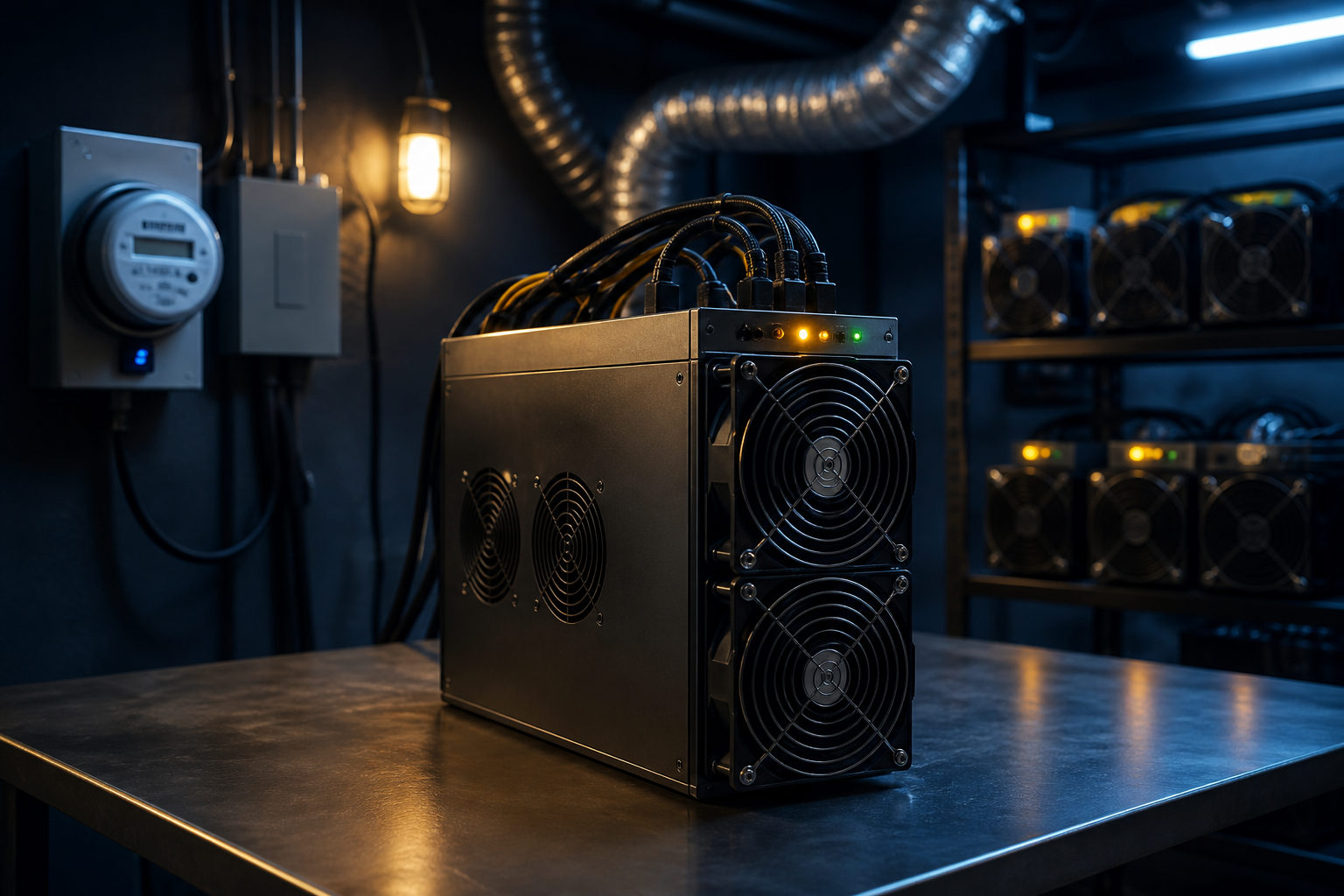
Can individuals mine Bitcoin profitably in 2026? Yes, in some cases, but profitability depends far more on electricity cost, machine efficiency, uptime, and operating discipline than on enthusiasm.
A simple way to understand Bitcoin mining is to picture a nonstop bookkeeping race. Transactions enter the network, miners compete to package them into a valid block, and the winner gets the block reward plus transaction fees under Bitcoin's rules. That sounds straightforward. The hard part is that this race rewards efficient operations, not casual participation.
What individual Bitcoin mining actually means
Bitcoin began with the genesis block in January 2009. Its creator used the name Satoshi Nakamoto, and that identity remains unknown. The system was designed so participants could help secure the network without asking a central operator for permission. Mining is the process of using computational work to compete for the right to add the next block.
Miners gather pending transactions into a candidate block and keep trying different values until they produce a result that meets the network's requirements. On average, a new block is found about every 10 minutes. That does not mean every miner gets a turn. It means everyone is competing at once, all the time.
Bitcoin's monetary policy also shapes the economics. The supply cap is 21 million coins. The block subsidy is cut in half about every 4 years, or every 210,000 blocks. The halving years so far are 2012, 2016, 2020, and 2024. For an individual miner, that matters because reward conditions do not stay constant, and weaker setups become harder to justify over time.
Why being able to mine is not the same as mining profitably
Many people ask whether they can mine Bitcoin profitably in 2026 when what they really mean is this: can the value of what I earn cover the full cost of what I run? That answer changes from one person to another because the cost structure is different in every setup.
Electricity is usually the first filter
Mining equipment runs for long periods, so power cost is not a side issue. It is often the core expense. A machine that looks acceptable on paper can still fail economically if the electricity rate is too high or if the power supply is unstable enough to cause repeated downtime.
This is where individuals often start at a disadvantage compared with larger operations. Bigger sites may have better power arrangements and more controlled environments. A home miner or small operator rarely gets the same margin for error.
Hardware efficiency decides whether you can stay in the race
Bitcoin mining is no longer a task for ordinary personal computers. In practice, people who mine Bitcoin use specialized ASIC hardware. The more efficient the machine, the more hashpower it can deliver for a given amount of electricity. Older equipment may still function, but functioning and competing are two different things.
For individuals, hardware quality is not only about the model name. It also includes machine condition, fan health, power supply stability, firmware settings, and how well the unit performs under sustained heat. A weak machine can keep running and still make the whole operation unattractive.
Heat, noise, and maintenance are real constraints
New miners often focus on purchase price and ignore what daily operation looks like. ASIC miners generate heat and noise. They need stable internet access and a location that can support continuous operation. In a home setting, these issues can quickly become the deciding factor.
If cooling is poor, machines may throttle, disconnect, or shut down. Every interruption cuts into effective mining time. In a business where the equipment needs to stay online, downtime is not a minor inconvenience. It directly affects the chance of earning enough to justify the setup.
Network competition keeps changing
Your machine may stay the same while the network around you does not. Bitcoin mining is a global competition. If more efficient operators join or existing operators expand, the relative position of a small miner can worsen even without any mistake on the miner's side.
That is why profitable Bitcoin mining for individuals is not a one-time buying decision. It is an ongoing operational question. The setup has to keep making sense as conditions change.
How individuals can participate in 2026
A better question than whether an individual can mine Bitcoin profitably is which participation model fits that person best. The main options come with different trade-offs in control, complexity, and risk.
Buy and run your own machine
This gives the highest level of control. You choose the hardware, location, network settings, and maintenance routine. You also deal with every practical issue yourself, including noise, airflow, troubleshooting, and possible equipment failure.
This route suits people who are comfortable with hardware, home networking, and ongoing monitoring. The upside is transparency. The downside is that there is nowhere to hide from the operational burden.
Join a mining pool
For most individuals, pool mining is more realistic than solo mining. A single small miner has a very uneven chance of finding blocks alone. Pooling combines hashpower from many participants and distributes rewards according to the pool's rules, making returns less erratic in practice.
That does not remove risk. It changes the pattern of payouts and introduces reliance on the pool's structure, policies, and account security. Even so, for small operators, it is commonly the more practical choice.
Use hosted mining or colocation
Some individuals place machines in a professional facility instead of running them at home. The host may handle power, cooling, network access, and basic maintenance. This can solve the home noise and heat problem, but it introduces a new set of concerns.
You have less direct control over the equipment. You depend on the provider's reliability, service standards, and communication. Hosted mining is not a shortcut to easy profit. It is a different risk arrangement.
Avoid products that market mining like passive income
If a service presents Bitcoin mining as effortless, stable, or close to guaranteed, caution is justified. Real mining is capital-intensive and operations-heavy. It depends on hardware, energy, and execution. Any pitch that hides those realities is leaving out the most important part.
What an individual should check before trying to mine profitably
Before thinking about earnings, an individual miner should test the basic assumptions of the setup. If these points are unclear, the operation is not ready for a serious decision.
- Power cost and power stability: Expensive electricity can erase the economic case, and unstable power can ruin uptime.
- Machine efficiency and condition: The model matters, but so do wear, repair history, and real operating stability.
- Location suitability: Ventilation, noise tolerance, and electrical capacity all shape the outcome.
- Maintenance ability: Someone has to handle disconnects, firmware settings, pool configuration, and faults.
- Risk tolerance: Mining conditions can change, and equipment value can fall.
- Exit plan: If the setup stops making sense, you need a practical way to stop, sell, or repurpose equipment.
Most unsuccessful small mining attempts do not fail because the owner misunderstood the basic idea of Bitcoin. They fail because one weak point in the setup keeps dragging down the rest. Cheap hardware with expensive power is a problem. Good power with poor cooling is another. A solid machine with no maintenance discipline can still underperform.
Common mistakes people make when judging mining profitability
The first mistake is assuming that a stronger Bitcoin price automatically means mining will be profitable. Price matters, but cost matters just as much. Electricity, downtime, maintenance, pool policies, and hardware depreciation can consume the room you thought you had.
The second mistake is treating a working machine as a working business. A miner that powers on and produces hashpower has only cleared the first step. The harder question is whether it can operate cleanly and consistently enough to make sense over time.
The third mistake is ignoring opportunity cost. Money and attention spent on mining are not available for other approaches, including simply buying and holding Bitcoin. For some people, direct ownership may fit their skills and risk tolerance better than managing machines.
FAQ
Is solo Bitcoin mining realistic for one person in 2026?
For most individuals, solo mining is possible in theory but hard to justify in practice. The chance of highly uneven results is a major issue when your share of total network hashpower is small.
That is why many people choose a mining pool instead. It does not guarantee profit, but it usually makes participation less unpredictable.
Can I mine Bitcoin profitably at home?
Some people can, but home mining depends on conditions that many households do not have. Noise, heat, airflow, electrical limits, and internet stability all matter.
If your location cannot support long continuous operation, the setup may be frustrating even before the economics are considered. Home mining should be tested as an environment question first.
What matters more in 2026: the miner model or the power bill?
Both matter, but power cost often becomes the harder boundary. A strong machine can still disappoint if electricity is expensive or unstable.
The best way to think about it is that efficient hardware gives you a chance, while favorable power conditions help you keep that chance. You usually need both.
Is joining a mining pool better than mining alone?
For most individuals, yes. Pool mining usually creates a smoother reward pattern than mining alone with a small setup.
You still need to review pool rules, payout methods, and account security. A pool can improve practicality, but it does not replace due diligence.
How should I decide whether mining is worth trying?
Start with a full operating checklist rather than with a profit story. Look at electricity, machine condition, cooling, uptime expectations, maintenance effort, and how you would exit if the setup no longer works for you.
If those answers are weak or incomplete, waiting is often the better choice. A disciplined no is usually cheaper than an impulsive yes.
If you are evaluating individual Bitcoin mining for 2026, do three things before buying anything: confirm your power conditions, confirm your operating environment, and confirm who will handle maintenance when something goes wrong. If those pieces are not clear, the decision is not ready.
Disclaimer: This article is for informational and educational purposes only and is not investment, financial, or legal advice. Crypto assets are highly volatile and you could lose your entire investment. Do your own research and decide carefully.