
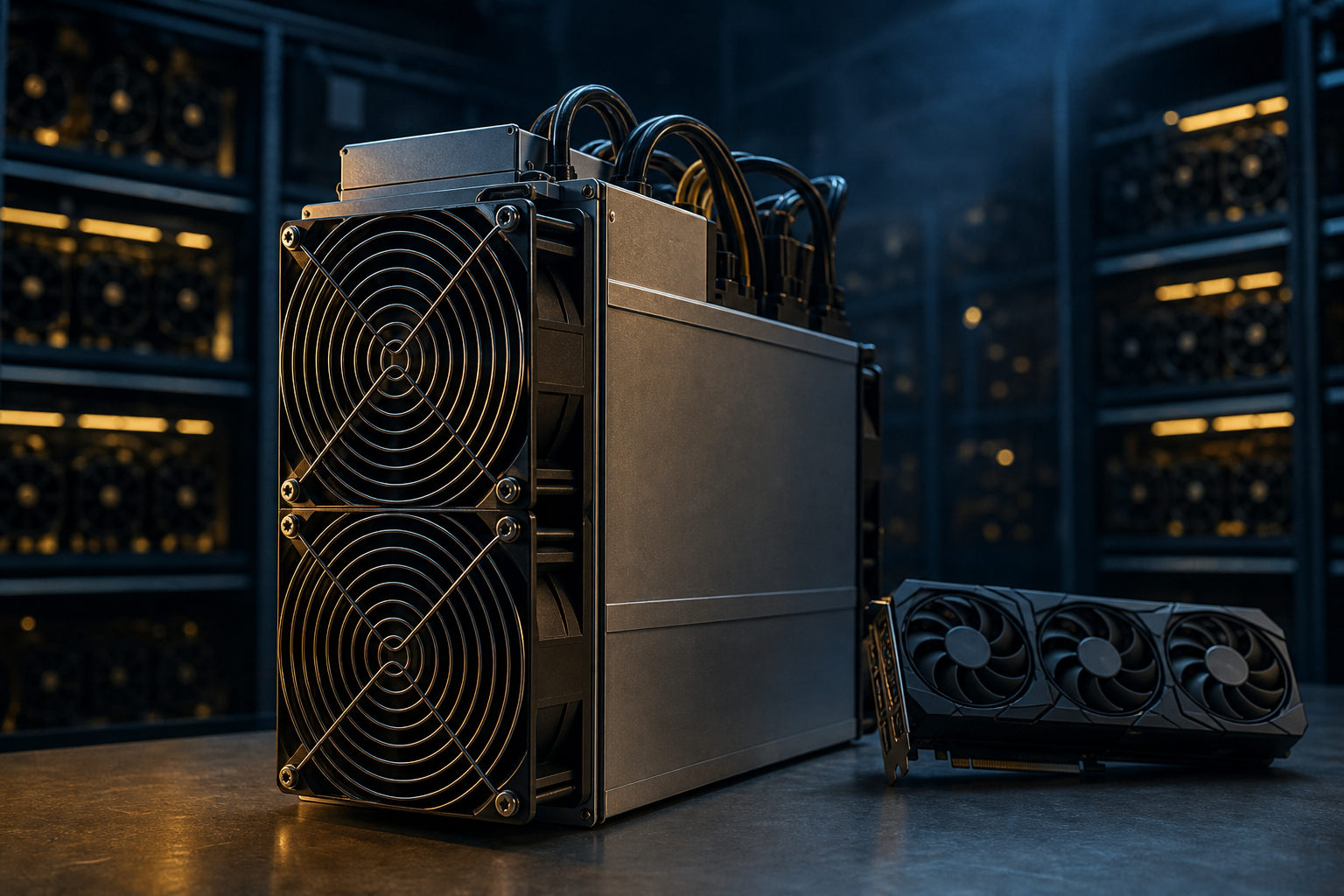
In 2026, GPU mining Bitcoin is usually not competitive. If your goal is to mine Bitcoin directly, the practical discussion is no longer GPU versus GPU; it is GPU versus ASIC, and ASIC is built for this race.
A simple way to picture Bitcoin mining is to treat it like a nonstop bookkeeping contest. Miners around the world compete to package transactions into a block and add that block to the chain. Bitcoin produces a new block about every 10 minutes, so the race does not pause. It runs all day, every day.
That framing matters because the tools used in the race have changed over time. General-purpose hardware once had a role, and GPUs remain useful in many computing tasks. Bitcoin mining, though, has long moved toward application-specific integrated circuits, or ASICs. These machines are designed for one narrow job, and that specialization is the reason the question “is gpu mining bitcoin profitable 2026 asic only” usually leads to a blunt answer: for direct Bitcoin mining, GPUs are on the wrong side of the hardware gap.
Why GPUs struggle against ASICs in Bitcoin mining
Bitcoin uses proof of work. Miners keep trying different outputs until one of them finds a result that meets the network’s target for the next block. There is no creative shortcut in that process. What matters is doing the required computation efficiently, consistently, and at scale.
GPUs are strong because they can handle many parallel workloads. That makes them useful for graphics, rendering, machine learning, and some other forms of crypto mining. Bitcoin mining is different in one important way: the market around it has had years to optimize for a single task. ASICs are not just faster graphics cards. They are purpose-built chips for a specific algorithm, which gives them a structural edge in the exact work Bitcoin miners perform.
That edge changes the economics. A GPU might still be able to perform the computation in a technical sense, but that is not the same as being viable in a live mining environment. Once the network is dominated by specialized hardware, a general-purpose device is competing at a disadvantage before electricity, cooling, and downtime are even considered.
So the better question is not whether a GPU can mine Bitcoin at all. The better question is whether a GPU can compete in an ASIC-led network strongly enough to justify the effort and operating costs. For most people, the answer is no.
What “profitable” really depends on in 2026
Many beginners focus on one thing: the price of the machine. After that, they jump straight to payback expectations. That misses the bigger picture. Mining is closer to running a small ongoing operation than buying a gadget and pressing a button.
Even without using any live revenue data, you can still break the decision into real cost categories.
Electricity
Mining hardware runs for long periods, and power cost is one of the main variables that never goes away. If your hardware is already less efficient than the market standard, electricity makes the weakness more visible. This is one of the main reasons a GPU setup struggles in direct Bitcoin mining.
Hardware efficiency and wear
Mining hardware is not a static asset. Fans wear down, thermal performance changes, dust builds up, and power delivery quality matters over time. There is also the simple reality that hardware competition does not stop. If the broader market moves toward better ASIC models, older and less specialized gear can lose ground even if it still functions.
Cooling, noise, and physical space
People often underestimate the physical side of mining. Continuous operation creates heat and noise. A setup that looks manageable on paper may be unpleasant in a home or apartment. Ventilation, wiring, room temperature, and maintenance access all matter.
Network stability and pool participation
Most miners do not rely on solo mining. They join pools to smooth out variance. That means configuration quality, uptime, and connection stability are part of the job. A machine that keeps dropping offline is not just annoying; it directly weakens the whole setup.
Put those pieces together and the meaning of “profitable” becomes clearer. It is not just about whether a device can produce hashes. It is about whether the entire operation can remain competitive in an environment where ASICs set the standard.
If you already own a GPU, what are the realistic options?
Owning a GPU does not mean you have no useful path forward. It means you should separate “participating in Bitcoin” from “mining Bitcoin directly with a GPU.” Those are different decisions.
- Learn the mining model first. Understand blocks, mining pools, network difficulty, proof of work, and halving before buying or repurposing hardware.
- If your goal is direct Bitcoin mining, research ASIC setups. That includes power availability, cooling, noise tolerance, maintenance time, and local compliance requirements.
- Use a GPU where it still has a clear edge. Rendering, video workflows, development, and machine learning are obvious examples. A GPU is not worthless; it is just not well matched to modern Bitcoin mining.
- Separate mining from ownership. Some people say they want to mine Bitcoin when what they really want is exposure to Bitcoin itself. Those are very different choices with different costs and responsibilities.
That distinction matters. Running mining equipment means you are operating hardware, managing heat, handling downtime, and monitoring a process. Holding Bitcoin is a different kind of decision entirely.
Common mistakes people make when thinking about GPU mining Bitcoin
The first mistake is confusing “possible” with “competitive.” A GPU may be able to run the relevant computation, but that does not make it a sensible tool for this market. Technical possibility is a very low bar.
The second mistake is looking only at the machine and ignoring the full system. Mining depends on stable power, decent airflow, acceptable noise, reliable internet access, and time for upkeep. Many first-time buyers assume the hard part is choosing hardware, when the harder part is keeping the setup running well.
The third mistake is ignoring the pressure created by halving cycles. Bitcoin’s supply cap is 21 million coins. The network launched with the genesis block in January 2009, and the white paper was published in 2008 under the name Satoshi Nakamoto, whose identity remains unknown. New block issuance is reduced about every 4 years, or every 210,000 blocks, with halving years including 2012, 2016, 2020, and 2024. That does not mean every miner becomes unviable overnight, but it does mean efficiency matters even more after each cut in block subsidy.
The fourth mistake is assuming cheap power alone fixes everything. Lower electricity cost helps, of course, but it does not erase hardware inefficiency, noise issues, downtime, cooling limits, or maintenance demands. One favorable variable cannot automatically rescue a weak overall setup.
FAQ
Can a home GPU still mine Bitcoin directly in 2026?
In a narrow technical sense, that is not the useful question. In practical terms, a home GPU is usually not a competitive tool for direct Bitcoin mining because the network is largely driven by ASIC hardware.
Why is Bitcoin mining talked about as an ASIC business now?
Because Bitcoin mining has become highly specialized over time. ASICs are designed for the exact computation the network requires, so they generally outperform general-purpose hardware in this specific task.
If I already own a GPU, does that make Bitcoin mining a low-cost experiment?
Not really. You may avoid a fresh hardware purchase, but electricity, cooling, noise, internet stability, maintenance, and opportunity cost still exist. On top of that, the GPU is still the weaker tool for this job.
Should a beginner buy a miner for Bitcoin at all?
Only after checking the operating conditions first. Power capacity, heat management, sound tolerance, reliable uptime, and the time needed for maintenance often matter more than the machine name on the box.
Where should I check the live Bitcoin price if I want current data?
Use major market data platforms or large trading services that show real-time spot pricing and clear timestamps. Compare more than one source, because small differences between platforms are normal.
If you are seriously considering mining, make a checklist before spending anything: hardware type, power access, ventilation, noise tolerance, internet stability, and who will maintain the setup. If several of those points are still unclear, waiting is usually the smarter move than forcing a weak GPU setup into an ASIC-dominated market.
Disclaimer: This article is for informational and educational purposes only and is not investment, financial, or legal advice. Crypto assets are highly volatile and you could lose your entire investment. Do your own research and decide carefully.