
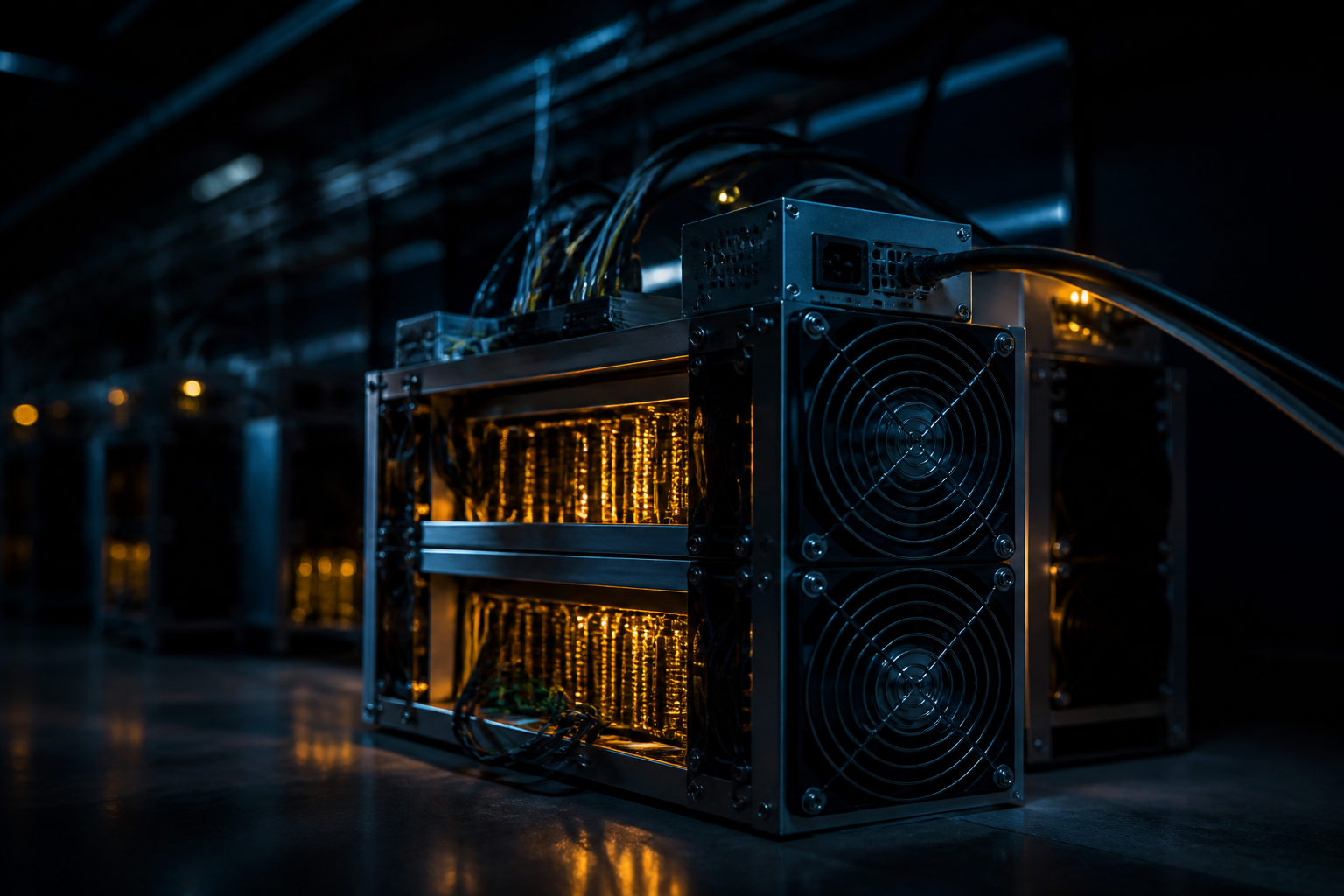
Are there any more bitcoins to mine? Yes. New bitcoin is still issued with each valid block, but the supply schedule slows over time, and taking part in mining today is far more demanding than many beginners expect.
Think of mining as a contest to win the next page of the ledger
Bitcoin runs on a public ledger that needs constant updating. Transactions have to be grouped, ordered, and confirmed before the network can treat them as final. Mining is the process through which participants compete to add that next block of transactions to the chain.
A useful way to picture it is a bookkeeping race. Many miners are trying to package transactions into a block and produce a result that fits the network rules. When one miner finds a valid result first, the rest of the network can check it quickly. If it passes verification, that block is added to the chain, and the winning miner can receive the block reward along with transaction fees.
This is why mining matters beyond coin issuance. The process gives a decentralized network a way to agree on a shared transaction history without relying on a central operator. People often describe mining as if someone is digging coins out of a hidden digital vault. That image misses the core point. New bitcoin enters circulation when blocks are added according to the protocol, so miners are competing for block production rights, not searching a hard drive for coins.
Why there are still bitcoins left to mine
Bitcoin has a fixed maximum supply of 21 million coins. That cap does not mean all coins appeared at launch. New bitcoin is released gradually as block rewards. The network produces a block about every 10 minutes, and the subsidy is cut in half every 210,000 blocks, which works out to roughly every 4 years. The halving years so far are 2012, 2016, 2020, and 2024.
That schedule explains the short answer: yes, more bitcoin can still be mined. It also explains why the question can be misleading if left there. Remaining supply and practical access are different things. A person can be right in saying there are still coins left to mine and still be wrong in assuming that mining is easy to enter.
Two forces shape the current reality. First, halvings reduce the amount of new bitcoin issued over time. Second, competition for each block is intense. As more specialized machines join the race, any single participant has a smaller chance of producing a block on their own.
There is also a built-in difficulty adjustment. When more computing power joins the network, the protocol raises the challenge so blocks do not start arriving too fast. In other words, extra machines do not cause the remaining bitcoin to be mined all at once. The system adjusts to keep block production close to its intended pace.
How people take part in bitcoin mining today
Modern mining is less about installing a program and more about deciding what role you want to play in a competitive infrastructure business. The most common paths differ in control, volatility, and operational burden.
Solo mining
Solo mining means you run your own machine or machines and compete directly with the rest of the network. If you find a block, you do not share that block reward with pool members. The tradeoff is that results can be extremely uneven. For a small participant, waiting for a block can take a very long time.
Mining through a pool
A mining pool combines the computing power of many participants. The pool works as a group to compete for blocks, then distributes earnings according to its rules and each miner’s contribution. For many users, this reduces the uncertainty that comes with mining alone. It also introduces a new set of questions: fee structure, payout method, transparency, and the reliability of the pool operator.
Running equipment yourself or using hosted facilities
Some miners keep machines on premises they control. Others place hardware in facilities that handle power, cooling, internet connectivity, and maintenance. Self-management offers direct control but also demands time and practical skill. Hosted setups can remove part of the day-to-day burden, though they add counterparty risk and require close attention to service terms, downtime policies, and custody boundaries.
For beginners, this is often the first reality check. The hard part is rarely understanding what a block is. The hard part is dealing with hardware uptime, heat, noise, electricity sourcing, wallet configuration, and routine maintenance without making expensive mistakes.
The costs that matter more than the headline question
The question “are there any more bitcoins to mine” sounds simple, but it does not tell you whether mining makes sense for your situation. The practical answer depends on a stack of real-world constraints that many introductions skip over.
Hardware is one of them. Bitcoin mining is dominated by specialized machines built for this one task. General-purpose home computers may be able to run software, but that does not give them meaningful competitive power in today’s environment. There is a big difference between being able to participate in theory and being positioned to compete in practice.
Electricity is another major factor. Mining converts continuous electrical power into continuous computation. If your power cost is high, if supply is unstable, or if outages are common, the economics become much harder to justify. Even without quoting any revenue figures, the direction is clear: sustained power demand makes electricity pricing central to the decision.
Heat and noise are not side issues. Mining machines can run hot and loud for extended periods. A home setting may not be suitable, especially if ventilation is limited or if local conditions make it difficult to manage temperature and sound. Then comes maintenance. Fans fail, power systems need attention, and aging equipment can lose ground as newer machines improve efficiency.
That is why many people ask the wrong first question. Instead of starting with the remaining supply, it is often better to ask whether you have access to stable power, a workable operating environment, solid wallet practices, and enough technical patience to manage the equipment over time.
Basic rules that help the whole picture make sense
Bitcoin began with the genesis block in January 2009. Its creator used the name Satoshi Nakamoto, though the person or group behind that name remains unknown. The design was introduced in the 2008 white paper, Bitcoin: A Peer-to-Peer Electronic Cash System. This background matters because mining was built to do two jobs at once: issue new coins and protect the integrity of the ledger.
A miner’s block reward includes newly issued bitcoin and transaction fees. As halvings continue, the newly issued portion declines, which means fees become relatively more important over time. For readers trying to understand the system, this is a better frame than focusing only on whether new coins still exist.
Bitcoin is also divisible. The smallest unit is 1 satoshi, equal to one hundred millionth of a BTC. That detail helps explain how a fixed-supply asset can still be used in small amounts. Divisibility does not expand total supply; it simply allows finer transfers and accounting.
FAQ
Can you still start mining bitcoin now?
Yes, mining is still possible because the network is still producing new blocks and issuing new bitcoin. Whether it is a sensible move for you depends on equipment, electricity, cooling, uptime, and your ability to handle the operational side.
When will all bitcoins be mined?
The protocol slows new issuance over time through halvings, so supply approaches the cap gradually rather than arriving all at once. For most readers, it is more useful to understand that schedule than to fixate on a single end date.
Can a home computer still mine bitcoin?
In a technical sense, a computer can run mining-related software. In a competitive sense, ordinary home hardware usually does not have a realistic edge against specialized machines already operating on the network.
Is joining a mining pool the better option?
For many smaller participants, a pool is the more practical route because it smooths out results and avoids the all-or-nothing wait of solo mining. You still need to study the pool’s rules, fees, and payout approach before committing resources.
If I do not want to mine, how else can I get bitcoin?
You can buy BTC through a compliant exchange or accept it as payment for goods and services. For most people, learning wallet security, private key handling, and how to check live market prices is more useful than learning mining hardware specifications.
If you are seriously considering mining, make a checklist before buying anything: power conditions, cooling, noise tolerance, machine upkeep, wallet setup, and your tolerance for ongoing operational work. Those points will tell you more than the headline question ever can.
Disclaimer: This article is for informational and educational purposes only and is not investment, financial, or legal advice. Crypto assets are highly volatile and you could lose your entire investment. Do your own research and decide carefully.