
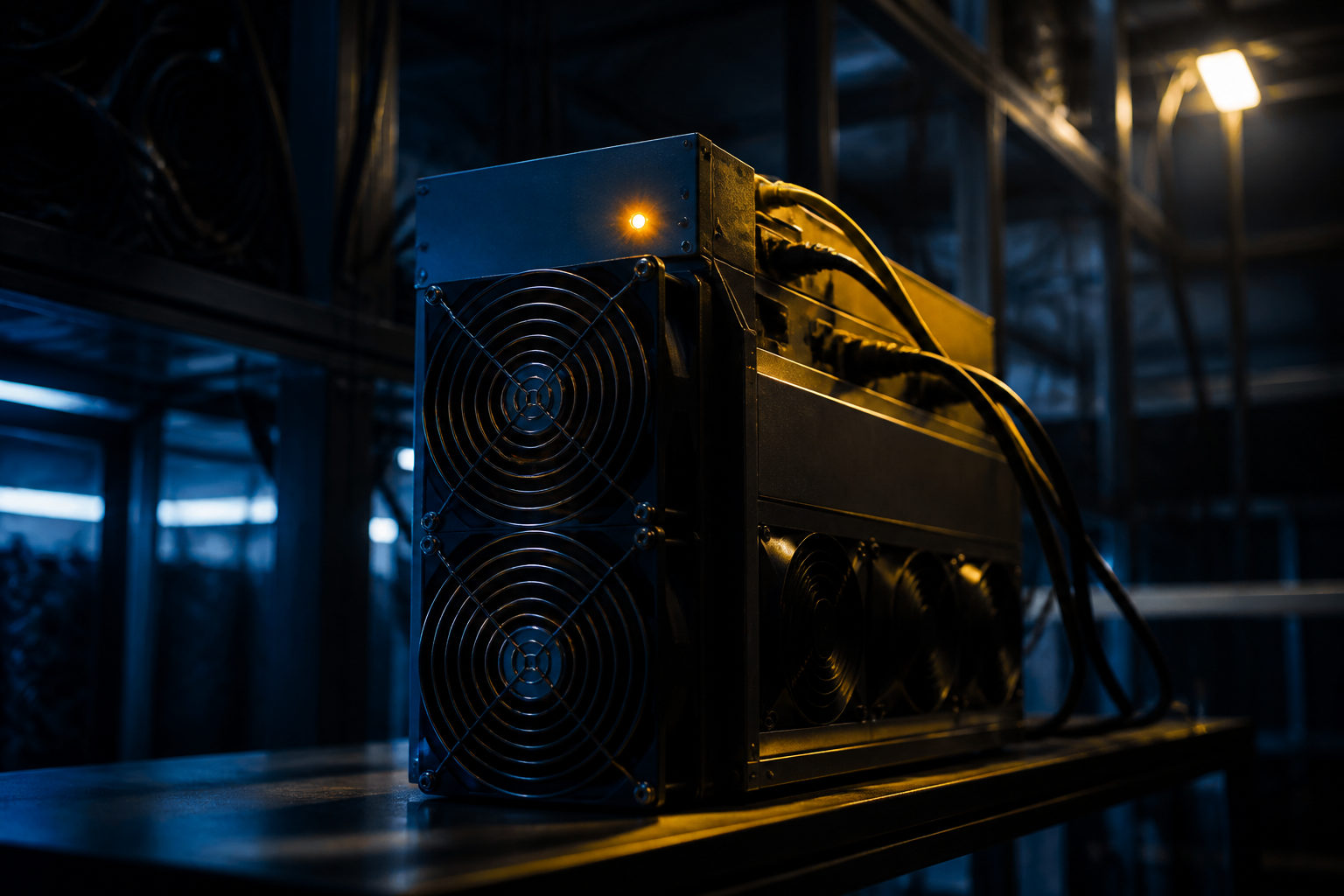
Yes, people are still mining Bitcoin today. Bitcoin mining never stopped, but the center of gravity moved from hobbyist computers to specialized machines, mining pools, and operators who can manage power, cooling, and uptime.
Why Bitcoin still needs miners
A simple way to picture Bitcoin is to think of an ongoing race to update a public ledger. New transactions need to be grouped into a block, checked against the network rules, and added to the blockchain. Miners compete for the chance to do that work.
Mining serves two jobs at the same time. It keeps new blocks coming, and it makes the ledger harder to rewrite after the fact. If someone wanted to alter past records, they would have to overcome the network's accumulated work. That security model depends on miners continuing to participate.
Bitcoin has been running since the genesis block in January 2009. Its design expects blocks to keep arriving over time, often described as about one block every 10 minutes. As blocks are added, the chain extends and the record of confirmed transactions grows with it.
What miners are actually doing
The word “mining” can be misleading if you take it too literally. Miners are not digging coins out of a hidden vault. They are using computing power to compete for block production under Bitcoin's proof-of-work rules, and the network rewards that work because it helps process transactions and protect the chain.
In practice, mining starts with candidate blocks. A miner or pool gathers pending transactions, builds a block template, and keeps running calculations in search of a valid result. When one participant finds a valid block first, it broadcasts that block to the network. Other nodes verify it, and if the block passes validation, it becomes part of the blockchain.
This is why mining is tied to probability. There is no turn-taking system and no guaranteed schedule for an individual machine. A stronger setup usually has a better chance of finding blocks over time, but the competition is network-wide, and difficulty adjusts as conditions change.
Bitcoin's supply schedule shapes the business side of mining as well. The total supply is capped at 21 million coins. The block subsidy is cut in half about every 4 years, or every 210,000 blocks. The halving years so far are 2012, 2016, 2020, and 2024. That means miners have to operate in an environment where newly issued coins become less generous over time, which puts more attention on efficiency and transaction fees.
Why people still mine, but casual solo entry is much harder
The short answer is that mining is still active because Bitcoin still needs block producers and because some operators can run the process at a scale that makes sense for them. The harder question is whether an ordinary person can compete from home under current conditions.
Mining looks like a pure computing contest from a distance, yet the real bottlenecks are often operational. Power quality matters. Cooling matters. Network stability matters. Machine uptime matters. Maintenance matters. A machine that sits offline, overheats, or runs inefficiently is not doing useful work no matter how expensive it was to buy.
This is where many first-time readers hit a gap between theory and practice. In theory, any compatible hardware can try to participate in the network. In practice, modern Bitcoin mining is dominated by application-specific machines built for that exact task. General-purpose home computers usually do not have a realistic position in that competition.
Running a miner also changes the physical environment around it. These machines can produce substantial heat and noise. A residential setting may not be suitable for long stretches of operation. Then there is the less visible side of the job: firmware management, fan issues, dust control, cable reliability, circuit limits, and the need to react quickly when something stops behaving normally.
That helps explain why professional operations continue to exist. Larger operators can organize space more efficiently, negotiate for suitable power arrangements, deploy maintenance routines, and reduce downtime through experience. A smaller participant can still join the network, but scale and execution now matter far more than they did in Bitcoin's early years.
How people participate in Bitcoin mining today
If your question is whether anyone still mines Bitcoin, the answer is clearly yes. If your next question is whether you can take part, the answer depends on which route you mean. The common paths are quite different in terms of control, workload, and risk.
Running your own machine
This is the most direct form of participation. You buy the hardware, place it somewhere, connect it, monitor it, and deal with every practical issue yourself. That gives you the highest level of control because you can see the equipment and make every decision around it.
The tradeoff is that all the friction stays with you as well. You need to understand the machine's operating state, deal with power and cooling, and handle failures instead of assuming they will sort themselves out. For some people, that is the point: they want hands-on exposure to how mining works. For others, it becomes a constant maintenance burden.
Joining a mining pool
Mining pools changed the experience for smaller participants. Instead of waiting for a single machine to find a block on its own, many miners combine their hash power and share the outcome according to the pool's payout rules. That can make results feel less erratic because rewards are tied to collective performance rather than one machine's rare success.
Still, not all pools feel the same in day-to-day use. Payout methods differ. Fee structures differ. Monitoring tools differ. Minimum withdrawal conditions and service stability differ. Two pools may look similar from a distance and create very different experiences over time.
Using hosted or managed setups
Some people prefer not to deal with heat, noise, space limits, or electrical planning at home. In that case, they may look at hosting, where the machine is placed in a third-party facility. This can remove some operational hassle, but it also introduces trust issues that are easy to underestimate.
You need clarity on who owns the machine, what happens during downtime, how repairs are handled, how performance is monitored, and how you exit the arrangement if you want to stop. If you cannot independently confirm that the machine is running as described, your risk increases fast.
The cost reality matters more than the idea of mining
Many people approach Bitcoin mining with one question in mind: can it make money. That question is too narrow if it comes first. Before any return discussion, you need to know whether you can operate the system reliably and whether the conditions around you support that effort.
- Power setup: Stable electricity and a suitable circuit are basic requirements for continuous operation.
- Cooling: If heat is not managed well, a machine may throttle, error out, or stop repeatedly.
- Machine wear: Mining hardware runs under sustained load, so degradation and failure risk are part of the picture.
- Maintenance skill: Knowing how to spot and respond to fan, network, firmware, or power issues affects uptime.
- Network conditions: Difficulty changes, fee activity, and halving cycles all shape the mining environment.
Seen from that angle, mining is less like buying a gadget and more like operating a small technical system. People who skip that mental shift often misjudge what they are getting into.
How to judge whether a mining offer is credible
Bitcoin mining attracts straightforward operators and questionable offers at the same time. If a pitch sounds effortless, guaranteed, or detached from the physical realities of hardware and electricity, it deserves extra scrutiny. Mining depends on real machines doing real work under real constraints.
Useful questions are simple. What machine is being used. Who owns it. How are fees broken down. What happens when the hardware goes offline. How is maintenance billed. Can you see persistent monitoring data. How do you leave the arrangement. Vague answers on basic points usually signal higher risk later.
Another source of confusion is the idea that cloud mining always gives you the same position as owning a machine. It does not. Control matters. Verification matters. Your ability to inspect performance and make decisions about the equipment changes the risk profile in a major way.
FAQ
Can an individual still mine Bitcoin now?
Yes, an individual can still participate, but doing it alone is much harder than it used to be. Most people who try today end up learning about pools, machine management, and operating costs very quickly.
Can I mine Bitcoin with a home computer?
You can use a home computer to understand the idea at a basic level, but that is very different from competing in the current network. Modern Bitcoin mining is centered on specialized hardware built for that single task.
Does joining a mining pool make it easy?
A pool can smooth out the reward pattern by sharing outcomes across many participants. It does not remove your need to deal with power, cooling, hardware quality, or maintenance if you are running the machine yourself.
Is mining Bitcoin the same as buying Bitcoin?
No. Buying Bitcoin means acquiring coins directly in the market. Mining means running hardware and participating in the network's block production process under its rules.
Where should I check the live Bitcoin price?
If you want to know the current market price, use a major market data platform or a trading service with live quotes. For mining decisions, price is only one input; operating conditions and equipment performance matter just as much.
If you are seriously considering Bitcoin mining, start by listing your actual constraints before you look at machines. Check your power situation, cooling options, tolerance for noise, willingness to maintain hardware, and ability to evaluate pool or hosting terms. That checklist will tell you more than any sales pitch.
Disclaimer: This article is for informational and educational purposes only and is not investment, financial, or legal advice. Crypto assets are highly volatile and you could lose your entire investment. Do your own research and decide carefully.