
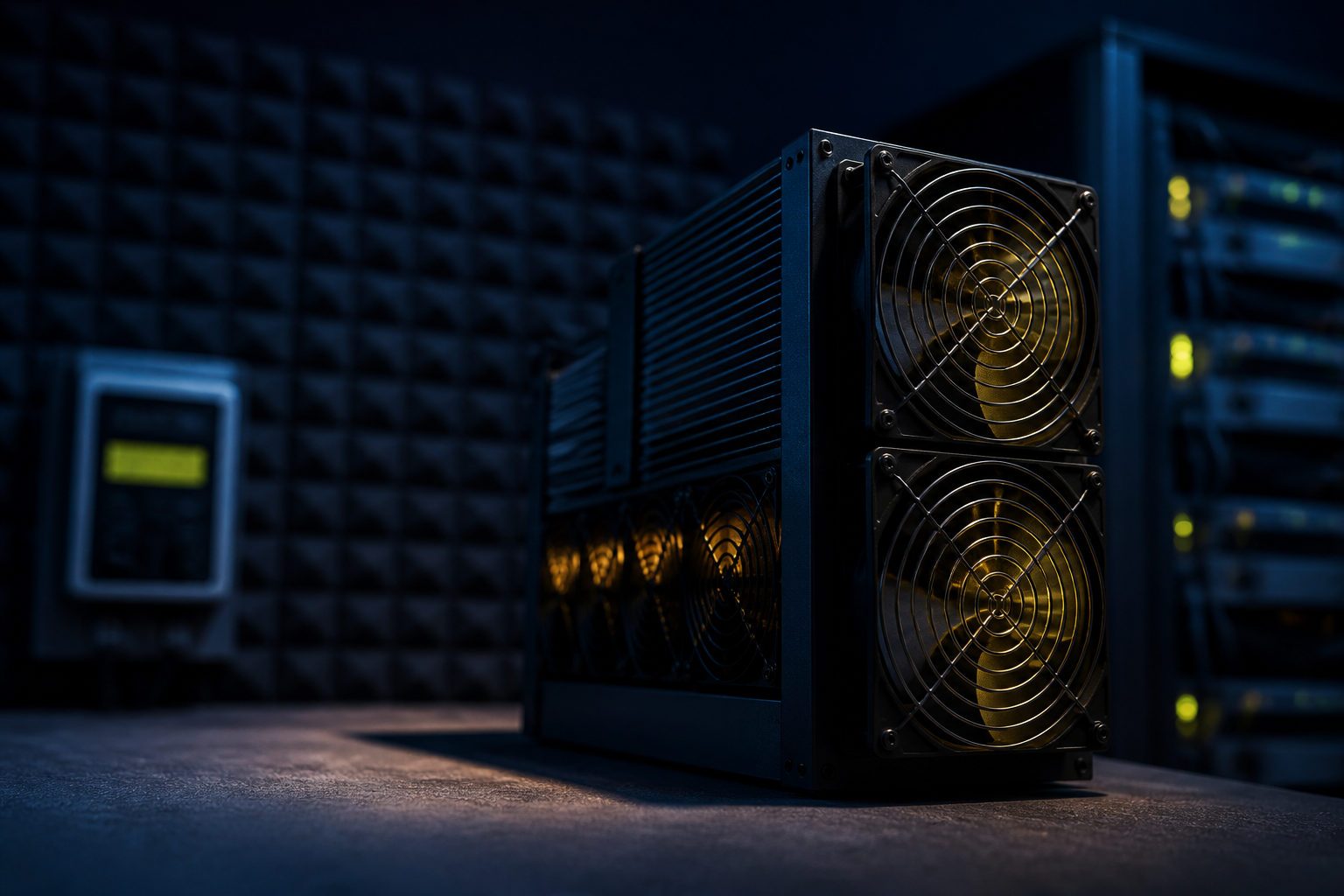
A good bitcoin miner is the one that fits your power cost, heat limits, noise tolerance, and operating plan, not simply the one with the biggest specs.
What a bitcoin miner actually does
It helps to picture Bitcoin as an ongoing bookkeeping race. Miners compete to package recent transactions into a new block by performing repeated hash calculations under the network's rules. When a valid result is found, that block can be added to the chain, and the miner receives the block reward plus transaction fees.
Bitcoin has used proof of work since the genesis block in January 2009. A new block is produced about every 10 minutes on average, and mining difficulty adjusts as total network participation changes. That means a miner is not creating coins out of thin air; it is supplying computing work to compete for the right to add a block.
This is why the phrase “a good bitcoin miner” needs context. Hardware is only one piece of the decision. The better question is whether a machine can keep running in your real environment without turning power, heat, noise, and maintenance into constant problems.
What makes a bitcoin miner good
A useful way to judge mining hardware is to look at four things together: algorithm fit, efficiency, stability, and serviceability. Bitcoin mining is done with specialized ASIC machines, not with ordinary laptops or standard consumer desktops in any practical sense. So the first check is simple: is the unit actually built for Bitcoin mining?
After that, efficiency matters because power use is an ongoing cost. A machine with strong paper performance can still be a poor choice if it consumes too much electricity for your setup. Stability matters just as much. A miner that overheats, drops offline, or develops fan and control board issues will not deliver the steady output its spec sheet suggests. Then there is serviceability: access to parts, firmware support, repair options, and how hard it is to diagnose faults when something goes wrong.
| Factor | Why it matters | What to check |
|---|---|---|
| Algorithm fit | The machine must be built for Bitcoin mining | Confirm that it is an ASIC intended for the Bitcoin network |
| Efficiency | Power cost keeps showing up over time | Compare hash rate and power draw together, not in isolation |
| Stability | Downtime cuts real output | Cooling design, operating reputation, and fault behavior |
| Noise and heat | These decide whether the unit fits your location | Ventilation, sound control, and room separation |
| Serviceability | Repairs and updates affect long-term usability | Parts availability, firmware support, and repair access |
| Operating model | Your setup changes what “good” looks like | Home use, self-managed site, or hosted mining |
That is why there is no single best answer for everyone. Someone with limited space and high residential power costs may care more about hosting options and operational simplicity. Someone with dedicated space may care more about uptime, airflow design, and how quickly faults can be fixed.
Common ways to take part in bitcoin mining
People often talk as if buying a miner is the whole decision. In practice, the larger question is how you plan to run it. For individuals, the usual choices are home operation, self-managed space, or hosting through a third party.
| Approach | Who it suits | Main advantage | Main challenge |
|---|---|---|---|
| Running at home | People who want direct hands-on experience | You learn fast because you see every operating issue yourself | Noise, heat, airflow, and power load can disrupt daily life |
| Self-managed site | People with dedicated space and technical control | You control cooling, networking, and machine handling | Setup and maintenance remain your responsibility |
| Hosted mining | People who do not want machines in their living space | Power, cooling, and routine handling are often easier to manage | You must judge the provider's reliability and operating terms |
If your goal is to understand how mining hardware works, running one unit yourself for a short period can be instructive. If your goal is ongoing participation, hosting is often the more realistic route because the physical side of mining gets serious very quickly.
Another practical point is pool mining. Many miners join a mining pool so their computing power is combined with others and rewards are distributed under the pool's rules. That does not remove operating risk, but it can make results less uneven than trying to mine entirely on your own. Pool choice should be judged by transparency, connection stability, payout rules, and whether the management interface is clear enough to spot problems early.
The cost reality most beginners miss
The machine itself is only the starting line. Ongoing power use is obvious, but it is not the only pressure point. You also need to think about ventilation, dust control, fan wear, repairs, replacement parts, shipping risk, and the cost of downtime when a unit is not hashing as expected.
Environment matters more than many first-time buyers expect. Bitcoin miners are loud, they push out concentrated heat, and they do not blend into normal household conditions well. If the room traps heat, collects dust, or cannot handle the electrical load, the miner may throttle, fail, or become too disruptive to keep running.
| Cost or limit | Typical mistake | Better way to judge it |
|---|---|---|
| Power | Focusing only on the purchase price | Check long-run electricity cost and whether your wiring can handle the load |
| Cooling | Assuming a basic fan solves everything | Look at heat exhaust paths and sustained operating conditions |
| Noise | Thinking any spare room will do | Decide whether you truly have isolated space or need hosting |
| Maintenance | Assuming steady operation with no interruptions | Plan for cleaning, parts replacement, and repair delays |
| Networking | Ignoring the impact of connection drops | Use a stable connection and make remote monitoring easy |
| Used hardware | Buying on price alone | Check wear, repair history, real-world stability, and noise |
There is also a structural issue tied to Bitcoin itself. The maximum supply is capped at 21 million coins, and the block subsidy is cut in half about every four years, or every 210,000 blocks. Halvings have already taken place in 2012, 2016, 2020, and 2024. That means mining conditions change over time, so a machine that looks acceptable today may not stay attractive for as long as you expect.
FAQ
Can I mine bitcoin with a normal PC?
In theory, any device that can perform the required calculations can participate. In practice, ordinary consumer computers are not competitive against ASIC miners, so they are better for learning than for serious mining.
Should I look at hash rate first or power draw first?
You need both at the same time. High hash rate without acceptable efficiency can create a bad operating profile, while low power use alone tells you little if total output is too weak for your setup.
Is a used bitcoin miner a smart buy?
It can be, but the risk is concentrated. Used units may have hidden wear, prior repairs, unstable behavior, or louder operation than expected, so inspection matters more than headline savings.
Do I need to join a mining pool?
Not by rule, but many individual miners consider it because pools combine hash power and distribute results under a known structure. Whether it fits you depends on how you balance payout rhythm, control, and operational simplicity.
How do I know if my place can handle a miner?
Start with three questions: can your electrical setup support continuous load, can you move hot air out effectively, and can you live with the noise. If one of those is a clear no, home mining is likely to become frustrating fast.
What to do before you buy anything
Make a short checklist of your own conditions before comparing machines: electricity cost, available space, ventilation, connection stability, acceptable noise level, and whether you want to handle maintenance yourself. If those basics are still unclear, test on a small scale first or compare hosting options before chasing what looks like the most powerful bitcoin miner on paper.
Disclaimer: This article is for informational and educational purposes only and is not investment, financial, or legal advice. Crypto assets are highly volatile and you could lose your entire investment. Do your own research and decide carefully.