
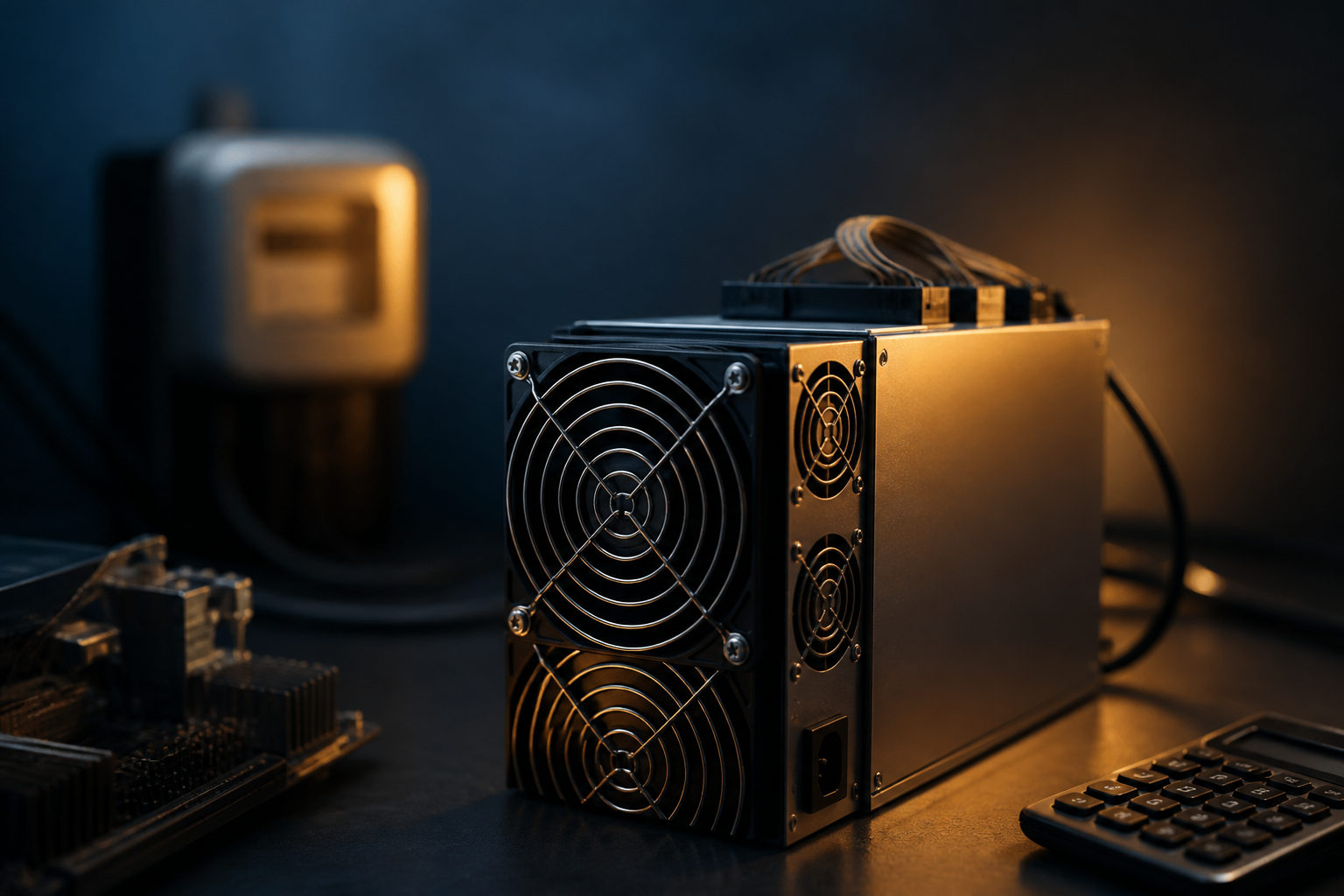
Yes, you usually have to pay to mine Bitcoin. There is no universal entry ticket, but mining is a contest for block production, and taking part means paying for hardware, electricity, cooling, connectivity, or a service that handles those pieces for you.
Think of Bitcoin mining as a bookkeeping race
Bitcoin miners compete to add new blocks to the blockchain. They run specialized machines that keep trying hashes until one participant finds a valid result under the network rules. The winner gets the chance to append the block and receive the protocol-defined reward.
This process is called proof of work. Its purpose is to make block production costly enough that no one can rewrite the ledger cheaply. The network does not rely on a central operator to pick who writes the next block; it relies on participants spending real-world resources to earn that role.
Bitcoin began with the genesis block in January 2009, following the 2008 white paper titled Bitcoin: A Peer-to-Peer Electronic Cash System. New blocks appear about every 10 minutes, the supply cap is 21 million coins, and the block subsidy is cut roughly every 4 years, or every 210,000 blocks. Halving years so far include 2012, 2016, 2020, and 2024. Those design choices shape the economics of mining over time.
What you are actually paying for
Mining is not a one-time registration fee. In most cases, the cost shows up as equipment spending, recurring utility bills, maintenance work, or fees charged by a mining pool or outside provider.
| Cost category | Why it exists | What it looks like in practice |
|---|---|---|
| Mining hardware | Bitcoin mining is dominated by specialized machines built for hashing | Upfront purchase, wear, replacement pressure |
| Electricity | Machines run continuously under heavy load | Power bills, uptime concerns, local power limits |
| Cooling and space | Mining equipment creates heat and noise | Ventilation, extra cooling gear, placement issues |
| Network and maintenance | Miners must stay online and properly configured | Downtime, troubleshooting, firmware or software work |
| Pool-related fees | Small operators often join pools to smooth out variance | Different payout rules and service charges |
Two costs are easy to miss. One is time: learning wallet setup, machine configuration, pool settings, and basic diagnostics takes effort. The other is opportunity cost: spending money on mining gear is a different decision from buying Bitcoin directly, because the risks are different from the start.
A normal home computer is generally not a practical way to mine Bitcoin today. The network has become highly competitive, and specialized hardware is the standard route.
Different ways to participate mean different kinds of spending
The better version of the question is not simply whether you must pay, but where the payment sits. Some people buy and run their own hardware. Others join a pool. Some outsource hosting, and some choose cloud-style contracts that package the operational side into a service.
| Participation route | Upfront spending | Ongoing exposure | Main trade-off |
|---|---|---|---|
| Run your own miner | Higher hardware and setup burden | You handle power, heat, noise, failures | More control, more responsibility |
| Join a mining pool | You still need your own machine | Pool rules affect payouts and fee treatment | Less variance than solo mining |
| Use hosted mining | Some physical setup is outsourced | You depend on a provider for operations | Convenience versus control |
| Buy cloud mining or contract hashpower | Lower visible setup burden | Terms can be hard to verify | Simplicity can hide major counterparty risk |
Running your own miner is the most direct approach. You control the hardware and can point payouts to your own wallet, but you also deal with noise, heat, network drops, machine failures, and the possibility that your setup becomes outdated.
Joining a pool changes the payout pattern, not the underlying economics of mining. A pool groups hashpower from many participants and distributes results by its own formula. That can reduce the long dry spells a small miner might face alone, yet it does not remove electricity costs or hardware exposure.
Hosted mining and cloud contracts can look easier because they move the operational burden elsewhere. That convenience comes with a different risk profile. You need to know who controls the machines, whether the equipment actually exists, how fees are deducted, what happens if the service stops, and how or whether you can exit early.
Why mining may be possible but still not make sense for you
People often mix up two separate questions: can I mine Bitcoin, and should I mine Bitcoin. The first is technical. The second is economic and practical. You are competing in a global system where machine efficiency, power cost, uptime, and operational discipline all matter.
Block production happens about every 10 minutes, but the network does not pause while you learn your setup. If your machine is less efficient, if your electricity is expensive, or if your environment causes frequent downtime, your cost burden rises quickly. Halvings also change the reward schedule over time, so a setup that seems acceptable at one moment may look very different later.
Mining machines are not appliances you can ignore after purchase. They create heat, generate noise, need monitoring, and can become less competitive as the broader network changes.
If your goal is education, a small experiment can help you understand what miners actually do. If your goal is sustained participation, you need a clear view of cost structure, machine management, and exit options before spending money.
What to check before you spend anything
Before buying hardware or signing up for a service, break the decision into a few plain questions. Are you trying to learn how mining works, or are you aiming to operate for a long time? Can your location handle the heat, noise, and power draw? Do you understand the rules of the pool or provider you plan to use? If you want to stop later, what does exit look like?
| Question to ask first | If you skip it | Better approach |
|---|---|---|
| Do I understand the mining flow? | You may buy gear without knowing how to configure or monitor it | Learn wallet setup, pool connection, and basic diagnostics first |
| Is my power and space suitable? | You may face heat, noise, or unstable operation | Check ventilation, placement, and power reliability beforehand |
| Am I comfortable with third-party risk? | You may depend on a provider you cannot verify well | Read terms on ownership, fees, control, and shutdowns carefully |
| Do I have an exit plan? | You may get stuck with equipment or a difficult contract | Decide in advance how you would stop, resell, or decline renewal |
It also helps to separate mining from direct Bitcoin ownership. Both relate to Bitcoin, but they expose you to different risks. Mining turns money into infrastructure and operating commitments. Buying Bitcoin gives you asset exposure without machine management.
FAQ
Can I mine Bitcoin at home?
You can try, but practicality depends on power, ventilation, heat, and noise tolerance. Many home setups fail on those basic conditions long before the software side becomes difficult.
Can a regular PC still mine Bitcoin?
In most cases, that is not a realistic route. Bitcoin mining is highly specialized now, so general-purpose computers usually struggle on efficiency and may add hardware wear without giving a useful result.
Do mining pools charge money?
Many pools have their own payout methods and fee rules, though the details differ. The important part is understanding where the fee is taken, how shares are counted, and how the pool handles payouts.
Is cloud mining a simple shortcut?
It can be simpler on the surface, but it adds counterparty risk. If a provider is vague about hardware, contract terms, payout treatment, or termination rights, convenience may come at the cost of transparency.
Do I need to mine Bitcoin to understand how it works?
No. You can learn a lot by understanding blocks, transaction confirmation, wallets, and the role miners play in proof of work. Hands-on mining is one way to learn, not a requirement.
If you want to go further, list the spending points, the control points, and the shutdown options before committing funds. For most people, that is the right first step: know exactly which cost you are agreeing to carry, and why.
Disclaimer: This article is for informational and educational purposes only and is not investment, financial, or legal advice. Crypto assets are highly volatile and you could lose your entire investment. Do your own research and decide carefully.