
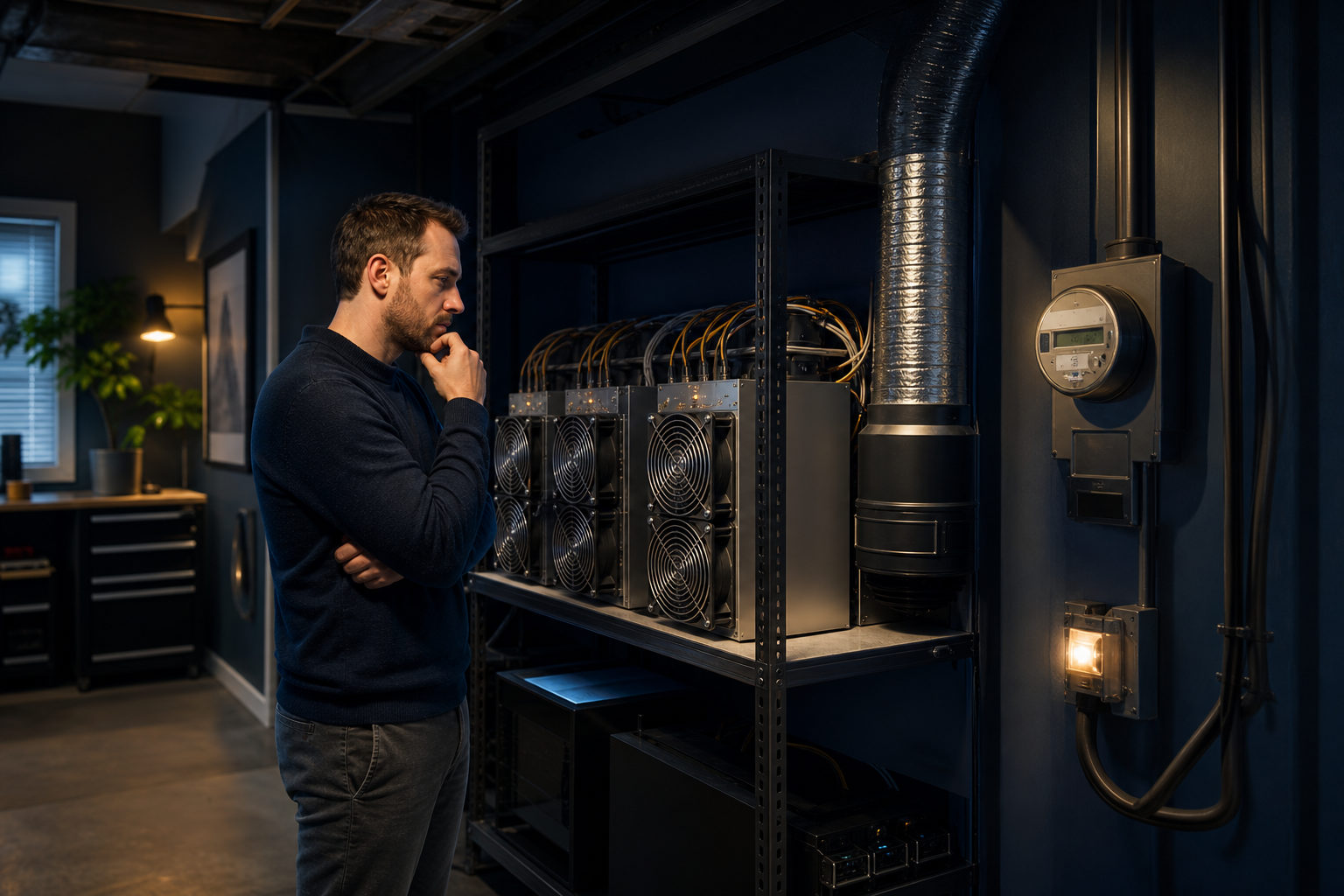
Small-scale home Bitcoin mining in 2026 can be profitable for some people, but not because a machine is simply running. The real test is whether power costs, hardware efficiency, heat control, noise, and downtime stay low enough to leave room after expenses.
A better way to understand it is to picture mining as a nonstop bookkeeping contest. Miners compete to add the next block to the Bitcoin blockchain, and the winner is not chosen by effort alone. It comes down to how much computing power you bring, how efficient that power is, and how expensive it is to keep the machine running at home.
Why mining works like a bookkeeping race
Bitcoin mining is the process of competing for block production under fixed network rules. The network produces a new block about every 10 minutes, and miners keep trying calculations until one of them finds a valid result. That process secures the chain and confirms new blocks; it is not the same as casually creating coins on a personal computer.
If you prefer a simpler analogy, think of mining as a huge draw that never stops. Every machine keeps buying chances with electricity and hardware performance. A home miner can join that race, but small-scale operators are competing with participants that often have better power arrangements, better cooling, and more specialized setups.
This is why many home miners do not mine solo. They join a mining pool, which combines computing power from many participants and distributes the outcome based on each member's contribution. A pool can smooth out payout variability, but it does not fix weak economics. If your operating costs are high, a pool only makes that reality easier to observe over time.
What decides whether home Bitcoin mining makes sense in 2026
When people ask whether home Bitcoin mining is profitable in 2026, they often focus only on Bitcoin's market price. That is not enough. Without current market data, the more useful approach is to break the problem into the parts you can actually control: energy cost, machine efficiency, home conditions, and operating discipline.
Power cost is usually the first filter
For a home setup, electricity is often the biggest operating expense. Mining hardware runs continuously, so even a modest difference in residential power rates can change the result from workable to unworkable. If your local power cost is high, your machine may still produce Bitcoin while your overall operation loses money.
There is also a practical detail many beginners miss: residential billing is not always simple. Some locations use tiered billing, time-based pricing, or other household power rules that affect the true cost of running energy-intensive hardware. Small-scale miners usually have less room to optimize than industrial operators, and that puts more pressure on the home budget.
Hardware efficiency matters more than purchase price
Bitcoin mining today is centered on ASIC miners, not general-purpose home computers. The question is not just whether a machine works. The key point is how much effective hash power it can deliver for the electricity it consumes. That ratio often matters more than getting a lower upfront deal.
This is where second-hand equipment can become a trap. A cheap machine can still be expensive if it draws a lot of power, runs hot, fails often, or becomes hard to maintain. For small-scale home Bitcoin mining, a weak hardware choice can damage the economics from day one.
Heat, noise, and uptime are part of the business model
Many people imagine home mining as a simple plug-in activity. In practice, ASIC miners generate steady heat and very noticeable fan noise. That changes daily life inside a home. Cooling, airflow, dust, room temperature, and ventilation all affect whether the machine can run consistently without thermal issues.
Uptime matters just as much. A miner that is offline is still costing you money in other ways: your capital is tied up, and the equipment is not contributing while the network keeps moving. Home setups are more exposed to router problems, power interruptions, room-temperature spikes, and basic maintenance gaps. With only one or a few machines, any outage has a larger impact.
The post-halving environment is less forgiving
Bitcoin halves roughly every 4 years, or every 210,000 blocks. Known halving years include 2012, 2016, 2020, and 2024. That mechanism reduces block rewards over time. It does not change the basic structure of mining, but it does make cost control more important for operators with weaker efficiency.
That matters for anyone thinking about home Bitcoin mining in 2026. The question is not whether mining still exists or whether people can still participate. The sharper question is whether your setup can stay competitive enough after accounting for costs that are hard to avoid in a residential environment.
Ways a small-scale home miner can participate
Not everyone who is curious about mining should bring an ASIC into the house. There is a big difference between learning how Bitcoin mining works and running mining hardware as an ongoing operation. Before spending money, it helps to decide which one you actually want.
Running your own machine at home
This is the most direct route and the most demanding one. You need to handle power availability, ventilation, internet stability, noise tolerance, cleaning, and periodic troubleshooting. That makes home mining much closer to equipment operation than passive investing.
The upside is control. You choose the machine, the settings, the pool, and the environment. The downside is that every problem lives with you too. If the unit overheats, disconnects, or needs attention late at night, there is no distance between the operation and your living space.
Using a mining pool
For a small operator, a mining pool is usually the practical choice. Solo mining with very limited hash power creates very uneven results, while a pool spreads the outcome across many participants. That makes it easier to track whether the operation is covering its ongoing expenses.
Still, a pool does not turn home Bitcoin mining into easy money. It changes how rewards are distributed, not the underlying cost structure. You still need to check payout rules, transparency, connection stability, and account security before joining one.
Doing a paper check before buying anything
For many readers, this is the smartest path. Write down your real home conditions before shopping for a miner: your household electricity setup, whether you have a place where noise is acceptable, whether you can remove heat safely, whether your internet is stable, and whether you are willing to handle routine upkeep. If the answers are weak, the machine is not the first problem. The environment is.
That also means it is completely reasonable to stop at the learning stage. Understanding how mining works is useful on its own. You do not need to force yourself into becoming a home miner if the economics and living conditions do not line up.
Common mistakes that distort the decision
Most bad decisions around small-scale home Bitcoin mining do not start with a technical misunderstanding. They start with the wrong expectation. A few assumptions show up again and again.
- Mistake one: if the machine earns Bitcoin, it must be profitable. Production is not profit. You still have to subtract electricity, wear, maintenance, and downtime.
- Mistake two: a normal desktop can do the job. A regular computer may help you learn the concept, but it is not a serious long-term tool for modern Bitcoin mining.
- Mistake three: cheaper second-hand hardware is always better. A low purchase price can hide poor efficiency, high failure risk, and weak resale value.
- Mistake four: heat and noise are just comfort issues. They are operational issues too. Bad cooling can reduce stability, shorten hardware life, and increase interruptions.
- Mistake five: if Bitcoin goes up, home mining automatically works. Price is only one side of the equation. Competition, efficiency, and operating execution matter as well.
FAQ
Can one machine at home count as real Bitcoin mining?
Yes. If the machine is connected and performing mining work, you are participating. The harder question is whether that participation makes economic sense after all home operating costs are included.
Can I mine Bitcoin at home with a regular PC?
You can use a regular computer to understand the idea, but that is different from running a viable mining operation. Modern Bitcoin mining is built around specialized ASIC hardware, not ordinary consumer computers.
What should I check first before trying home Bitcoin mining in 2026?
Start with your electricity cost and home conditions. After that, look at hardware efficiency, cooling, noise, and how much maintenance you are ready to handle.
Does joining a mining pool make small-scale mining safe?
It can make payouts less erratic, which helps with planning. It does not remove the main risks of home mining, especially power cost, hardware issues, and household constraints.
How do I know if home mining is a poor fit for me?
If you lack cheap electricity, a place that can handle heat and noise, stable internet, or the willingness to monitor equipment, it is usually a weak fit. It helps to treat mining as a small operating project rather than a hands-off purchase.
Before making any decision, build a basic checklist for your own situation: electricity terms, hardware efficiency, cooling plan, noise tolerance, expected downtime response, pool rules, and account security. That list will tell you more about whether small-scale home Bitcoin mining is profitable in 2026 than any slogan ever could.
Disclaimer: This article is for informational and educational purposes only and is not investment, financial, or legal advice. Crypto assets are highly volatile and you could lose your entire investment. Do your own research and decide carefully.