
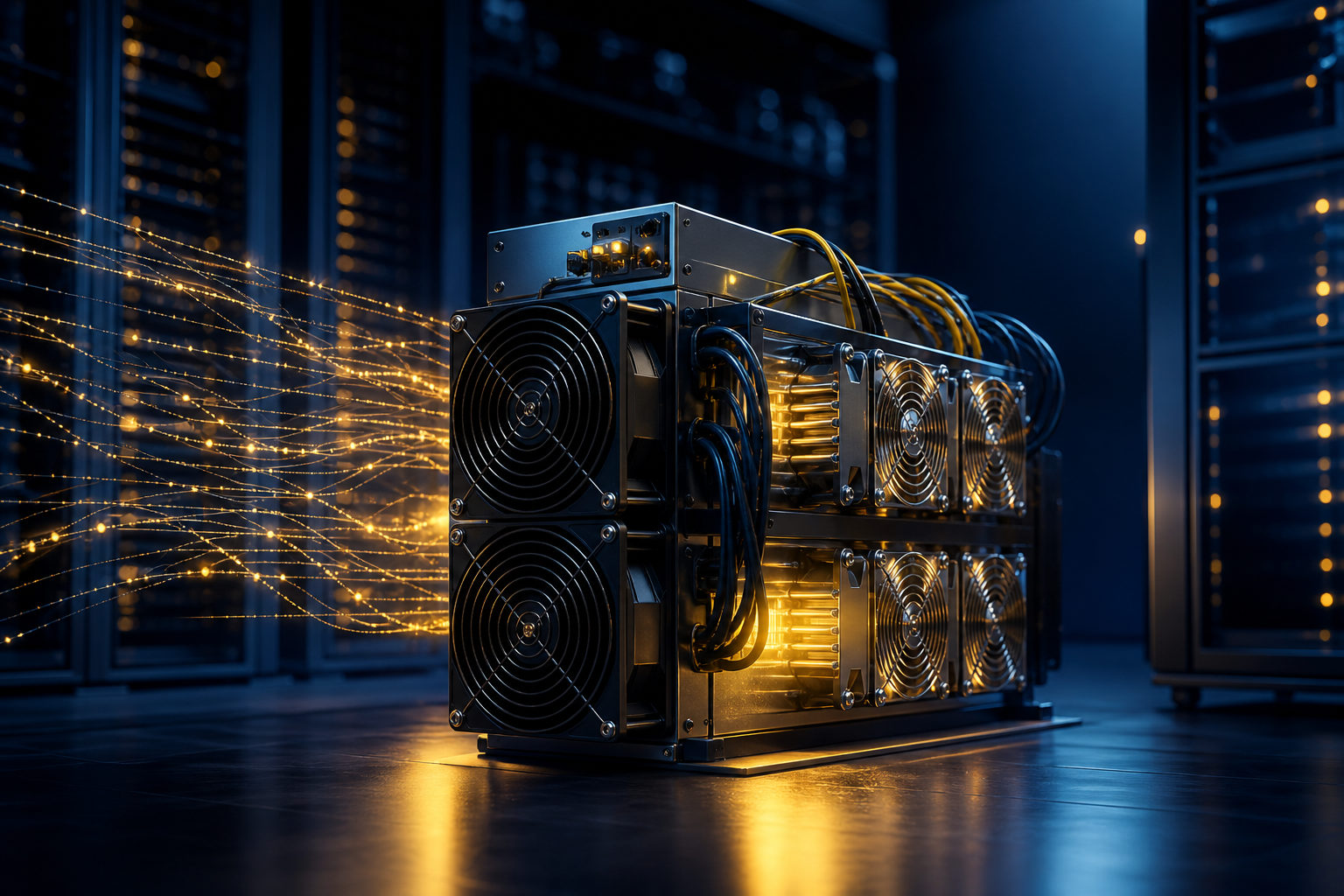
How does a bitcoin miner work? At its core, a bitcoin miner is a machine that joins a nonstop record-keeping race, trying to find a valid hash so a new block can be added to the Bitcoin blockchain.
That sounds technical, but the idea is simpler than most beginners expect. A miner does not “create money” in the everyday sense. Bitcoin already has fixed rules, including a supply cap of 21 million coins. Mining is the process of collecting transactions, building a candidate block, and performing huge numbers of hash calculations under Bitcoin’s proof-of-work system. If a miner finds a valid result before others do, it earns the right to propose the next block to the network.
Think of mining as a public bookkeeping contest
Imagine Bitcoin as a shared ledger that anyone can inspect. New transactions are always waiting to be recorded, but no one should be allowed to edit the ledger at will. Bitcoin solves that problem by making participants compete for the right to write the next page.
This is where the miner comes in. A bitcoin miner takes a batch of pending transactions, references the previous valid block, and repeatedly hashes the block header while changing a variable field. The goal is to produce a hash that meets the network’s current difficulty target. There is no shortcut for this. The machine keeps making guesses at high speed until one of them fits the rule.
So when people ask how bitcoin miners work, the short answer is this: they convert electricity and specialized computing power into a chance to win block production rights.
What a bitcoin miner actually does step by step
To understand how do bitcoin miners work in practice, it helps to break the process into parts. Mining is not one isolated action. It depends on coordination between hardware, software, nodes, and the broader protocol.
1. It starts with pending transactions
Bitcoin transactions do not go straight into the blockchain the moment they are sent. They first wait in a pool of unconfirmed transactions. A mining setup selects valid transactions from that pool and prepares them for inclusion in a block. Invalid transactions, or ones that try to spend the same coins twice, will not pass network checks.
2. The miner builds a candidate block
Next, the mining system assembles a candidate block. That block includes the chosen transactions and a reference to the previous block. This chain structure is the reason the system is called a blockchain: each new block links back to the one before it, creating a history that is hard to alter.
3. The machine performs repeated hash calculations
This is the part most people mean when they talk about mining. The bitcoin miner runs the block header through Bitcoin’s hashing process over and over while adjusting a variable field, often called a nonce. The output must fall below the current target set by the network difficulty.
A miner is not solving a puzzle through insight. It is doing repeated trial and error at very high speed. Because hash functions are designed to be one-way and unpredictable, the only practical method is to keep trying until a valid hash appears.
4. If it finds a valid result, it broadcasts the block
When a miner finally finds a valid hash, it sends the block to the rest of the network. Other nodes then verify the block. They check the block structure, validate the transactions, confirm that the proof of work is correct, and make sure the block follows Bitcoin’s rules.
If the block passes those checks, it becomes part of the accepted chain. From there, miners move on to the next block and the race starts again.
5. The process never stops
Bitcoin produces a new block about every 10 minutes, so miners are in constant competition. The network also adjusts difficulty over time so blocks do not appear too quickly just because more computing power joins the system. That adjustment is a big part of what keeps issuance and confirmation rhythm relatively steady.
Miner, mining hardware, node, and mining pool: not the same thing
These terms are often mixed together, which causes a lot of confusion for beginners. They are related, but they do different jobs.
- Bitcoin miner: this can refer to the machine or the participant, depending on context. In hardware discussions, it usually means the specialized device doing the hashing.
- Miner operator: the person or company running the equipment and managing the setup.
- Node: a system that validates blocks and transactions and keeps a copy of blockchain data. A node does not have to mine, and a mining machine does not always perform full node functions.
- Mining pool: a group arrangement where many miners combine computing power and share results according to the pool’s rules.
For most individuals, mining through a pool is easier to understand than trying to mine alone. A pool distributes work to participants and smooths out the randomness of block finding. That does not remove risk or cost, but it changes how outcomes are shared.
Why specialized machines are used
In Bitcoin’s early history, different kinds of hardware could participate more competitively. Today, the job is dominated by specialized mining machines built for one purpose: running Bitcoin’s hash calculations efficiently. That is why people talk about bitcoin miners as if they were a separate hardware category. In practice, they are.
Efficiency matters because proof of work is resource-intensive by design. The machine must keep hashing continuously, often under heavy load for long periods. That makes power delivery, cooling, airflow, dust control, and maintenance central to mining operations. A miner that overheats, loses connection, or runs unstably is not just inconvenient; it loses chances to contribute useful work.
This is also why a normal home computer is usually discussed only as a learning tool in the context of Bitcoin mining. It can help someone understand the concept, but that is different from competing seriously in the network.
How mining helps secure Bitcoin
Mining is not only about issuing new coins. It is also part of Bitcoin’s security model. Proof of work forces anyone who wants to add a block to spend real-world resources. That cost makes rewriting transaction history much harder than simply editing a database.
If an attacker wanted to change old records, the attacker would need to redo massive amounts of computational work and keep pace with the honest chain as it keeps growing. The need to commit real resources is what gives the system resistance against cheap manipulation.
That point is easy to miss when mining is framed only as a way to earn bitcoin. A bitcoin miner works as one piece of a wider mechanism that coordinates transaction ordering, block creation, and network defense at the same time.
Can an ordinary person still take part?
Yes, but the question should be framed carefully. It is possible to participate in Bitcoin mining, yet participation today is much closer to running specialized hardware than casually installing software on a spare computer.
Anyone considering mining needs to think beyond the machine itself. Electricity cost, heat management, noise, uptime, internet stability, hardware failure, and ongoing maintenance all matter. Even if you join a mining pool, you are not removing those realities. You are mainly changing how block-finding variance is shared.
That is why mining should not be treated as an automatic income machine. It is a technical and operational activity with real constraints. Some people explore it to learn how Bitcoin works. Others treat it as a business decision. Those are very different starting points, and mixing them often leads to poor assumptions.
If your goal is education, begin with the protocol: learn what a block is, how proof of work functions, how nodes verify data, and how pools assign jobs. If your goal is long-term mining participation, cost structure and operating conditions need to come before excitement.
Key factors that affect mining results
Without bringing in live revenue figures, you can still evaluate what matters most in mining. A few variables shape the experience more than anything else.
- Hardware efficiency: more useful hashing per unit of power gives a miner a better competitive position.
- Electricity cost: mining runs for extended periods, so power cost is central.
- Cooling and environment: heat, poor airflow, and dust can reduce stability and hardware life.
- Pool terms: pools differ in payout methods, operational practices, and service reliability.
- Network difficulty: as total mining competition rises, an individual setup has a harder time producing the same outcome.
- Operations discipline: downtime, firmware issues, failed fans, and connectivity problems all reduce effective work.
None of these can be replaced by asking a vague question like whether mining is “worth it.” A better question is whether your setup can operate consistently under real conditions.
FAQ
What is a bitcoin miner actually calculating?
It repeatedly hashes block header data while changing a variable field to search for a valid output under Bitcoin’s difficulty rules. It is not decrypting wallets or cracking private keys.
Can I mine Bitcoin with a regular computer?
In principle, a regular computer can perform the relevant calculations. In practice, that is usually not competitive and is better suited for learning than for serious participation.
Are miners and mining pools the same thing?
No. A miner provides hashing power, while a mining pool coordinates many miners and shares results according to pool rules. Joining a pool changes how outcomes are distributed, not the underlying proof-of-work process.
Does a bitcoin miner validate transactions too?
A mining setup works with transaction data and proposes blocks that include valid transactions. Full validation across the network is performed by nodes that check whether the block and its contents follow Bitcoin’s rules.
What should I review before getting into mining?
Start with electricity conditions, cooling, noise, hardware reliability, and pool terms. If those basics do not fit your situation, buying a machine first is usually the wrong order.
If you want a practical next step, separate the concept from the purchase decision: learn how blocks, nodes, pools, and proof of work fit together first, then assess whether your power, space, cooling, and maintenance setup can support a bitcoin miner at all.
Disclaimer: This article is for informational and educational purposes only and is not investment, financial, or legal advice. Crypto assets are highly volatile and you could lose your entire investment. Do your own research and decide carefully.