
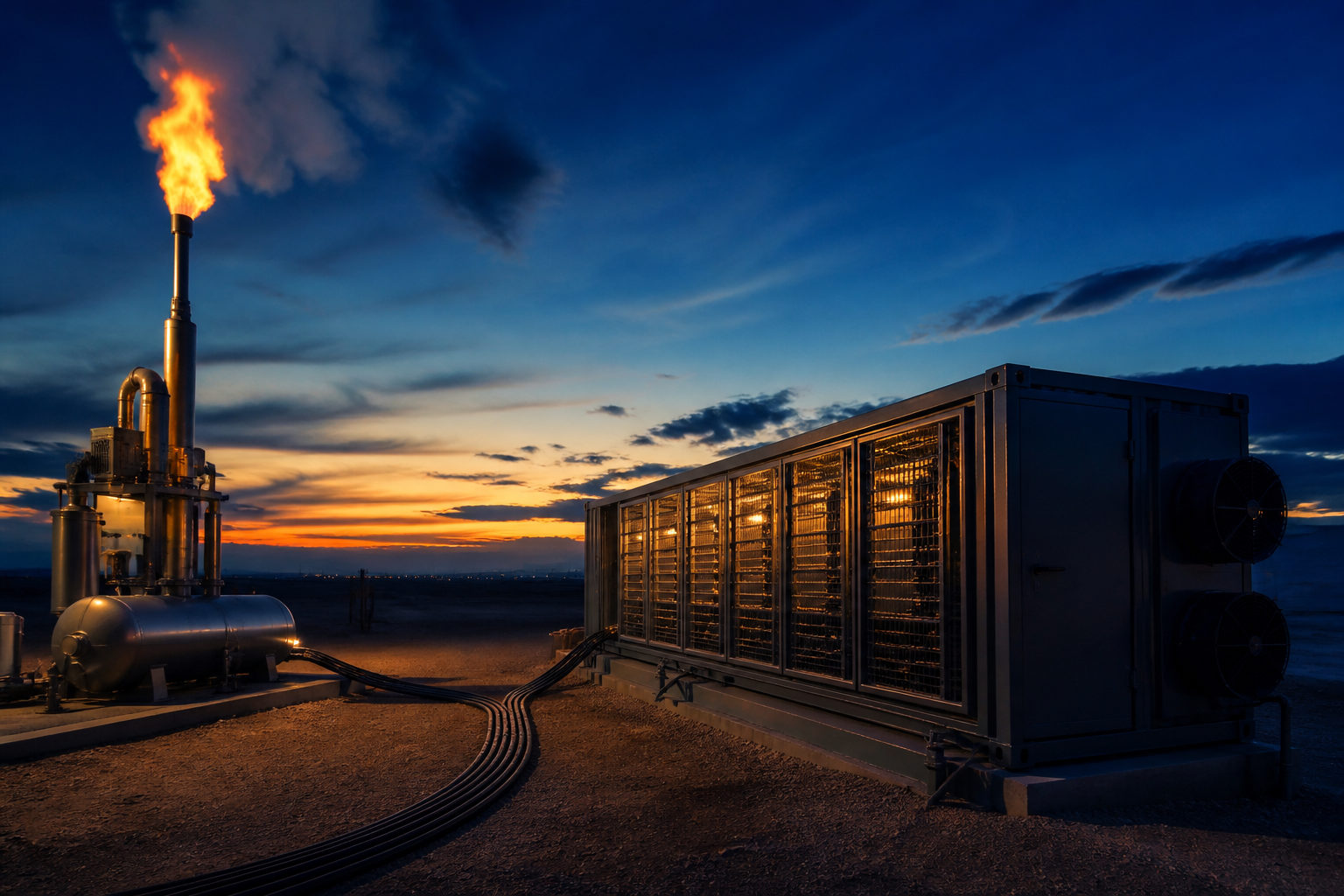
Bitcoin mining can transform the energy industry by acting as a flexible power buyer, turning electricity that is hard to store, transport, or sell on time into a digital output that can be settled globally.
Start with mining as a nonstop race to update the ledger
Bitcoin mining is often described as creating coins, but that skips the part that matters most to the energy business. Miners compete to add new blocks to the chain, and that competition is what helps secure the network and order transactions.
Mining machines run calculations again and again until one participant finds a valid result under the network rules. Roughly every 10 minutes, a new block is added. That means miners are always converting electricity, hardware performance, cooling capacity, and operating discipline into a chance to win block rewards.
For the energy sector, this is unusual because mining is a location-flexible load. A factory often needs labor pools, transport links, suppliers, and access to end markets. A mining site mainly needs power, network access, cooling, and a setup that can keep machines running efficiently.
Why this matters to power producers
Energy companies deal with a basic problem: generating electricity is not the same as monetizing it well. Power may be abundant at the wrong hour, in the wrong region, or before local demand and transmission links are ready to absorb it.
Bitcoin mining changes that calculation in some cases because it can serve as a buyer of electricity where traditional demand is thin or delayed. If a project has surplus generation during certain periods, mining can absorb part of that output instead of leaving the operator with curtailment, weak pricing, or idle capacity.
This does not mean every power plant should host miners. The model makes sense only where the power source, site conditions, operating costs, and local rules line up. In a power-constrained region, mining may create tension rather than value.
| Energy challenge | Typical outcome without mining | What mining may change |
|---|---|---|
| Local oversupply | Low realized value or curtailment | Surplus power can be redirected to mining load |
| Remote generation site | Wait for transmission or local demand to catch up | A mine can provide early on-site consumption |
| Volatile power output | Revenue depends heavily on timing and grid conditions | Mining may add another demand outlet during excess periods |
| Slow project monetization | Developers rely on conventional offtake alone | Mining introduces another potential power customer |
Mining is attractive because it can behave like flexible demand
Many industrial users cannot shut down quickly without serious operational costs. Bitcoin mining is different. Machines can often be powered down, throttled, or brought back online more easily than a traditional production line.
That makes mining interesting for grids and generators dealing with uneven supply and demand. During periods of excess generation, miners can run harder. When power is needed elsewhere, mining load can be reduced so electricity can flow to higher-priority users.
This feature is one reason mining is often discussed alongside wind and solar. Renewable generation can be intermittent, and project owners do not fully control when output will be strongest. Mining does not fix intermittency, but it can add a layer of demand that responds to periods when generation exceeds what the local system can use efficiently.
It also affects investment thinking. A developer reviewing a new energy project may no longer ask only who will buy the electricity through standard channels. They may also ask whether a flexible digital load can improve early-stage economics, site utilization, or project resilience under changing grid conditions.
| Dimension | Conventional industrial load | Bitcoin mining load |
|---|---|---|
| Shutdown tolerance | Often low | Often higher |
| Site selection | Tied to logistics and supply chains | Driven mainly by power, cooling, and connectivity |
| Load adjustment | Commonly slower | Commonly more responsive |
| Output | Physical goods or services | Hashrate securing the Bitcoin network |
How people participate in the mining-energy link
Participation is broader than buying machines and plugging them in. A generator may build and run its own mining operation. A professional miner may buy power from a plant or industrial park. Another company may focus on hosting, cooling, maintenance, controls, or site management.
For power producers, the key question is not whether mining is technically possible. The real question is whether it is the best use of available electricity compared with other offtake paths. That requires looking at dispatch needs, uptime, labor, cooling design, equipment replacement cycles, and whether the load can step back when the grid needs power elsewhere.
For independent miners, cheap power is only the start. Reliability of supply, cooling performance, maintenance response, local noise limits, network stability, and the ability to manage hardware at scale all matter. A site that looks attractive on paper can fail once outages, repairs, and operational friction are included.
| Participant | Common role | Main concern |
|---|---|---|
| Power producer | Uses surplus electricity for in-house mining | Dispatch flexibility, capital recovery, compliance |
| Professional miner | Buys power and runs the site | Power quality, cooling, uptime, operations |
| Hosting or data center operator | Provides site and infrastructure | Electrical capacity, fire safety, noise, maintenance |
| Service provider | Handles monitoring and technical support | System reliability, response time, cost control |
The limits are real, and they matter
It is easy to overstate the role of Bitcoin mining in energy. Mining can help monetize some forms of underused or poorly matched power, but it is not a cure-all for generation economics, transmission gaps, or grid design.
The first hard limit is cost. Machines, transformers, cooling systems, buildings, monitoring tools, and ongoing maintenance all require capital. Hardware also ages, and efficiency does not stay best-in-class forever.
The second limit is business volatility. Mining results depend on power costs, equipment performance, the level of network competition, and the market price of bitcoin. If an energy project treats mining as its only answer, that project may become too exposed to variables outside the operator's control.
There are also site-specific constraints. Some places have strict rules on noise, heat rejection, land use, grid access, or environmental review. In those settings, a mining operation may be difficult to sustain even if the power source itself looks attractive.
A more grounded view is to treat mining as one tool in the energy toolkit. In the right setting, it can improve monetization of excess power and add a responsive load. In the wrong setting, it simply moves existing problems into a different part of the project.
FAQ
Why would a power plant care about bitcoin mining at all?
Because mining is a large electricity consumer, and some power projects need more ways to sell output. Where generation is underused or poorly matched with local demand, mining can become a possible customer.
Is bitcoin mining a natural fit for renewable energy?
It can be relevant for some renewable sites because output can be uneven and location can limit monetization options. Still, suitability depends on grid access, site operations, compliance, and full-cycle costs rather than the power source alone.
Does low power cost automatically make a mining site attractive?
No. Cheap electricity can be offset by outages, weak cooling, poor maintenance, network instability, or local restrictions. A site has to work operationally, not just financially on a headline power rate.
Can small operators take part in this model?
They can, but the practical barriers are higher than many expect. Power arrangements, infrastructure, hardware management, and day-to-day operations all require more than simply owning a few machines.
Can mining replace transmission upgrades or grid planning?
No. Mining can help in specific cases by absorbing excess power or acting as flexible demand. It does not replace the need for transmission, storage, load growth, or long-term grid investment.
If you want to judge whether bitcoin mining can transform the energy industry in a specific case, ask a few direct questions: where the power comes from, when it is surplus, who operates the site, how quickly the load can step down, and whether there is a better buyer for that electricity. Those answers usually matter more than the headline pitch.
Disclaimer: This article is for informational and educational purposes only and is not investment, financial, or legal advice. Crypto assets are highly volatile and you could lose your entire investment. Do your own research and decide carefully.