
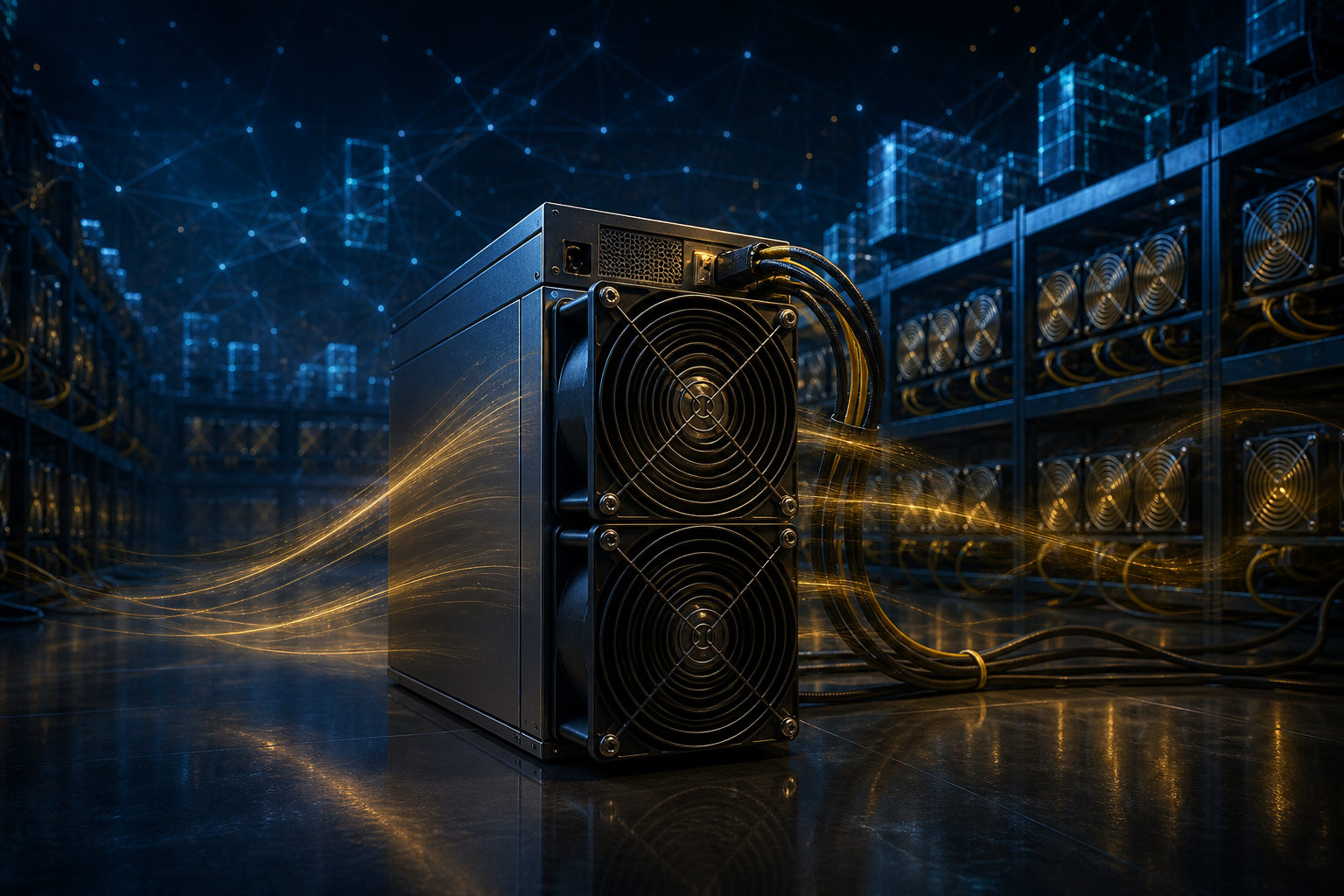
Bitcoin mining is a nonstop contest to win the right to add the next block. Miners spend computing power on that race, and the network uses the result to keep its ledger in order.
Think of mining as a bookkeeping tournament
Bitcoin runs on a shared ledger. People broadcast transactions to the network, but those payments do not become part of the chain by themselves. Someone has to collect them, arrange them into a candidate block, and present a valid block that other nodes accept.
That “someone” is a miner. Each miner gathers pending transactions, builds a block, and then starts hashing the block header again and again with slightly different inputs. The goal is simple to describe and hard to achieve: produce a hash that satisfies the network’s current difficulty rule.
No puzzle-solving trick changes the odds. Raw trial and error does. A miner that finds a valid result first broadcasts the block, other nodes verify it, and the block gets added to the chain if everything checks out.
What the machines are actually doing
A lot of beginners hear that miners “solve math problems” and picture something like advanced equations. The real process is more repetitive than dramatic. Mining hardware performs hash calculations at very high speed, changing a small piece of block data each round and testing whether the output lands below the required target.
Bitcoin is designed to produce a new block about every 10 minutes. The network adjusts mining difficulty as total computing power changes, so block production stays near that pace over time. More miners joining does not make blocks appear much faster for long; it mostly makes the competition tighter.
New blocks usually include user transactions and a special transaction that assigns the block reward. Bitcoin’s supply cap is 21 million coins. The issuance schedule slows through halvings, which happen about every 4 years, or every 210,000 blocks. Halvings took place in 2012, 2016, 2020, and 2024.
How people take part in mining
There is more than one way to join. Some miners run their own machines and compete directly. Others connect their hardware to a mining pool, which combines many participants’ hash power and shares results according to the pool’s rules.
Solo mining offers full control, but it also leaves the miner exposed to long stretches without finding a block. Pools smooth that out. You contribute hash power, the pool submits work on behalf of participants, and payouts are divided based on measured contribution rather than luck alone on a single machine.
- Solo mining: direct competition with the whole network, usually suited to operators with deeper resources and strong infrastructure.
- Pool mining: shared effort with steadier distribution, though pool fees and payout methods matter.
- Hosted setups: machines stay in a third-party facility, which can reduce hands-on work but raises questions about control, service terms, and access.
Home PCs are not the center of this story anymore. Bitcoin mining is dominated by specialized hardware. Device efficiency, power availability, cooling, noise, uptime, and maintenance shape the real experience far more than the initial setup screen.
Why costs matter more than the simple idea
The concept is easy enough to grasp. Running it in the real world is where things get sharp.
Electricity is usually the first issue people look at, and for good reason, but it is not the only one. Hardware purchase costs, heat output, ventilation, repair cycles, firmware upkeep, internet reliability, pool fees, and downtime all affect whether a setup is manageable. A machine that sits idle too often is not just annoying; it changes the whole economics of participation.
Mining also puts pressure on the physical environment around the hardware. These machines run hard for long periods. Dust, poor airflow, unstable connections, and neglected maintenance can drag performance down or stop operations entirely. That is why experienced participants often talk less about the theory of mining and more about power planning, cooling design, and keeping equipment online.
| Stage | What happens | Often overlooked |
|---|---|---|
| Transaction selection | Miners gather pending transactions | Fees can influence what gets included |
| Block building | A candidate block is assembled | Data format must follow network rules |
| Hashing | Hardware repeats hash calculations | There is no shortcut around computation |
| Broadcasting | A valid block is sent to other nodes | Fast propagation can matter in competition |
| Operations | Machines, cooling, and connectivity are maintained | Downtime and failure hit results directly |
What a newcomer should check before getting involved
Curiosity is a fine starting point, but it is not a plan. Before buying anything, a newcomer should ask a few blunt questions: Do I have stable power access? Can I deal with heat and noise? Who handles repairs? If the setup stops making sense later, how do I exit without a mess?
Those questions sound boring. They are also the ones that decide whether mining stays an educational project or turns into a frustrating obligation. People often focus on the machine itself and skip the support system around it. The support system is the job.
FAQ
Is bitcoin mining just creating new coins?
Not by itself. Mining is mainly the process that orders transactions and secures the chain through proof of work, while new coin issuance is one part of the block reward structure.
Can an individual still mine bitcoin today?
Yes, but the practical barrier is much higher than the basic idea suggests. Hardware efficiency, electricity access, cooling, and maintenance usually matter more than enthusiasm.
What is the difference between solo mining and pool mining?
Solo mining leaves one operator competing directly for full block discovery. Pool mining combines many miners’ hash power and spreads results according to pool rules, which tends to make participation less erratic.
Can a regular computer mine bitcoin?
A regular computer can perform the same kind of hashing in principle, but that does not make it competitive. Bitcoin mining is now centered on specialized machines built for this specific task.
Where should I look if I want current mining conditions or the live bitcoin price?
Start with major market data platforms for the live price and widely used on-chain or mining dashboards for network conditions. Then compare hardware efficiency, pool terms, hosting contracts, and your local power situation before making any move.
If you only wanted the plain-English version, here it is: bitcoin mining is specialized computing used to compete for block-writing rights. If you want to go further, map the power, cooling, maintenance, and exit plan first, then decide whether participation makes sense.
Disclaimer: This article is for informational and educational purposes only and is not investment, financial, or legal advice. Crypto assets are highly volatile and you could lose your entire investment. Do your own research and decide carefully.