
Bitcoin mining is easiest to understand as a public race for bookkeeping rights: miners compete to package transactions into a block, and the winner can add that block to the blockchain in exchange for newly issued bitcoin and transaction fees.
Think of mining as a contest to write the next page
The word “mining” throws people off. It sounds like coins are hidden somewhere inside a computer, waiting to be dug up. That picture is wrong. A better one is a giant shared ledger with no bank in charge, where thousands of participants want to write the next page and the system needs a fair way to decide who gets to do it.
Every time someone sends bitcoin, that transfer enters the network as a transaction waiting to be confirmed. Miners gather some of those transactions and try to place them into a new block. Since anyone can attempt that job, the network needs a selection method that is open, easy to verify, and hard to fake. That method is called proof of work.
| Term | Plain-English meaning | Job in the Bitcoin network |
|---|---|---|
| Transaction | A request to send bitcoin | Waits to be confirmed |
| Block | A page of the ledger | Holds a batch of verified transactions |
| Miner | A participant in the race | Provides computing power and proposes blocks |
| Mining | Competing for record-keeping rights | Secures the network through computation |
| Blockchain | The full chain of ledger pages | Stores the transaction history |
What miners are actually doing
This is the part that sounds mysterious until you strip away the jargon. Miners are not solving useful homework problems or searching for a hidden file. They are repeatedly running calculations, changing a small piece of the block data each time, trying to produce a result that meets the network’s current requirement.
A simple analogy helps. Picture a lock that accepts only one kind of pattern. Checking whether a key fits takes a moment. Finding the right key is the hard part, because there is no shortcut that lets you jump straight to the answer. You keep trying. Fast. Very fast.
You will also hear the word “hash.” For a beginner, it is enough to treat a hash like a digital fingerprint produced by a fixed rule. Change the input even a little, and the output changes completely. Mining uses that behavior. A miner keeps adjusting allowed parts of a candidate block and hashing again and again until one result lands inside the target the network accepts.
Bitcoin produces a block roughly every 10 minutes. The network tries to keep that rhythm steady by adjusting mining difficulty as total mining power rises or falls. More machines joining the race makes the target harder to hit. If overall mining power drops, difficulty moves the other way. That is why Bitcoin does not suddenly start producing blocks at a wild pace when more miners show up.
Each new block points back to the block before it, which is why the record forms a chain. If someone wanted to rewrite an older transaction, they would need to redo the work for that block and all the blocks after it, while also catching up with a network that keeps moving forward. That makes tampering extremely expensive in practice.
Where the mining reward comes from
A successful miner usually earns from two sources: the block reward and the transaction fees inside that block. The block reward is not fixed forever. It is cut in half about every 4 years, or more precisely every 210,000 blocks. The halving years so far are 2012, 2016, 2020, and 2024.
Bitcoin’s total supply is capped at 21 million coins. New coins are introduced gradually through mining instead of appearing all at once. So mining does two jobs at the same time: it helps order transactions, and it handles part of Bitcoin’s issuance schedule.
What happens when a mining machine joins the network
A mining machine does more than sit there burning electricity. It connects to the network, receives transaction data, checks whether those transactions follow the rules, builds a candidate block, and then starts the brute-force search for a valid result. If it finds one, it broadcasts that block so other nodes can verify it.
That verification step matters. Other nodes check signatures, make sure the bitcoin being spent actually exists, and reject attempts to spend the same coins twice. They also check whether the new block properly links to the previous one. If the block passes those tests, the network accepts it as the latest page in the ledger.
| Step | What the miner does | Why it matters |
|---|---|---|
| Collect transactions | Selects pending transfers | Builds the list of payments for the block |
| Verify transactions | Checks signatures and conflicts | Filters out invalid or double-spend attempts |
| Assemble a block | Combines transactions with block data | Creates a candidate that can attach to the chain |
| Run repeated calculations | Tries many possible inputs | Competes for the right to publish the block |
| Broadcast the result | Sends the new block to the network | Lets other nodes confirm and update their records |
People often ask why many miners can work at once but only one gets the block. The answer is timing. The network accepts the valid block that spreads and gets recognized first. Others may have been very close, but close does not count here. Their effort usually ends up with no direct reward for that round.
How people participate today
Understanding mining is one thing. Doing it is another. In Bitcoin’s early years, ordinary computers had a much clearer role. Today, mining is highly specialized. Most participation falls into three buckets: mining alone with your own machines, joining a mining pool, or getting exposure to the mining business indirectly rather than running hardware yourself.
| Method | Best for | Main feature | Real-world challenge |
|---|---|---|---|
| Solo mining | Operators with hardware and technical skill | Full control over the setup | Strong competition and uneven results |
| Pool mining | Participants who want smoother payouts | Combines computing power with others | Need to understand pool rules and fees |
| Indirect exposure | People studying the sector | No need to run machines directly | Still requires careful risk review |
A mining pool is basically a group effort. Many miners combine their computing power so the pool finds blocks more regularly, then rewards are shared according to the pool’s rules. That can make outcomes less lumpy for smaller participants. It does not erase the economics, though. Your share still depends on machine efficiency, uptime, power costs, pool fees, and network difficulty.
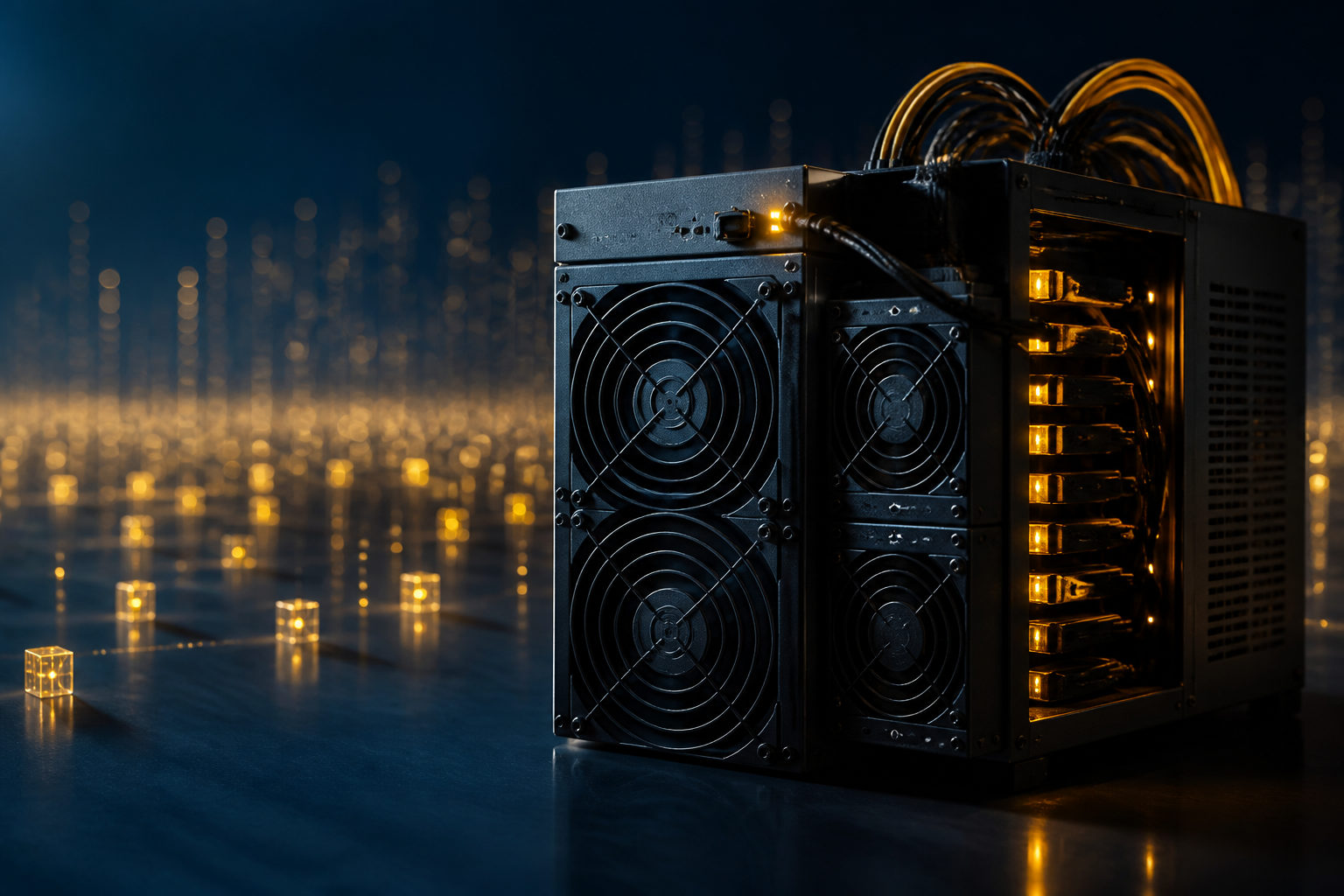
Hardware is another reality check. Modern Bitcoin mining usually relies on purpose-built machines rather than a home office computer. The reason is simple: this job is repetitive, and efficiency matters. A machine that can do more work per unit of electricity has a major edge. Buying the machine is only the opening move. Cooling, noise, stable power, repairs, and day-to-day maintenance all shape the result.
Why cost is always part of the conversation
Mining sounds straightforward when you hear only the top line: machines run, blocks are found, rewards are paid. The harder part is surviving the cost structure. Electricity is central. Hardware ages. Machines fail. Ventilation can become a problem. A site that looks workable on paper may become difficult once heat and noise enter the picture.
There is another mistake beginners make: treating “I can switch on a miner” as if it means “this is a good business for me.” It does not. The gap between those two ideas is wide. You have to think about equipment sourcing, downtime, maintenance, local rules, and whether the setup can keep operating when conditions change.
Some newcomers also confuse real mining with questionable cloud-hash offers. Actual Bitcoin mining depends on real machines doing real work and consuming real electricity. If a service hides the hardware, gives vague payout rules, or makes it impossible to verify what exists, the problem is not only technical complexity. It is opacity.
FAQ
Is bitcoin mining basically solving math problems?
That is a decent beginner shortcut, but it is incomplete. Mining is closer to repeated trial and error under fixed rules: checking an answer is easy, while finding one that qualifies takes a huge number of attempts.
Can I mine bitcoin with a home computer now?
In theory, you can run software and interact with the network. In practice, home computers usually cannot compete well because Bitcoin mining is now dominated by specialized hardware built for this exact task.
Does joining a mining pool guarantee steady bitcoin income?
A pool can make payouts more regular than going solo because many participants share results. That still does not make income automatic, since your outcome depends on pool terms, machine performance, uptime, and costs.
What is the difference between mining bitcoin and buying bitcoin?
Buying bitcoin is a market transaction: you pay to acquire coins directly. Mining is an operating activity where you spend on equipment and electricity to compete for block rewards and fees.
Why does Bitcoin need miners at all?
Without miners, the network would need some central party to decide which transactions count. Proof of work spreads that role across participants and makes rewriting old records expensive enough to deter tampering.
What to check before you go deeper
If your goal is education, start with the core ideas: blocks, hashes, difficulty, transaction fees, and halvings. Read the white paper, Bitcoin: A Peer-to-Peer Electronic Cash System, then watch how a real transaction moves into a block on a blockchain explorer. That gives you a much clearer picture than staring at mining sales pitches.
If your goal is actual participation, make a checklist first. Hardware source. Power conditions. Cooling. Noise. Maintenance. Pool rules. Downtime plans. Go line by line before you commit money or time. Mining is understandable once explained simply, but participating in it is still a hard, physical, cost-sensitive business.
Disclaimer: This article is for informational and educational purposes only and is not investment, financial, or legal advice. Crypto assets are highly volatile and you could lose your entire investment. Do your own research and decide carefully.