
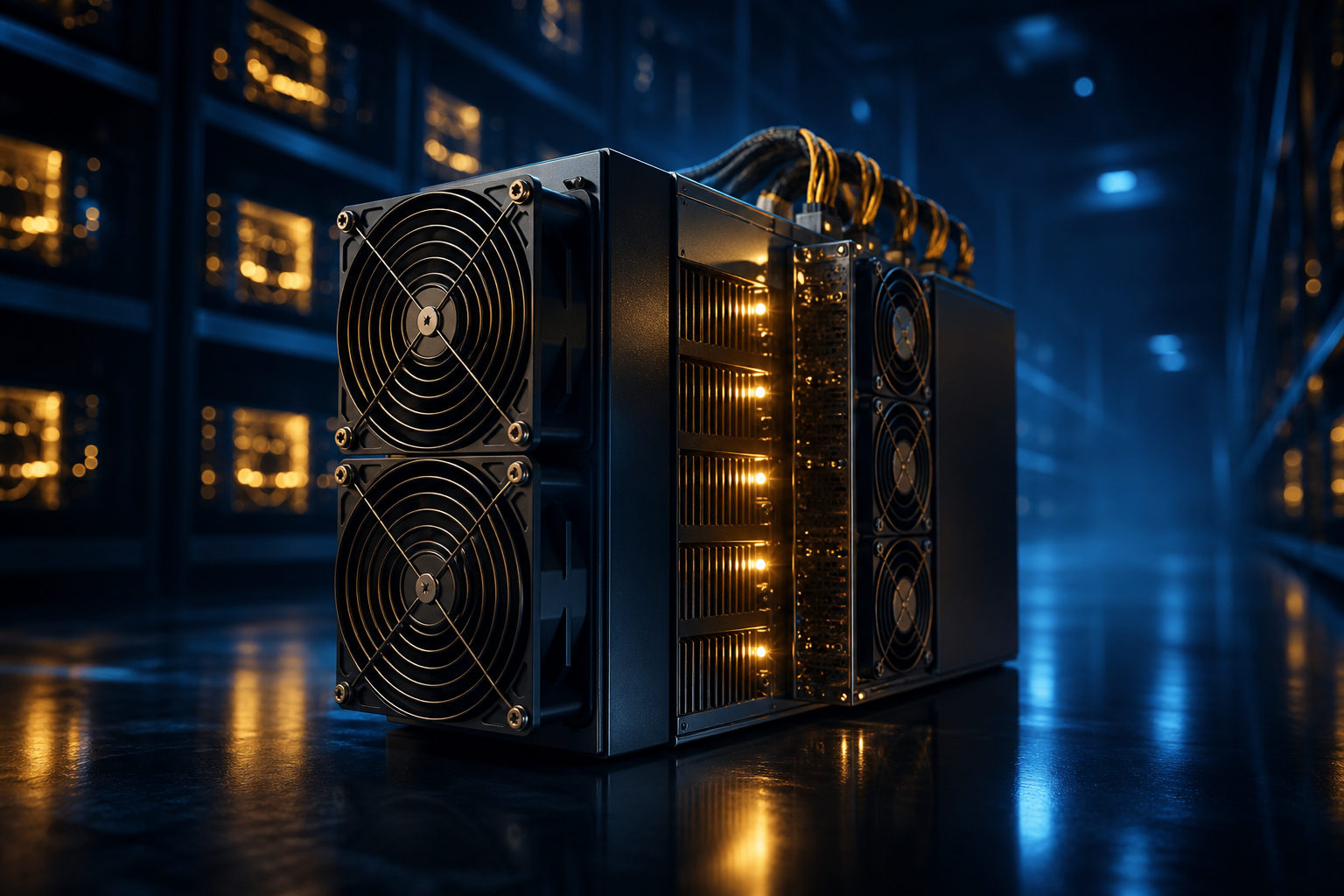
How does bitcoin mining work? At its core, it is a public bookkeeping race where miners use computing power to compete for the right to add the next block to the blockchain.
What bitcoin mining actually means
The word “mining” can be misleading. Bitcoin is not dug out of the ground. In practice, mining means using hardware to process candidate blocks and compete to confirm transactions under the network’s proof-of-work rules.
A simple way to picture it is a bookkeeping contest. Miners gather pending transactions, build a candidate block, and try to produce a valid hash that meets the protocol target. The first valid result can be broadcast to the network, and other nodes check it before accepting the block.
This process does two jobs at once. It helps order and confirm transactions, and it makes the ledger hard to rewrite because changing old records would require repeating a large amount of computation.
How proof of work functions like a race
Proof of work is designed so that finding a valid block takes repeated trial and error, while checking the answer is easy. Miners keep changing block data and hashing it again and again until one result satisfies the network’s current difficulty requirement.
That is why hash rate matters. It reflects how many hashing attempts a miner or group of miners can make over time. A higher hash rate does not guarantee the next block, yet it improves the odds over the long run.
Bitcoin produces a new block about every 10 minutes on average. The timing is not fixed like a clock. Instead, the network adjusts difficulty so block production stays near that pace even as total mining participation changes.
When a valid block is accepted, the winning miner can receive the block reward and the transaction fees included in that block. Bitcoin has a supply cap of 21 million coins, and the issuance schedule is reduced roughly every 4 years, or every 210,000 blocks. Halving years include 2012, 2016, 2020, and 2024.
What miners, hash rate, and a mining pool each do
Mining hardware performs the raw hashing work. Its job is simple but demanding: make as many valid attempts as possible while staying powered, cooled, and connected. For beginners, it helps to think of hash rate as answer speed in the bookkeeping race.
Still, even fast hardware faces uncertainty. A solo miner may wait a long time before finding a block, because competition across the network is intense. That is why many participants choose a mining pool instead of mining alone.
A mining pool combines the work of many miners. The pool coordinates jobs, tracks each participant’s contribution, and distributes payouts under its own rules when blocks are found. This does not change Bitcoin’s core rules. It changes how mining income is shared among participants.
The key benefit is smoother results. Solo mining can mean long dry periods followed by a rare block win. A mining pool turns that uneven pattern into smaller, more regular payouts tied to contributed work.
How a beginner can mine bitcoin in practice
If you ask how do you mine bitcoin, the practical answer starts with setup rather than profit. You need suitable mining hardware, stable internet access, a wallet for receiving payouts, reliable power, and enough cooling to keep equipment running for long stretches.
After that, you choose between solo mining and joining a mining pool. Most beginners look at pools first because the workflow is easier to manage and the payout pattern is less erratic. You then configure the machine, connect it to the pool if needed, and monitor uptime, temperature, and power use.
For home users, the biggest surprise is often the electricity bill. Mining is not just a software task running quietly in the background. It can also bring heat, noise, hardware wear, and ongoing maintenance. Those factors matter before any result is measured.
It also helps to separate mining from simply buying bitcoin. Buying gives you direct exposure to the asset. Mining is an operating activity with equipment, power, and maintenance demands. If your goal is only to hold bitcoin, mining may not be the easiest route.
FAQ
What is bitcoin mining?
Bitcoin mining is the process of using computing power to help confirm transactions and add new blocks to the blockchain. Miners compete under proof of work, and a successful block can earn a reward plus fees.
How do you mine bitcoin?
You mine bitcoin by setting up mining hardware, power, internet access, and a payout wallet, then choosing solo mining or a mining pool. For most new users, understanding operating costs comes before switching on the machine.
How can I mine bitcoin at home?
You can try mining at home if you have the right hardware, ventilation, stable power, and tolerance for heat and noise. The hard part is not opening an account; it is handling the ongoing electricity and equipment reality.
Is a mining pool better for beginners?
For many beginners, a mining pool is easier because it smooths income instead of leaving everything to rare solo wins. The pool organizes the work and pays participants based on contribution, though each pool has its own payout rules.
Checks to make before you spend money
Before you buy any equipment, make a simple checklist: power cost, cooling, noise, available space, maintenance time, and pool rules. If even one of those is a poor fit, home mining can become a burden quickly.
If your main goal is education, start by learning proof of work, mining pool payout methods, and wallet setup. Before running hardware for long periods, confirm that your home power and cooling conditions can handle continuous operation.
Disclaimer: This article is for informational and educational purposes only and is not investment, financial, or legal advice. Crypto assets are highly volatile and you could lose your entire investment. Do your own research and decide carefully.