
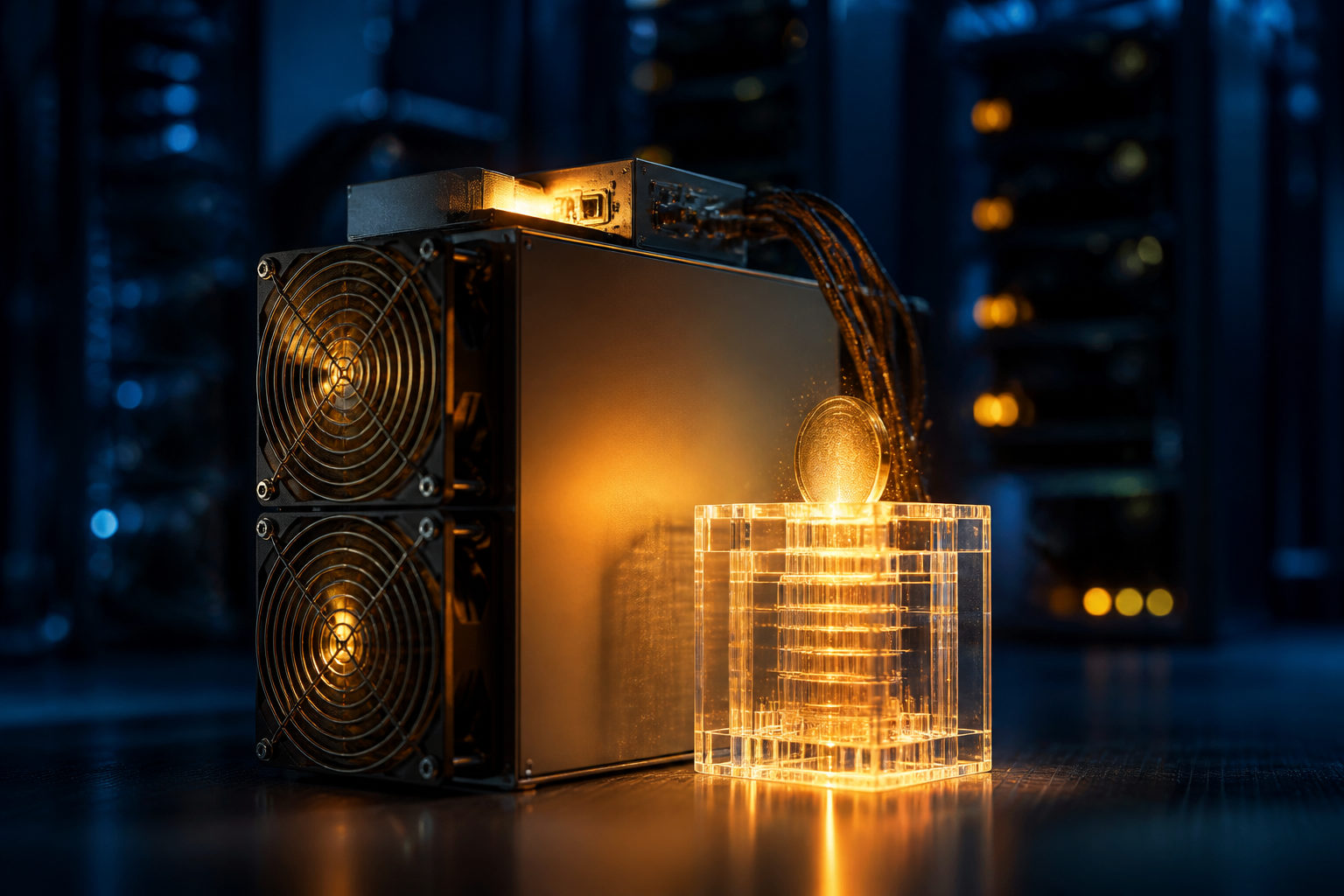
How are bitcoins found? In practice, they are not found sitting somewhere on the internet. New bitcoins are issued when miners win the right to add a valid block, and the network accepts that block.
What people usually mean by “found”
The phrase makes Bitcoin sound like buried treasure or a lost file waiting to be uncovered. That image is misleading. Bitcoin follows a fixed issuance schedule, and new coins appear as part of the block reward when a miner successfully produces a block under the network rules.
That matters because mining does two jobs at once. It releases new bitcoin into circulation, and it also keeps the ledger in order by deciding which transactions enter the chain next. If you only focus on the new coins, you miss the reason the system can run without a central bookkeeper.
| Common assumption | What actually happens |
|---|---|
| Bitcoins already exist somewhere and miners locate them | New bitcoin is issued by protocol rules as blocks are created |
| Seeing transactions first means getting the reward | The reward goes to the miner whose block is accepted by the network |
| Mining is only about making coins | Mining also orders transactions and protects the ledger |
| Any computer can keep earning coins by staying online | Rewards depend on competition, hardware, and mining method |
How new bitcoin is created through mining
Bitcoin began with the genesis block in January two thousand nine, after the white paper titled Bitcoin: A Peer-to-Peer Electronic Cash System was released in two thousand eight. From there, the network has followed the same basic model: miners gather unconfirmed transactions, build a candidate block, and try to produce a block hash that satisfies the current difficulty target.
This is a repeated trial-and-error process. A miner changes parts of the candidate block and runs the hash function again and again. Most attempts fail. Eventually, one miner finds a valid result and broadcasts that block to the network.
Other nodes then verify the block. They check whether the transactions are valid, whether the block format follows consensus rules, and whether the proof of work is acceptable. If the block passes those checks, it is added to the chain. At that point, the miner becomes eligible for the block reward and the transaction fees included in that block.
People often hear the word “solve” here, but it helps to be precise. Miners are not solving a puzzle with a clever shortcut. They are performing repeated computation until one result meets the rule set by the network.
Where the mining reward comes from
A miner’s payout usually has two parts. One part is the block subsidy, which is the newly issued bitcoin created by the protocol. The other part is the set of transaction fees paid by users whose transfers were included in that block.
Bitcoin has a supply cap of twenty-one million coins. The block subsidy falls roughly every four years, or every two hundred ten thousand blocks. Halving years so far are two thousand twelve, two thousand sixteen, two thousand twenty, and two thousand twenty-four. Over time, that means newly issued bitcoin becomes smaller as a share of miner revenue.
| Stage | What miners do | Result |
|---|---|---|
| Collect transactions | Build a candidate block from pending transfers | Prepare for block competition |
| Run repeated hashes | Try many block variations | Search for a valid proof of work |
| Broadcast the block | Send the proposed block to the network | Wait for node verification |
| Gain acceptance | Pass consensus and transaction checks | Receive block reward and fees |
Why Bitcoin needs mining in the first place
If anyone could add records to the ledger at no cost, the system would be easy to spam and much harder to trust. Mining ties block creation to a real-world cost: computation. That cost makes rewriting history expensive and helps the network resist double spending.
Mining also gives the network a way to agree on transaction order. Different nodes may hear about transactions at different times. By anchoring them into blocks through proof of work, Bitcoin can converge on a shared history without asking a single company, bank, or server to make the final call.
This is why the phrase “found bitcoins” only captures part of the story. New coins are issued through mining, but mining exists because Bitcoin needs a permissionless way to secure its ledger and settle transaction order.
Can ordinary people still “find” bitcoin today?
They can participate, but the path is different from the early years. Mining is now highly competitive, so using a normal home computer is usually not realistic if your goal is consistent rewards. Many participants use specialized mining machines, or they join a mining pool and combine their hash power with others.
A mining pool does not change Bitcoin’s issuance rules. It changes how rewards are shared among participants. Instead of waiting for your own machine to win a block on its own, you contribute work to a group and receive a portion of the pool’s rewards according to that pool’s payout method.
That makes the experience less lumpy for many miners, but it also introduces practical trade-offs. You need to understand pool policies, payout structure, hardware upkeep, heat, noise, and power costs. For some people, direct purchase is a simpler way to get bitcoin exposure than running mining equipment.
| Approach | Main feature | Best fit |
|---|---|---|
| Solo mining | Full control, but rewards are less predictable | People with technical skill and mining setup |
| Pool mining | Shared rewards based on contribution | Participants who want smoother income flow |
| Buying bitcoin directly | No block production involved | People focused on holding rather than mining operations |
If your real question is how to get bitcoin, mining is only one route. You can earn it, buy it, or accept it as payment. Those choices may all lead to bitcoin in a wallet, yet the required knowledge, cost profile, and risks are very different.
FAQ
Are bitcoins generated automatically by the network?
Yes, but only under strict conditions. New bitcoin is issued according to protocol rules when a valid block is accepted, so the network is not handing out coins at random.
Can I mine bitcoin with a regular PC?
You can learn the process that way, but it is usually a poor fit for serious mining. Competition is intense, and specialized hardware has a major advantage in real-world mining.
Why do miners keep hashing over and over?
Because proof of work is the mechanism that decides who gets to add the next block. Repeated hashing creates a public contest that is costly to win and easy for everyone else to verify.
Will bitcoin mining create more than the maximum supply?
No. Bitcoin has a hard cap of twenty-one million coins, and the block subsidy keeps shrinking through halvings, so issuance does not continue at the same pace forever.
Does someone need to own one whole bitcoin to use it?
No. Bitcoin is divisible, and the smallest unit is the satoshi. One satoshi equals one hundred millionth of one BTC, which allows very small balances and transfers.
To understand how bitcoins are found, keep your attention on three pieces: blocks, proof of work, and the reward schedule. Once those click, it becomes easier to read about mining pools, transaction fees, confirmations, and wallet balances without treating bitcoin as something hidden that miners simply dig up.
Disclaimer: This article is for informational and educational purposes only and is not investment, financial, or legal advice. Crypto assets are highly volatile and you could lose your entire investment. Do your own research and decide carefully.