
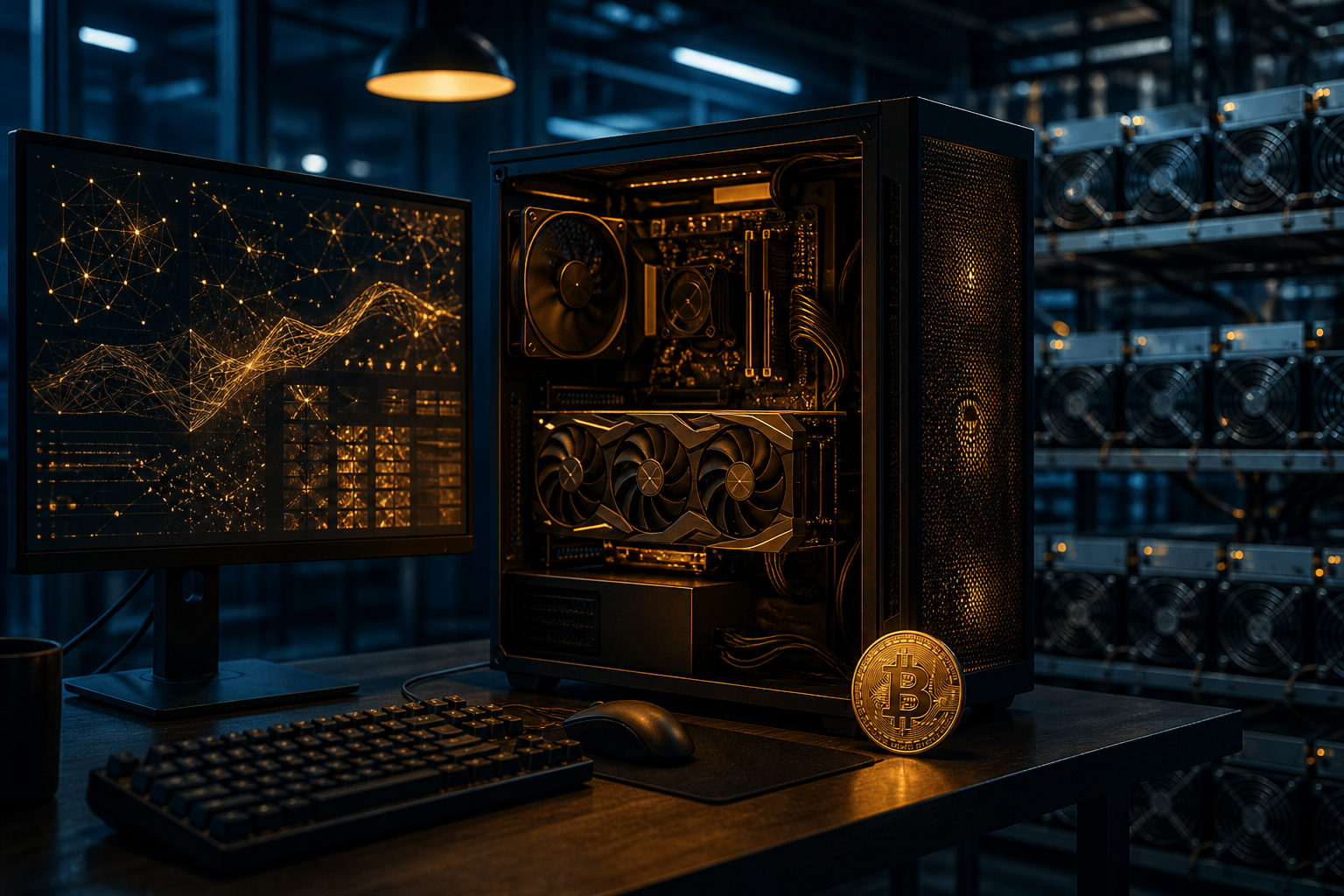
How does a computer mine bitcoins? A computer mines Bitcoin by performing repeated hash calculations in a race to build the next block. If its result meets the network's rule, that block can be accepted and the miner may receive the block reward and transaction fees.
What a computer is really doing when it mines
Mining sounds like coins are hidden inside a machine, waiting to be extracted. That is not how Bitcoin works. The network is a shared public ledger, and mining is the process of competing for the right to add a new block of verified transactions.
You can picture it as a bookkeeping contest. Many machines assemble candidate blocks and keep changing a small part of the data, then run the Bitcoin hash function again and again. The goal is to find an output that falls under the current difficulty target set by the network.
Bitcoin is designed to produce a new block about every 10 minutes, so this race repeats all day. In plain terms, when people ask how computers mine bitcoin, the answer is that they verify pending transactions, package them into a candidate block, perform massive amounts of hashing, and broadcast a valid result if they find one.
Why a regular computer can participate but rarely compete
At a basic level, any computer that can run the right software can take part in mining. The harder question is not whether it can hash, but whether it can hash fast enough to matter. Bitcoin mining is now dominated by specialized hardware built for this single task.
A home desktop or laptop can still perform the same kind of calculation, yet its efficiency is usually far behind dedicated mining machines. That means a normal computer may be working constantly without having a realistic chance of finding a block on its own.
This is the gap many beginners miss. A computer can mine Bitcoin in the technical sense, but that does not mean it is a practical way to earn coins. Electricity use, heat, noise, hardware wear, and setup errors all become part of the real cost.
How the mining process works step by step
Set up hardware, power, and network access
Mining requires a machine that can stay online for long periods. Stable power, cooling, and internet access matter because interruptions reduce effective participation. Even a working setup can underperform if it overheats or disconnects often.
Install mining software
The software tells the machine what work to do and where to send results. It may connect to a mining pool or, in some cases, work with a full node. During setup, users often configure a wallet address, device settings, logs, and operating permissions.
Choose solo mining or a mining pool
Solo mining means your machine competes by itself against the whole network. You only receive a result if you actually find a valid block. A mining pool combines the work of many participants and distributes the outcome based on contributed hashing power, which is why pools are the usual route for individuals.
Monitor performance and safety
Mining is not a one-time install. Devices need ongoing checks for temperature, fan behavior, system errors, connection drops, and hardware stress. Security also matters because fake mining tools and compromised wallet software can expose funds or take control of the machine.
The rules behind Bitcoin mining
Bitcoin uses proof of work. Miners show that they spent real computing effort, and the network checks whether a proposed block follows the shared rules. This design makes it expensive to rewrite the ledger because an attacker would need to reproduce a huge amount of valid work.
The genesis block was created in January 2009. Bitcoin's supply is capped at 21 million coins, and new coins enter circulation through block production rather than appearing all at once. The block subsidy is cut in half about every 4 years, or every 210,000 blocks, with halvings having occurred in 2012, 2016, 2020, and 2024.
That structure is why mining does two jobs at the same time. It confirms transactions and also handles the release of new bitcoin according to the protocol's schedule.
What to think about before mining on your computer
The first issue is economics, even without quoting any revenue figure. A machine that runs hard for long periods consumes power, produces heat, and wears down parts. If you are using an ordinary computer, the educational value may be higher than the financial case.
The second issue is expectations. Many people search for ways to mine Bitcoin on a PC because they hope the barrier to entry is low. In reality, professional competition is intense, so a personal computer is better seen as a way to learn how proof of work and pools operate.
The third issue is operational risk. Wallet mistakes, poor backups, unsafe downloads, and weak system security can do more damage than low mining performance. For a beginner, learning wallet basics and software hygiene may be more useful than trying to keep a machine hashing nonstop.
FAQ
Can I mine Bitcoin on my own computer?
Yes, in the technical sense you can. The bigger issue is competitiveness, since a normal computer is usually far less efficient than dedicated mining hardware.
Do I need to leave my computer on all the time?
Mining works best with continuous operation because the process is a nonstop race. Frequent shutdowns reduce your effective contribution and can interrupt software or pool connections.
Is joining a mining pool required?
No, it is not required. Still, most individuals use pools because they turn a very low-probability solo outcome into a steadier distribution based on contributed work.
Can a laptop mine Bitcoin?
A laptop can run mining software, but it is usually a poor fit. Heat limits, throttling, fan noise, and component wear make long sessions hard on portable devices.
Where do mined bitcoins go?
They are usually assigned to the wallet address or pool account you set during configuration. Before starting, make sure you understand backups, address accuracy, and private key storage.
If your goal is to understand how a computer mines bitcoins, start with proof of work, pool payouts, and wallet safety first. After that, you can decide whether running hardware for long periods makes sense for your situation.
Disclaimer: This article is for informational and educational purposes only and is not investment, financial, or legal advice. Crypto assets are highly volatile and you could lose your entire investment. Do your own research and decide carefully.