
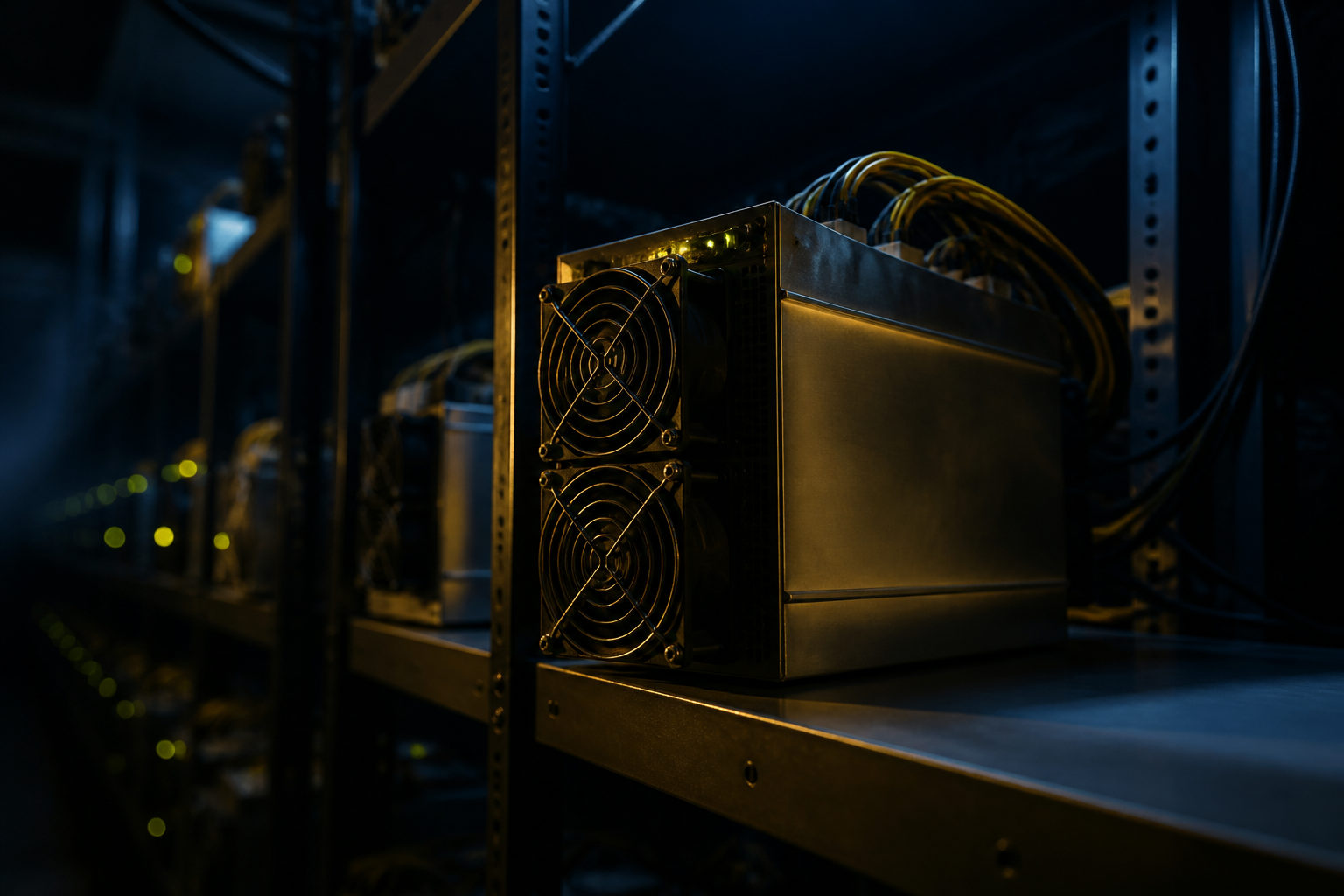
Bitcoin mining is not easy today. In simple terms, it is a nonstop race for block production, and while almost anyone can learn how it works, competing in a meaningful way is much harder than plugging in a home computer.
Why bitcoin mining feels like a bookkeeping contest
Think of the Bitcoin network as a public ledger with no chief accountant. New transactions need to be grouped into blocks, and miners compete for the right to add the next one. The winner gets to write that next page of the ledger and collect the block reward plus transaction fees.
That is why the “mining” label can mislead beginners. Nothing is being dug out of a hidden place. Miners are doing repeated hash calculations, over and over, to prove they committed real computing work and real electricity to securing the network.
Bitcoin produces a new block about every 10 minutes. The network also adjusts mining difficulty, which keeps block timing relatively steady even as more machines join. So when more computing power enters the race, one small participant usually finds the race tougher, not easier.
What actually makes mining hard now
A lot of newcomers frame the question the wrong way. They ask whether it is possible to start. That part is not the hard bit. The hard part is staying in the race without getting squeezed by costs, downtime, weak hardware efficiency, or conditions at home that make continuous operation unrealistic.
| Challenge | What it looks like in practice | What it means for a beginner |
|---|---|---|
| Competition | Miners across the network chase the same kind of block rewards | A home setup rarely has strong odds on its own |
| Hardware barrier | Serious mining usually depends on dedicated ASIC machines, not standard PCs | You face buying, setup, compatibility, and upkeep issues early |
| Power cost | Mining hardware runs continuously and draws meaningful electricity | Your power rate can shape whether participation makes sense at all |
| Heat and noise | Machines under heavy load get hot and can be loud | A normal living space may not suit long-term operation |
| Output volatility | Miner income moves with difficulty, fees, and bitcoin price | The real result can feel very uneven |
| Ongoing maintenance | Connection issues, hardware faults, and bad settings can interrupt mining | This is not a set-it-and-forget-it activity |
That gap matters. Being able to run mining software is one thing. Running a setup that stays efficient, stable, and economically sensible is another. People often discover this late, after they have already spent money on equipment that looked fine on paper.
There is also a built-in supply rule behind the whole system. Bitcoin has a maximum supply of 21 million coins, and new issuance follows preset rules. The block reward is reduced about every 4 years, which turns mining into a long competition where efficiency matters more and more over time.
How regular people can still take part
Regular users are not locked out completely. The catch is that participation today rarely looks like the old image of one person mining alone on a laptop. Most people who get involved choose a path based on budget, available space, tolerance for noise and heat, and how much hands-on work they are prepared to do.
| Participation method | Who it may suit | Main feature | Key caution |
|---|---|---|---|
| Solo mining | People comfortable handling hardware and deployment themselves | High control over the setup | If your hash power is small, finding a block alone can take a very long time |
| Mining pool | Users who want a smoother payout experience | Many miners combine hash power and share output by pool rules | Check fees, payout structure, and operator credibility carefully |
| Hosted mining equipment | People who want to own machines but lack a suitable location | Operation happens in a dedicated facility | Contract terms, transparency, and downtime risk matter a lot |
| Learning first | Beginners who want to understand the process before spending | Lets you study wallets, pools, and payout logic before buying hardware | Often the best way to avoid a rushed equipment decision |
If your goal is understanding rather than immediate deployment, start with the flow. Learn what a block is, what hashing does, how difficulty adjustment works, how pool payouts are split, and how a wallet receives funds. That sounds basic, but it answers most of the mistakes people make at the start.
Bitcoin can also be divided into very small units. The smallest unit is the satoshi, and 1 satoshi equals one hundred millionth of a BTC. For miners, the practical takeaway is that pool payouts are often sliced according to contribution, so the experience can feel more like steady fractional allocation than waiting to hit one full block reward yourself.
The real question is cost, not curiosity
Once people ask how easy it is to mine bitcoins, the conversation usually lands here: cost structure. Buying hardware is only the opening move. After that come power stability, cooling, internet reliability, routine maintenance, machine aging, and the plain reality that a noisy heat-producing device may not fit the place where you live.
| Cost area | Why it matters | What beginners often miss |
|---|---|---|
| Hardware purchase | It shapes your starting efficiency and hash power | People may focus on headline specs and ignore upkeep |
| Electricity | It is a continuing expense, not a one-time line item | Different locations and usage patterns can change the picture a lot |
| Cooling conditions | Too much heat can hurt stability and hardware life | A normal room may not handle constant thermal output well |
| Internet stability | Disconnects reduce useful running time | Home internet is not always a dependable production environment |
| Maintenance time | Updates, troubleshooting, and restarts take real effort | The daily attention requirement gets underestimated |
| Rules and compliance | Requirements differ by region for hosting, electricity use, and operations | External limits are often ignored in early planning |
So, is bitcoin mining easy? Learning the mechanics is manageable. Keeping a mining setup running well is not. For home users in particular, the trouble often shows up in ordinary places: outlet capacity, heat, background noise, and the time needed to keep everything healthy.
One more structural point matters here: halvings. Bitcoin started with the genesis block in January 2009, and the block reward declines on a fixed schedule. The halving years so far have been 2012, 2016, 2020, and 2024. That does not mean mining suddenly becomes impossible on a single day, but it does make cost discipline and machine efficiency more important as time goes on.
FAQ
Can you still mine bitcoin with a regular computer?
From a technical angle, a computer can perform mining-related calculations. In real competition, though, standard consumer machines usually lack the efficiency needed to keep up for long.
Does joining a mining pool make mining easy?
A pool can make payouts feel less erratic because many participants combine hash power and share the output. That does not remove your hardware costs, electricity bill, or the need to understand the pool's fee and payout rules.
Is solo mining better than pool mining?
Solo mining gives you more control and preserves the chance of receiving a full block reward on your own. The trade-off is long stretches with no result at all if your hash power is limited.
What should a beginner learn before buying mining equipment?
Start with wallet setup, pool payout methods, hardware efficiency, and what downtime does to the whole plan. Those topics shape the real experience far more than the first software install does.
How does the bitcoin halving affect mining difficulty?
The halving changes the block reward structure, which can make miners more sensitive to costs. It does not automatically mean the process becomes harder to operate that same day, but it can widen the gap between efficient and inefficient setups.
If you are trying to judge whether mining fits your situation, list your likely hardware path, electricity conditions, available space, tolerance for heat and noise, and the time you can spend on maintenance before looking at machines or pool options. If those basics do not line up, staying in the learning stage is a perfectly sensible choice.
Disclaimer: This article is for informational and educational purposes only and is not investment, financial, or legal advice. Crypto assets are highly volatile and you could lose your entire investment. Do your own research and decide carefully.