
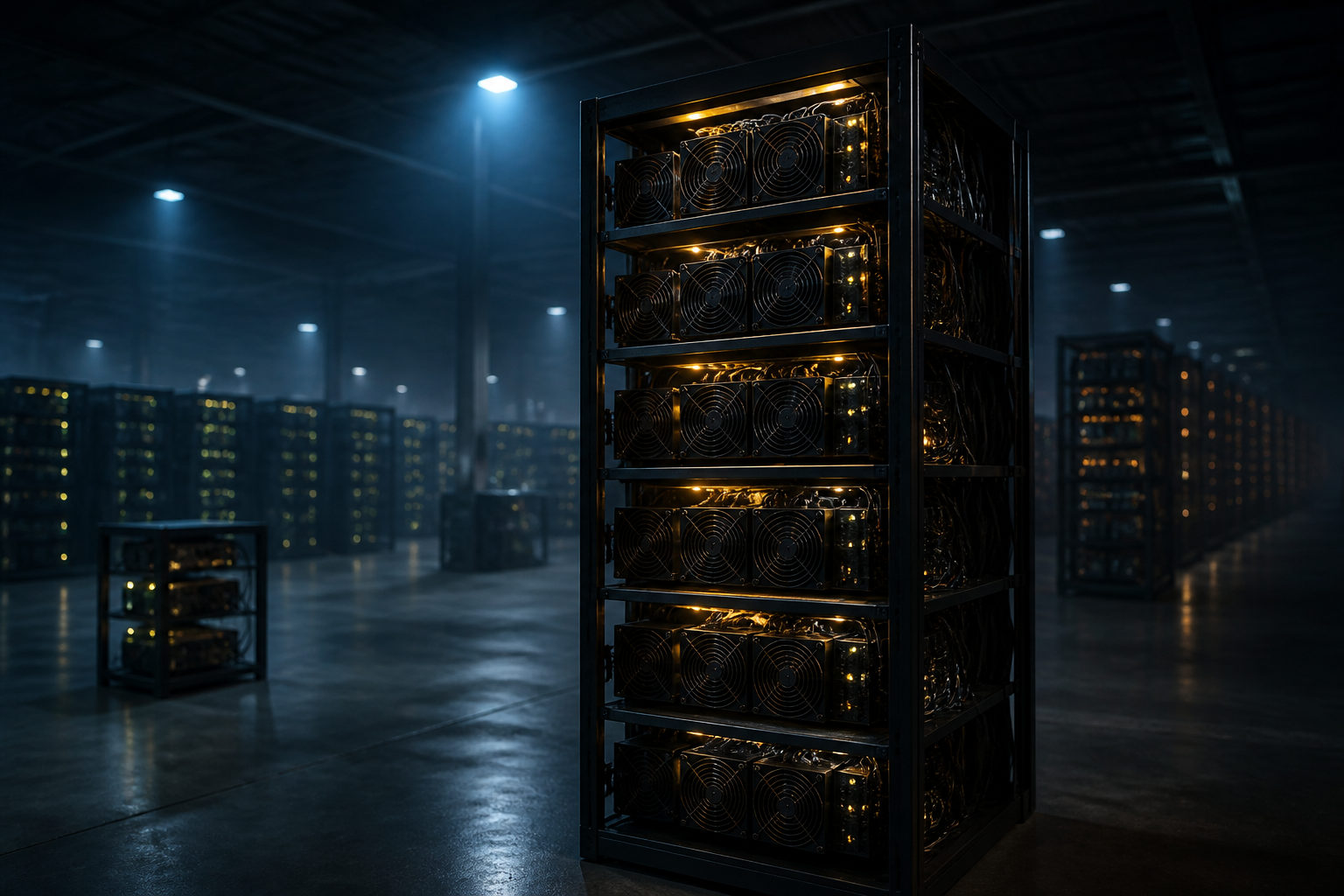
There is no exact public number for how many bitcoin miners are out there. The Bitcoin network does not keep a real-name list of everyone mining, and most public data shows which pool found a block, not how many separate people or companies were behind that result.
Why the number is hard to pin down
A simple way to think about bitcoin mining is as a nonstop bookkeeping race. Miners use computing power to compete for the chance to add a new block, and the network keeps moving whether one participant joins or leaves. What outsiders can observe is the winning block announcement, while the full set of unsuccessful participants stays mostly invisible.
The counting problem starts with definitions. Some people mean individual miners who own machines. Others mean mining firms that run large sites. Some use mining pools as a stand-in for miners, even though a pool is only an organizing layer that combines many participants. Change the definition and the answer changes with it.
| What is being counted | What it usually means | Why an exact count is difficult |
|---|---|---|
| Solo miners | People or firms mining on their own | The chain does not show every participant who failed to find a block |
| Pool members | Miners contributing hash power to a pool | One person may run many machines or switch between pools |
| Mining operators | Companies managing sites full of hardware | Machine counts and uptime are not always public |
| Active machines | Hardware currently hashing | Machine count is not the same as miner count |
There is also no formal sign-up step that turns someone into a bitcoin miner. If the hardware, software, and network setup are in place, that participant is already competing. Entry and exit can happen at any time, which makes the total look less like a member directory and more like a moving target.
Miner, mining pool, and mining machine are not the same thing
Many readers asking how many bitcoin miners there are are really asking who keeps Bitcoin running. That question makes more sense once the pieces are separated. A miner is the person or company taking on cost and operational risk. A mining machine is the hardware doing the hashing. A mining pool is a coordination service that combines hash power from many miners.
This distinction matters because public block data often names the pool, not the underlying contributors. A pool may look like one actor from the outside, while behind it sit many independent miners with different machine counts, power costs, and operating conditions. The reverse can also happen: one large operator may spread machines across multiple pools.
| Term | Main role | Common misunderstanding |
|---|---|---|
| Miner | Supplies hash power and pays the bills | May not appear by name in public block records |
| Mining machine | Performs SHA-256 hashing work | More machines do not automatically mean more miners |
| Mining pool | Coordinates workers and distributes payouts | Pool count does not equal miner count |
| Full node | Validates transactions and blocks | Running a node does not mean someone is mining |
That is why a list of major pools cannot answer the original question on its own. Pools are aggregation points. They help smooth out the randomness of block discovery, but they hide the exact number of separate participants behind the pool label.
How people actually take part in bitcoin mining
If someone wants to become a bitcoin miner, there are a few practical paths. They can buy hardware and run it themselves, place machines in a hosted facility, join a pool, or build a test setup first to understand the workflow. The barrier is rarely the button-clicking part. The real pressure comes from electricity, heat, noise, maintenance, downtime, and hardware management.
| Participation path | Best fit for | Main challenge | Reality check |
|---|---|---|---|
| Home setup | People who want hands-on learning | Noise, heat, and power limits | Most homes are poor long-term environments for mining hardware |
| Hosted facility | Owners of hardware without suitable space | Trust, service terms, and maintenance coordination | Read the operating and downtime rules closely |
| Pool mining | Miners who want less payout variance | Pool fees, payout model, server reliability | Joining a pool does not remove hardware or power costs |
| Test and research first | Newcomers | Confusing theory with practical viability | Understanding the process is different from running it profitably |
Bitcoin uses proof of work, and a new block is found about every 10 minutes. The protocol adjusts mining difficulty as total network hash power changes. So when more miners enter, the network does not simply become easier for everyone. Competition rises with participation.
Block subsidies also change over time through halvings, which occur about every 4 years, or every 210,000 blocks. That does not make mining impossible, but it does change the economics and raises the importance of machine efficiency, power sourcing, and operational discipline. New miners often focus on setup guides and ignore the longer-term cost structure.
What causes miner counts to rise or fall
The number of bitcoin miners is always shifting. Some participants join during periods of stronger price expectations or when they gain access to favorable power conditions. Others shut down when hardware becomes less efficient, maintenance gets harder, or operating conditions turn against them.
Professionalization is another factor. Early participation looked very different from mining today. Modern bitcoin mining depends heavily on specialized hardware, stable internet connections, cooling, monitoring, and ongoing upkeep. For an individual, being able to start is one question. Being able to stay in the game is another.
| Factor | How it affects miner count | What to pay attention to |
|---|---|---|
| Electricity cost | Higher costs squeeze out less efficient miners | Do not focus only on hardware purchase price |
| Machine efficiency | Older units are more likely to be retired | Power draw matters as much as raw hash output |
| Cooling and site conditions | Unstable environments increase downtime | Physical setup shapes real operating performance |
| Pool rules | Affects payout timing and variance | Understand the distribution model before joining |
| Halvings and fees | Changes the revenue mix miners rely on | Past operating assumptions may not hold later |
From a network-security angle, the headline number is only part of the story. A larger miner base can help distribute block production, but decentralization also depends on where hash power is concentrated. If too much hash power sits behind a small set of pools or operators, the miner count alone can give a misleading picture.
FAQ
Can anyone see the exact number of bitcoin miners?
No. There is no official live counter for total miners. Public observers usually infer activity from pool shares, block production patterns, and broader hash power data, which can show concentration trends but not an exact headcount.
Is a mining pool the same as a miner?
No. A mining pool is a service that groups many miners together and handles payout rules. Calling a pool a miner can be useful shorthand, but it hides how many separate participants are inside the pool.
Are bitcoin miners and nodes the same thing?
No. Miners compete to produce blocks by spending computing power. Full nodes verify whether transactions and blocks follow Bitcoin's rules. Some operators do both, but the jobs are different.
Can an individual still mine bitcoin?
Yes, in a technical sense. A person can still buy hardware, configure mining software, and join a pool. The harder question is whether the person has suitable power, cooling, space, and maintenance capacity.
Does a higher miner count always mean Bitcoin is safer?
It can help, but the distribution of hash power matters too. A network with many miners is healthier when control is not clustered too tightly in a few pools or operating groups.
If you want a practical answer to the original question, stop looking for one magic number. Make a checklist for hardware, electricity, cooling, pool choice, and maintenance first. That will tell you more about real bitcoin mining than any headline estimate of miner count.
Disclaimer: This article is for informational and educational purposes only and is not investment, financial, or legal advice. Crypto assets are highly volatile and you could lose your entire investment. Do your own research and decide carefully.