
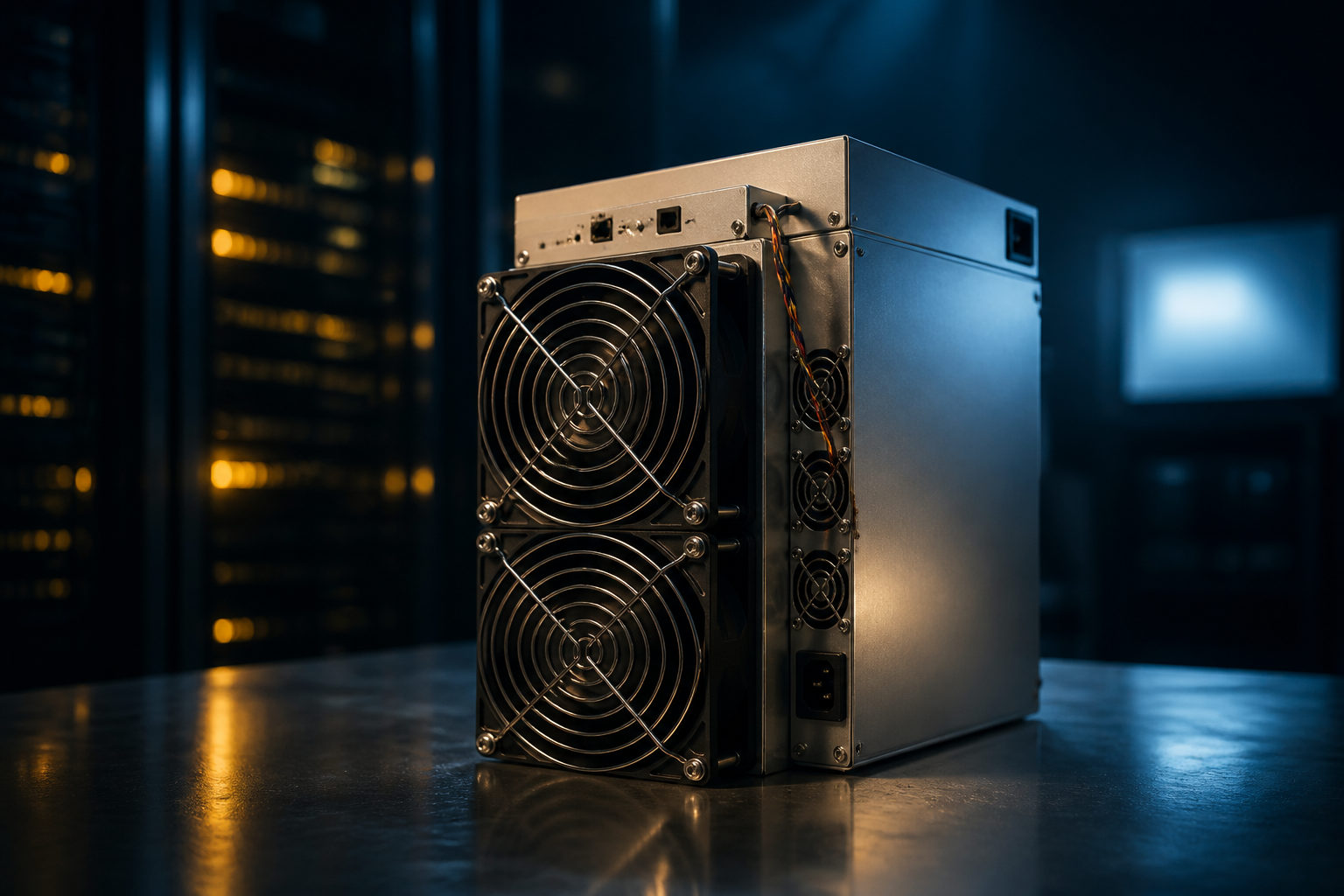
How many bitcoins can an Antminer S19 mine? There is no fixed answer. Its output depends on how much effective hash power it contributes, how hard the network is at that time, how a mining pool pays out, and whether the machine stays online without issues.
Why there is no single number for an S19
Bitcoin mining works like a nonstop bookkeeping contest. Machines across the network compete to produce the next valid block, and the reward goes to the winner, along with the transaction fees included in that block. An Antminer S19 is one participant in that contest, so its result changes with the level of competition around it.
Bitcoin is designed to produce a block about every 10 minutes. That does not mean one machine earns bitcoin on a steady schedule. The network adjusts mining difficulty so block production stays near that rhythm, and when more miners join, a single machine usually gets a smaller share of the total pie.
This is why a calculator result can never be permanent. A figure you see today can change later without the machine itself changing, because the network around it has changed. For a reader asking how many bitcoins an S19 can mine, the honest answer starts with uncertainty, not a hard daily count.
There is also a practical point many beginners miss. Most owners do not run one machine alone and hope to find a full block by themselves. They usually connect to a mining pool, combine hash power with other miners, and receive a share of the pool's earnings based on contribution. What lands in the wallet is often a payout share, not the result of solo mining success.
What an Antminer S19 actually does
The Antminer S19 is an ASIC miner, meaning it is purpose-built for a specific type of computation. In Bitcoin's case, that job is repeated hashing under the proof-of-work system. The machine does not store your coins for you, and it is not doing general computer tasks in the background. Its whole role is to turn electricity and hardware performance into hash power for the mining race.
That distinction matters because people often treat a miner like a fixed-income appliance. In reality, the S19 improves your chance of earning a share only by adding competitive power to your side. Even a strong machine still operates inside a changing network where total competition, block rewards, and pool conditions keep shifting.
If you join a pool, your machine submits shares to show that it is doing valid work. The pool uses those shares to estimate how much hash power you are contributing, then distributes earnings according to its payout method. So when someone asks how many bitcoins an Antminer S19 can mine, part of the answer sits in the pool's rules, not only in the machine's label.
Real-world performance also depends on conditions outside the chip itself. Heat, dust, unstable internet, weak power delivery, and hardware faults can reduce effective output. A miner that looks active on its local screen may still underperform if the pool sees frequent disconnects or a high rate of rejected shares.
The variables that shape S19 mining output
The first variable is network difficulty. Bitcoin adjusts difficulty to keep blocks coming at roughly the same pace, around one block every 10 minutes. If difficulty rises, a machine with the same hash power can still end up receiving less bitcoin over time because the contest has become harder.
The second variable is the pool payout model. Pools do not all distribute earnings in the same way. Some aim for smoother payouts, while others track actual block-finding variance more closely. Fees, settlement timing, and how the pool handles luck all affect what the miner owner finally receives.
The third variable is uptime. A machine only earns when it is online, properly configured, and submitting valid work. Downtime from overheating, internet failures, power interruptions, firmware issues, or hardware problems can cut into the final result more than many beginners expect.
The fourth variable is the halving cycle. Bitcoin has a maximum supply of 21 million coins, and the protocol cuts the block subsidy roughly every 4 years, or every 210,000 blocks. The halving years so far are 2012, 2016, 2020, and 2024. Any discussion of mining output has to include that rule because it changes the release pace of new bitcoin.
The fifth variable is cost structure. Many people focus on how much bitcoin the machine can produce and forget that mining is also an operating activity. Power price, cooling, space, maintenance, and outages all shape whether the setup makes sense. Output in BTC is only one part of the picture.
How people usually participate with an S19
Owning the machine is only the start. A person who wants to mine with an S19 usually has to decide between self-hosting and hosting the machine in a dedicated facility. Self-hosting means handling power, airflow, noise, cleaning, monitoring, and repairs on your own. Hosted mining shifts much of that work to a third party, but then the contract terms and service standards become part of the risk.
After that comes wallet and pool setup. The miner needs a payout address and the correct pool server information. A small setup mistake can leave the machine powered on but producing no usable result. For first-time users, this stage often causes more trouble than turning the machine on.
Then comes monitoring. Watching the local interface is not enough. The more useful checks are the pool dashboard, reported hash rate, effective hash rate, worker uptime, share rejection patterns, and any temperature alerts. Mining output depends on stable contribution over time, so these operating details matter more than a single snapshot on the device.
Maintenance is part of the job as well. Dust buildup, blocked airflow, unstable power, and aging components can all drag performance down. A better way to frame the original question is not only how many bitcoins the S19 can mine, but how reliably it can keep mining under real operating conditions.
Why many people decide not to mine at home
The barrier is often practical rather than technical. A machine like the S19 is built for professional-style competition, which means noise, heat, and sustained power demand are serious considerations. A home environment may not handle those conditions well for long periods.
There is also an ongoing management burden. Mining is not a one-time setup followed by months of neglect. Pool connectivity, thermal behavior, power quality, firmware stability, and hardware wear all need regular checks. For someone whose main goal is simply to gain bitcoin exposure, buying bitcoin directly may be easier to manage than running mining hardware.
Another misunderstanding is the idea that mining output automatically makes the route superior to buying coins. Mining uses hardware, electricity, time, and operating attention in exchange for a chance to receive newly issued bitcoin and fee-based distributions. Whether that trade-off fits a person depends on their power access, location, tolerance for hands-on work, and risk preference.
FAQ
How much bitcoin can an S19 mine in a day?
There is no universal daily figure. The result changes with network difficulty, pool terms, uptime, and the machine's effective performance, so the best estimate comes from live pool data or a current mining calculator.
Can one Antminer S19 mine a full block alone?
It can participate in solo mining, but the odds are highly uncertain because it is competing against the entire Bitcoin network. Most users join a pool so they can receive smaller, more regular payout shares based on contributed work.
Is an Antminer S19 suitable for home mining?
That depends on your power setup, cooling, noise tolerance, and ability to maintain the machine. In many homes, heat and sound become the main obstacles long before the setup process does.
Where can I check real-time output estimates for an S19?
You can check a mining pool dashboard or use a public mining calculator that updates with current conditions. When comparing estimates, look at more than gross output and include pool fees, uptime, and electricity costs in your review.
Does the Bitcoin halving affect the S19?
Yes. Bitcoin cuts the block subsidy roughly every 4 years, which changes the pace of new coin issuance and affects mining economics. Any serious estimate for an S19 should be viewed with the halving cycle in mind.
If you are evaluating an S19, gather four things before trusting any estimate: your power conditions, the place where the miner will run, the pool rules you plan to use, and the machine's ability to stay online consistently. Without those details, the answer to how many bitcoins an Antminer S19 can mine stays too abstract to be useful.
Disclaimer: This article is for informational and educational purposes only and is not investment, financial, or legal advice. Crypto assets are highly volatile and you could lose your entire investment. Do your own research and decide carefully.