
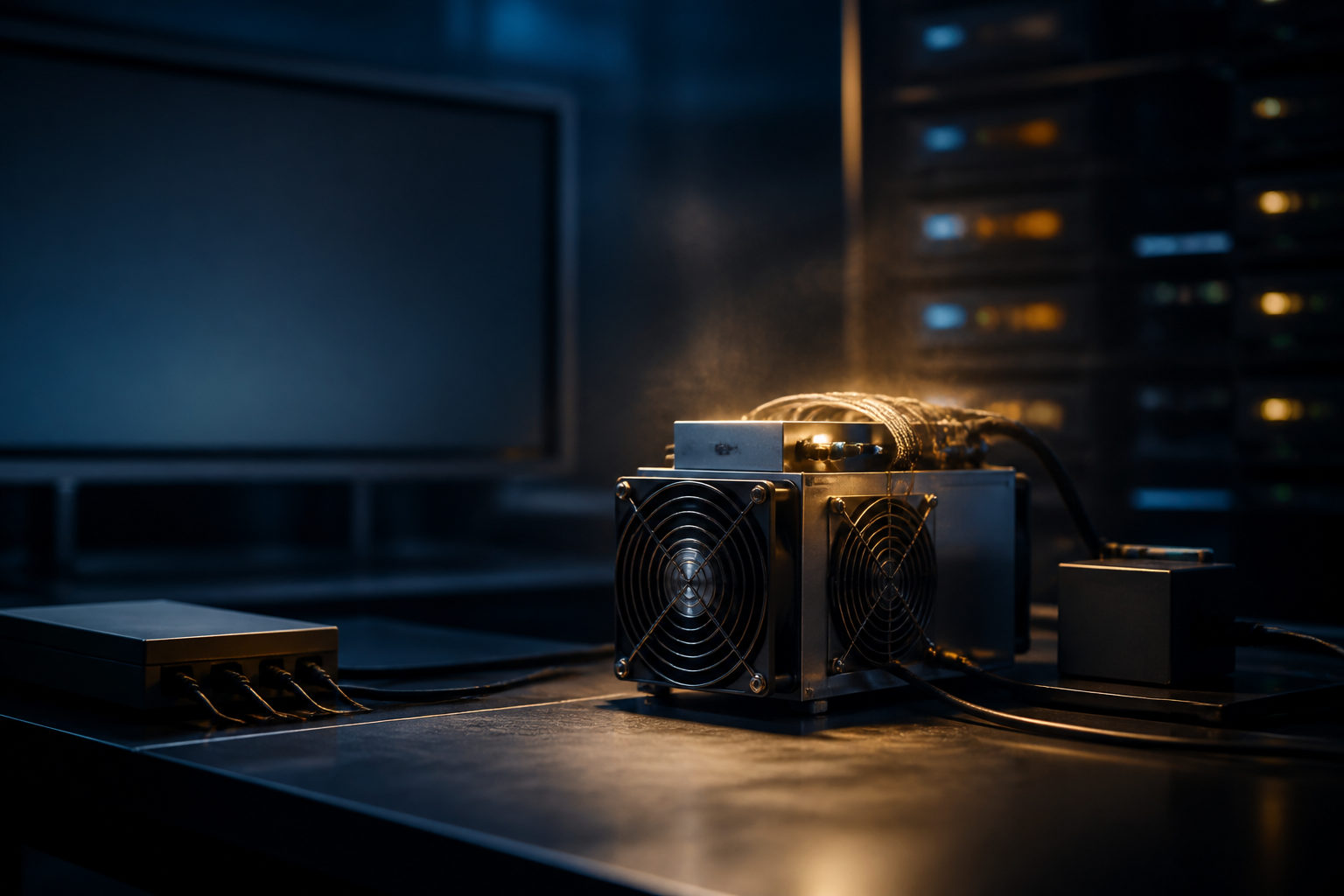
How many bitcoins can you get from mining? There is no fixed amount. What you receive depends on block rewards, whether you mine solo or in a pool, your hardware efficiency, operating costs, and how much hash power you control compared with the rest of the network.
What miners are actually competing for
A simple way to picture bitcoin mining is to think of a nonstop bookkeeping race. New transactions keep arriving, and miners compete to package them into a valid block. The miner that meets the network requirement first gets to add that block to the blockchain and claim the reward tied to it.
That reward has two parts. One is the block subsidy, which is the newly issued bitcoin. The other is transaction fees paid by users whose transfers are included in the block. Since the subsidy changes over time and fees vary with network activity, the answer to how many bitcoins you can get from mining is variable from the start.
Bitcoin has a hard cap of 21 million coins. The genesis block was created in January 2009. A new block is produced about every 10 minutes, and the subsidy is cut in half about every 4 years, or every 210,000 blocks. That schedule matters because the amount of new bitcoin available to miners keeps shrinking over time.
The main factors that decide your bitcoin output
People often ask how much a machine can mine in a day, but that question is too narrow on its own. Mining output is shaped by several moving parts at once, and leaving out one of them can make the whole estimate useless.
| Factor | What it changes | Why it matters for your payout |
|---|---|---|
| Block reward rules | The amount of new bitcoin issued per block | After a halving, less new bitcoin is available to be distributed |
| Mining method | Whether you mine solo or through a pool | Solo mining can mean long stretches with nothing; pools spread rewards by contribution |
| Hardware efficiency | How much hash power you get for the electricity used | Better efficiency helps you keep a stronger share of output for the same power draw |
| Operating costs | Power, cooling, maintenance, and uptime | You may receive bitcoin but still face poor economics if costs are too high |
| Network competition | The total hash power mining alongside you | If the network gets more competitive, your slice of the reward tends to shrink |
The key idea is share. You do not receive bitcoin just because a machine is switched on. You receive a portion of rewards based on how much useful mining power you contribute relative to the rest of the network.
If your setup represents only a tiny share of global hash power, your expected share of mined bitcoin will also be tiny. That is why the same question can have very different answers for a large industrial operator and for a person running a single machine.
Solo mining and pool mining lead to very different outcomes
The way you participate changes the pattern of what you get. With solo mining, you keep the full block reward and fees if you find a block yourself. The trade-off is uncertainty: you could go a very long time without getting anything at all.
Mining pools take a different approach. Many miners combine their hash power, the pool finds blocks more often than any one member could on their own, and rewards are then split according to each participant's contribution and the pool's rules.
| Approach | Payout pattern | Best suited for | Main drawback |
|---|---|---|---|
| Solo mining | Irregular; possibly nothing for a long time, then a full reward if a block is found | Operators with very large hash power and high tolerance for variance | Extremely unpredictable for small miners |
| Pool mining | Smaller but more frequent payouts based on contributed work | Most individual miners | You share rewards and must accept the pool's fee and payout method |
For most people, pool mining is the only practical way to see a steady flow of bitcoin from mining. Still, a pool does not create extra rewards. It changes the timing and smooths the variance by distributing earnings across participants.
A common mistake is to treat a pool estimate as a promise. Pool dashboards usually show projections based on current conditions. If fees change, your machine goes offline, or network competition rises, the amount you actually receive can differ.
Why cost matters more than the headline output question
Mining is a hardware-and-energy business before it is a balance number in a wallet. Machines need stable power, enough cooling, regular maintenance, and consistent uptime. If any of those fail, your effective hash contribution falls, and so does your share of bitcoin.
Electricity is often the first reality check. Two miners can use similar hardware and join similar pools, yet end up with very different results because their power costs and operating conditions are not the same. Cooling also matters because overheating can reduce performance or force shutdowns.
| Cost area | Why it affects mining | What newcomers often miss |
|---|---|---|
| Electricity | Mining machines run continuously | The machine price is visible up front; the power bill keeps coming after that |
| Cooling | Heat affects stability and performance | A hot room can cut output even if the machine itself is technically working |
| Noise and space | Mining hardware is not always suitable for home use | Living spaces may not tolerate the sound or airflow needs |
| Maintenance | Downtime means no contribution to the pool or network | Dust, fan issues, and connectivity problems can quietly reduce results |
| Pool payout rules | Different methods split rewards in different ways | The amount shown on a dashboard may not match what reaches your wallet |
This is why “how many bitcoins can you get from mining” and “is mining worth it for me” are related but separate questions. You may mine some bitcoin and still decide that the effort, cost, and operational burden do not make sense for your situation.
What a regular person should check before trying to mine
Bitcoin mining is no longer something a standard home computer can do in a meaningful way. Competition has become specialized, and serious participation usually depends on purpose-built hardware, stable power, and an environment that can support nonstop operation.
If your goal is to judge whether you can get any meaningful amount of bitcoin from mining, start with the practical gatekeepers below.
| Checkpoint | What to verify | If the answer is weak |
|---|---|---|
| Hardware type | Whether the machine is designed for bitcoin mining | General-purpose devices usually cannot compete effectively |
| Power setup | Whether electricity is stable and manageable over time | Interruptions and high power costs can break the whole plan |
| Cooling environment | Whether the space can handle sustained heat output | Thermal stress can reduce uptime and machine life |
| Pool rules | Payout model, fees, and withdrawal conditions | Your actual bitcoin receipts may feel very different from your expectation |
| Wallet readiness | Whether you have a secure wallet to receive payouts | Even mined bitcoin can become difficult to manage if the setup is poor |
If you have not checked these basics, the output question is premature. First work out how much stable, useful hash power you can actually contribute, then look at how a pool would credit that contribution under its own rules.
FAQ
How much bitcoin can one mining machine produce?
There is no universal figure because output depends on reward rules, your share of hash power, pool terms, machine uptime, and network competition. Any estimate should be treated as conditional, not guaranteed.
Can a normal PC still mine bitcoin?
In theory, any computing device can perform calculations related to mining. In practice, bitcoin mining is highly specialized now, so a normal PC usually cannot generate meaningful bitcoin output.
Do mining pools pay less than solo mining?
Pool payouts are smaller per payment because rewards are split among participants. The benefit is a steadier flow, since you are no longer waiting to find a full block on your own.
What happens to mining output after a halving?
The newly issued bitcoin per block is reduced, so the subsidy portion of miner rewards becomes smaller. After that, miners rely more heavily on efficiency, fees, and tight control of operating costs.
If I do not plan to mine, should I still learn how mining works?
Yes, because mining explains how bitcoin is issued, how transactions are confirmed, and how the network stays secure. Even buyers who never run hardware can use that knowledge to better understand supply and market structure.
Before you focus on how many bitcoins you might get, check your hardware, power conditions, cooling, pool rules, and wallet setup. In the end, mining rewards follow your share of useful hash power, and that share only matters if your operation can stay stable.
Disclaimer: This article is for informational and educational purposes only and is not investment, financial, or legal advice. Crypto assets are highly volatile and you could lose your entire investment. Do your own research and decide carefully.