
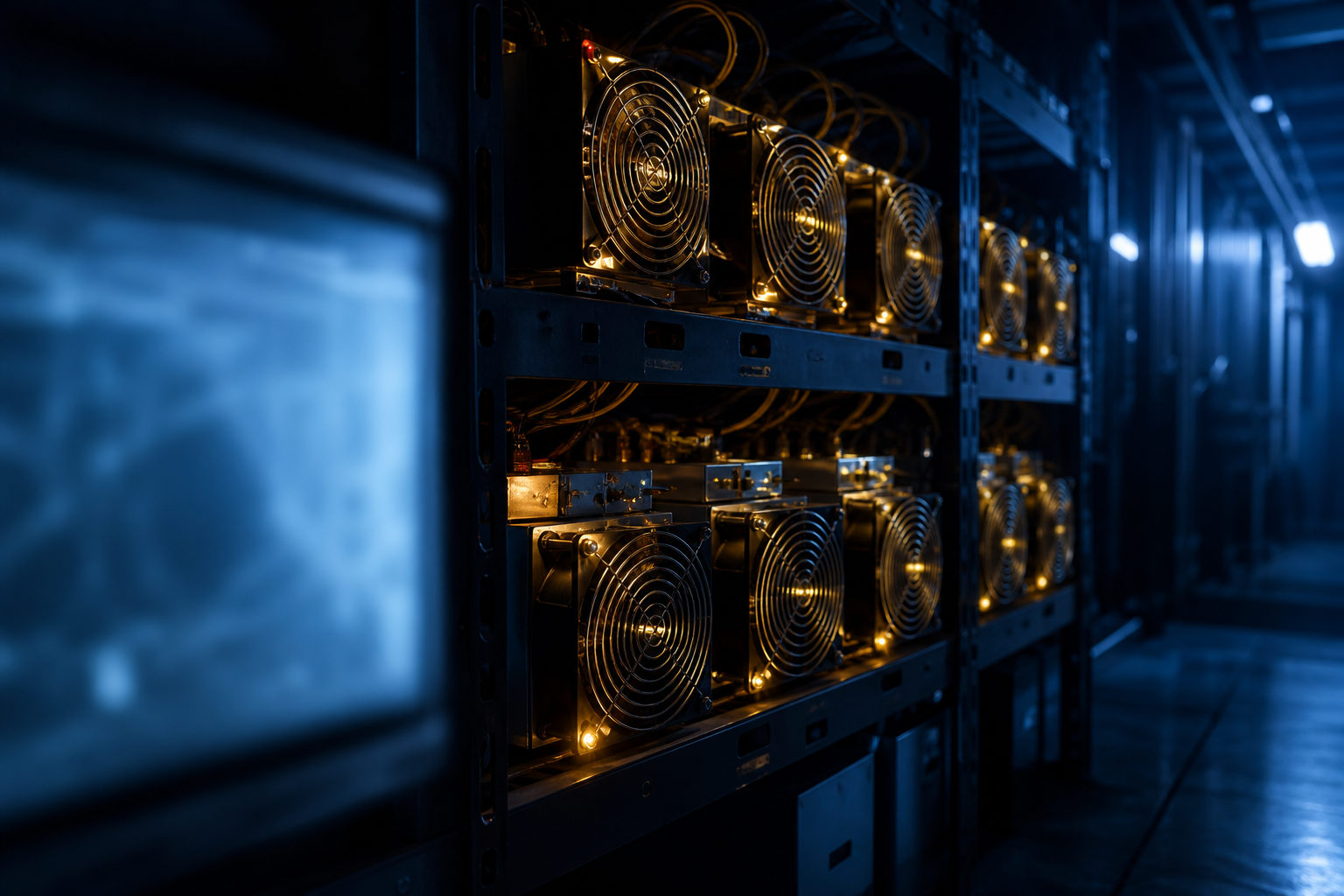
How many bitcoins Riot mines a day does not have one fixed answer. For a large mining company, daily output comes from its share of a network-wide race to win block rewards, and that share keeps changing.
Why there is no permanent daily number
People often picture bitcoin mining as if machines simply produce coins at a steady rate once they are switched on. That mental model misses how the system works. Mining is closer to a nonstop bookkeeping contest where participants compete to add the next block to the chain.
Riot operates a large fleet of specialized machines, but a bigger fleet does not create a guaranteed daily coin count. Its results depend on how much computing power it controls relative to the rest of the network, whether those machines stay online, and how rewards are distributed through its mining setup. A daily figure can move even when the company itself has not changed much operationally.
| Factor | Why it changes daily bitcoin output |
|---|---|
| Company hash power | More hash power usually means a larger long-run share of block wins |
| Network hash power | More competitors can dilute one miner's share |
| Mining difficulty | Difficulty changes affect how hard it is to find valid blocks |
| Machine uptime | Maintenance, outages, or heat issues reduce effective output |
| Pool payout method | The same mining activity can show up differently in payouts |
| Halving cycle | Each halving reduces the new bitcoin released per block |
Think of Riot's mining as a share of a block race
The Bitcoin network produces a new block about every 10 minutes. Miners are not digging up physical coins. They are repeatedly trying to produce a valid result that lets them claim the next block. The winner gets the block reward and transaction fees attached to that block.
So when someone asks how many bitcoins Riot mines in a day, the better question is how many of the day's new blocks Riot can expect to win or share in through its mining arrangement. That is a probability-based process. Over short periods, results can swing. Over longer periods, averages tell you far more than a single day ever could.
This is also why reporting language matters. One company may talk about bitcoin produced, another may focus on bitcoin received, and another may separate self-mining from hosting or transitional machine deployments. Those labels are not interchangeable. If you mix them together, the daily number becomes easy to misread.
What you should look at if you want to estimate Riot's daily output
If your goal is to judge Riot's mining capacity, chasing one isolated number is less useful than understanding the conditions behind it. Hash power deployment, machine uptime, energy access, and reward distribution rules explain more than a headline figure ever will.
| What to review | What to ask | Why it matters |
|---|---|---|
| Deployed machines | Are the miners actually installed and running? | Purchased hardware does not help until it is online |
| Operational stability | Is power, cooling, and maintenance consistent? | Nameplate capacity can differ from real output |
| Mining structure | Is it solo exposure or pool-based distribution? | This affects payout smoothness and timing |
| Network competition | Are other miners expanding at the same time? | The same fleet can earn a smaller share in a tougher field |
| Halving stage | Where is the network in the reward cycle? | New bitcoin issuance drops after each halving |
Bitcoin has a maximum supply of 21 million coins. New issuance enters through block rewards. The network halves that reward about every 4 years, or every 210,000 blocks. The halving years so far are 2012, 2016, 2020, and 2024. For a miner like Riot, that means staying the same size does not preserve the same coin output forever. After a halving, the pool of newly issued bitcoin available to all miners becomes smaller.
Can an individual participate the way Riot does?
People can participate in mining, but that does not mean they can copy the operating model of a public mining company. Riot's edge comes from scale: large machine orders, power arrangements, dedicated facilities, cooling systems, staff, repairs, and the ability to keep a large fleet running over time.
At the household level, mining often runs into practical limits. Machines are loud. They generate a lot of heat. Power setups may not fit. Maintenance is ongoing, and hardware becomes less competitive as newer models enter the market. Knowing how Bitcoin issues coins is useful; running mining hardware profitably is a separate challenge.
| Approach | Best suited for | Main trade-off |
|---|---|---|
| Buy your own miners | People who can manage power and operations | More control, much more operational burden |
| Join a mining pool | Miners who want smoother payout patterns | Less variance in distribution, still hardware-heavy |
| Buy bitcoin directly | People who only want exposure to bitcoin | No mining operations, no hardware headaches |
| Study mining stocks | People interested in the mining business model | Exposure is tied to company operations, not direct block rewards |
If the hidden question is whether an ordinary user can reproduce Riot's daily bitcoin production setup, the realistic answer is usually no. Large mining firms rely on systems, not just machines. Operations, energy, uptime, and replacement cycles matter as much as raw hardware count.
The cost reality behind any mining output figure
New readers often focus only on the number of bitcoins mined. That leaves out the harder part. Mining is asset-heavy and operation-heavy. Machines need electricity, space, cooling, monitoring, repair, and eventual replacement. Downtime and aging equipment can erode the value of headline production.
Another mistake is to treat mined bitcoin as the same thing as profit. A company still has to deal with energy bills, facilities, labor, equipment depreciation, and the pressure to upgrade when more efficient hardware arrives. Even without quoting any earnings figures, the business logic is clear: daily mined bitcoin is one operating signal, not a complete verdict on performance.
That is why the question of how many bitcoins Riot mines a day is most useful as a starting point for understanding mining mechanics. Once you understand hash share, network difficulty, uptime, pool accounting, and the halving cycle, you can read mining disclosures with much better judgment.
FAQ
Why can Riot's daily bitcoin production change from one day to the next?
Bitcoin mining has built-in variance over short periods. On top of that, machine uptime, maintenance windows, pool settlement timing, and network difficulty can all move the reported daily result.
Is a single-day mining number useful when evaluating a company?
It has some value, but only as a short snapshot. A longer average usually gives a cleaner view because it reduces the effect of outages, temporary deployments, and normal block-finding variance.
Does bitcoin mined by Riot always equal the amount it ends up holding?
No. Production, treasury holdings, and sales are different categories. A company may mine bitcoin, sell part of it, and report those items separately.
Will Riot automatically mine fewer bitcoins per day after a halving?
The protocol cuts new bitcoin issued per block at each halving. The actual day-to-day effect on one company still depends on its fleet growth, machine efficiency, and how the rest of the network is competing at the same time.
If I only want bitcoin exposure, do I need to study how much Riot mines per day?
You do not need that number for its own sake. It is helpful because it teaches you how bitcoin issuance works and why owning bitcoin is different from operating a mining business.
If you plan to read mining company updates, start by checking whether the disclosure is talking about deployed hash power, mined bitcoin, held bitcoin, or sold bitcoin. Then line that up with uptime and the halving cycle before drawing conclusions from any daily output figure.
Disclaimer: This article is for informational and educational purposes only and is not investment, financial, or legal advice. Crypto assets are highly volatile and you could lose your entire investment. Do your own research and decide carefully.