
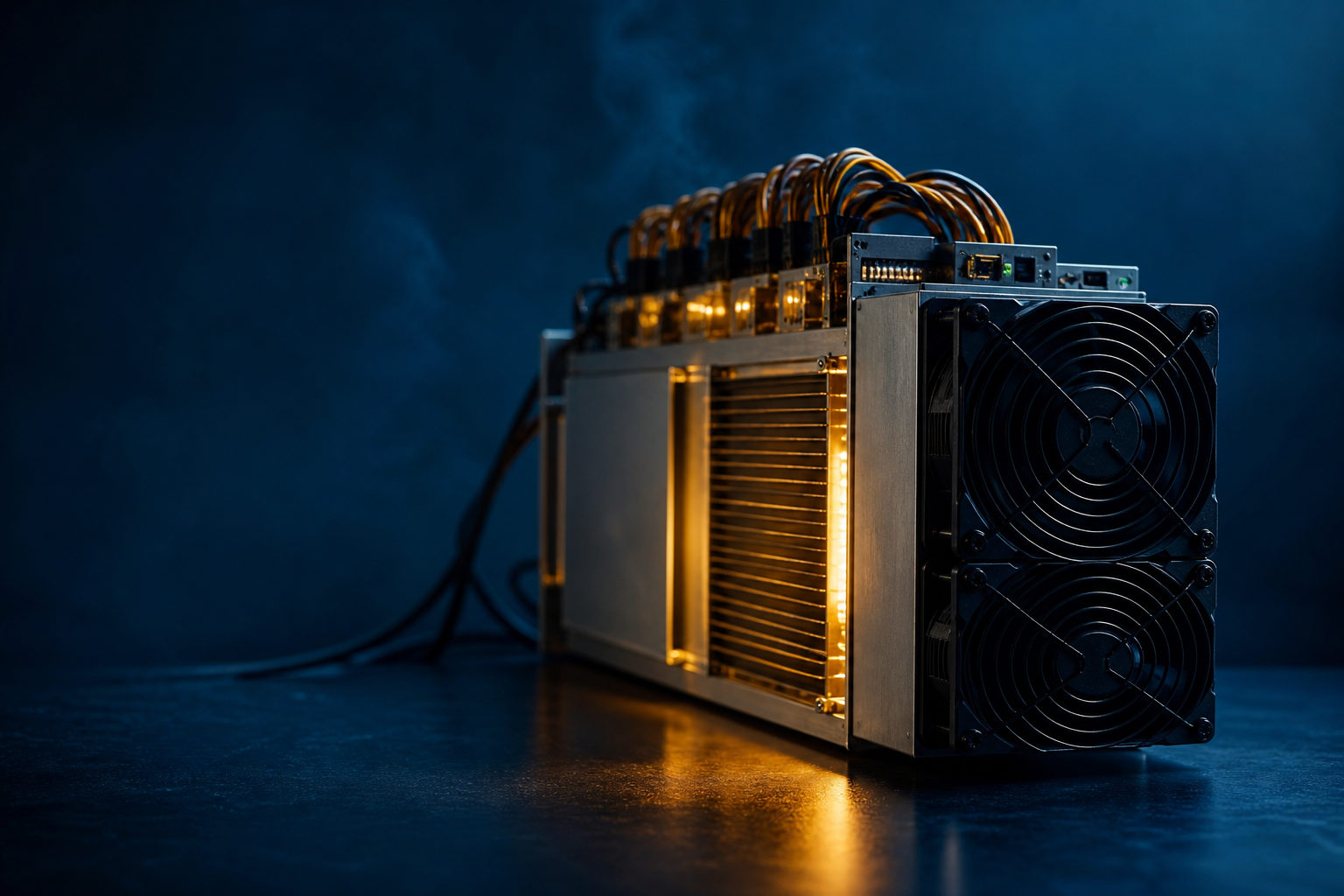
Bitcoin mining is a public competition to win the right to add the next block to the chain. Miners do that by spending computing power, electricity, and time to satisfy the network’s proof-of-work rules.
What mining actually is
The phrase “mining bitcoin” creates the wrong picture for a lot of people. It sounds like coins are sitting somewhere waiting to be extracted. In practice, miners are packaging transactions into candidate blocks and racing to produce a valid proof that the rest of the network will accept.
The system uses proof of work. A miner takes block data, changes a field that can vary, runs the block through a hash function, and checks whether the result meets the current difficulty target. If it does not, the miner changes the input and tries again. The process repeats at very high speed.
There is no clever shortcut that skips the work. You can improve hardware efficiency, power cost, cooling, and uptime, but you still have to grind through massive numbers of attempts. That is why bitcoin mining is a computing contest first and a business operation right behind it.
The network aims to produce a block about every 10 minutes. When total mining power across the network changes, difficulty adjusts so block production does not speed up or slow down too far from that rhythm. If stronger miners enter the race, weaker miners do not stay in the same place; they fall behind.
| Common belief | What is closer to reality |
|---|---|
| Mining means pulling coins out of the system | Mining means competing for block production under fixed rules |
| Any always-on computer can do it in a meaningful way | Serious participation depends on specialized hardware and power economics |
| Skill matters more than infrastructure | Efficiency, uptime, and operating conditions often matter more |
| Miners can rewrite the ledger as they like | Nodes reject invalid blocks, even if a miner spent real resources on them |
How a block gets mined
Start with pending transactions. When people send bitcoin, those transactions spread through the network and wait to be included in a block. Miners choose which ones to include, usually favoring valid transactions that fit their block template and make economic sense from a fee perspective.
Next comes block assembly. A miner builds a candidate block that points to the previous block and includes a summary of the chosen transactions. The miner then runs repeated hash calculations while changing the nonce and, when needed, other mutable parts of the block data.
If one miner finds a hash that meets the current target, that miner broadcasts the block. Other nodes then verify it. They check the proof of work, transaction validity, block structure, and reward rules. If the block breaks consensus rules, it gets rejected. If it passes, it becomes part of the active chain and miners move on to the next block.
This is where many simplified explanations go wrong. Miners do not have open-ended control over the ledger. They have room to choose transaction ordering and inclusion, but they do not get to invent balances, ignore signatures, or claim rewards outside the protocol rules.
| Stage | What miners do | What nodes verify |
|---|---|---|
| Transaction selection | Build a candidate block from pending transactions | Validity, signatures, double-spend conflicts |
| Hashing | Run repeated attempts to meet difficulty | Proof-of-work requirement |
| Block broadcast | Send the found block to the network | Block format and reward compliance |
| Chain extension | Begin work on the next block | Whether the block is a valid continuation |
Why mining turned into an industrial activity
Bitcoin launched in 2009, and early participation looked very different from the present day. Over time, mining became more specialized because competition kept rising. Once the network filled with stronger operators, general-purpose machines stopped being practical for meaningful participation.
That is why specialized mining hardware matters. In a proof-of-work system, the winner is not chosen by seniority or by staking coins. The winner is whoever produces a valid block first. Better hardware gives more attempts for the same power draw, and that changes the odds in a direct way.
Then there is the issue of variance. A single miner working alone may wait a very long time before finding a block, especially with a small share of total network hash power. Mining pools exist to smooth that randomness. Pool participants contribute hash power together and receive payouts based on pool rules and measured contribution.
That smoother payout pattern comes with tradeoffs. The operator takes a fee, the participant depends on the pool’s accounting and payout design, and some control shifts away from the individual miner. Pool mining reduces payout volatility; it does not erase operating risk.
| Approach | Main appeal | Main drawback |
|---|---|---|
| Solo mining | Full independence and no pool split on a found block | Extremely uneven outcomes unless you control major hash power |
| Pool mining | More regular payout flow | Fees and dependence on pool rules |
| Hosted mining | Less direct site management | Reliance on a third party and more layered costs |
Don’t sugarcoat it: the hard part is cost control
If someone presents bitcoin mining as passive income with a machine attached, leave some room for doubt. Mining can be simple to describe, but it is not simple to run well. The rough edges show up in power bills, equipment wear, maintenance, noise, heat, and downtime.
Electricity is not a side detail. It is one of the core variables that decides whether an operation can stay alive. Hardware depreciation is just as real. A machine can still function and still lose competitiveness if newer hardware delivers better efficiency under the same operating conditions.
Uptime also matters more than many beginners expect. A miner that sits offline because of cooling failure, unstable internet, fan trouble, firmware problems, or power interruptions is not just delayed; it is absent from the race during that period. Missed time cannot be recovered later.
Cooling and noise create another layer of reality. Mining machines generate serious heat under sustained load. That heat has to go somewhere. In many home environments, the machine may run, but the surrounding conditions make long-term operation unpleasant, inefficient, or impractical.
There is also a business-side risk that basic explainers often skip. Rules around electricity use, zoning, commercial activity, taxes, and facility standards vary by location. For some people, the first real barrier is not the machine purchase. It is whether the setup can operate legally and consistently where they are.
| Cost or risk | Why it matters | What people often miss |
|---|---|---|
| Electricity | Directly eats into operating margin | They focus on machine price and ignore ongoing power use |
| Hardware depreciation | Older machines lose edge as competition improves | They treat miners like assets that hold value by default |
| Cooling and noise | Affects stability and site suitability | They assume a home setup will be easy to live with |
| Downtime | Removes your hash power from the race | They underestimate repairs and spare parts planning |
| Pool or host dependence | Can affect payout flow and operating continuity | They do not read the rules behind the marketing |
What regular people should do with this information
If your goal is to understand Bitcoin, you do not need to start by buying mining hardware. Learn how transactions propagate, how blocks link together, how hashes are used, and how nodes validate blocks. That gives you the logic of mining without forcing you into a costly setup on day one.
If your goal is to run miners, think like an operator before you think like a buyer. Site conditions, power pricing, ventilation, internet stability, maintenance ability, and pool terms should be on your checklist before model comparisons. A weak setup can ruin a good machine faster than a glossy sales pitch suggests.
If your goal is simply to hold bitcoin, mining is not the only path and often not the cleanest one. Buying and holding bitcoin exposes you to price swings. Running miners exposes you to price swings plus equipment, power, and operating execution risk. Those are different profiles and should be judged separately.
| Your goal | Better starting point | Why |
|---|---|---|
| Understand Bitcoin | Study nodes, transactions, and block validation | Lower cost and clearer exposure to core mechanics |
| Operate a mining setup | Review site, power, cooling, hardware, and pool terms | Mining lives or dies on execution details |
| Own bitcoin without running machines | Consider direct purchase and secure storage | Avoids hardware and facility burdens |
FAQ
Can I still mine bitcoin at home?
You may be able to turn a machine on at home, but that does not mean the setup makes practical sense. Heat, noise, power cost, and stability are the usual limits, not the basic ability to plug hardware in.
Why does hash power matter so much?
Because proof of work is a race built on repeated attempts. More efficient hash power means more chances to find a valid block within the same span of time and energy use.
Does joining a mining pool solve the problem?
It solves one problem better than others: payout variance. It does not fix expensive electricity, weak hardware, poor cooling, or unreliable operation.
What does Bitcoin halving change for miners?
Bitcoin halves the block subsidy about every 4 years, with halving years including 2012, 2016, 2020, and 2024. When that reward drops, inefficient miners usually feel pressure first because their margin for error gets thinner.
If I want to learn the mechanics first, where should I start?
Start with transaction flow, block structure, hashing, and node validation. Once those pieces click, mining claims become much easier to judge because you can see what the machine is actually doing for the network.
Before spending money on bitcoin mining, write down your own hard constraints: power, cooling, noise tolerance, maintenance ability, internet stability, and exit plan. Those details decide far more than the slogan on a product page.
Disclaimer: This article is for informational and educational purposes only and is not investment, financial, or legal advice. Crypto assets are highly volatile and you could lose your entire investment. Do your own research and decide carefully.