
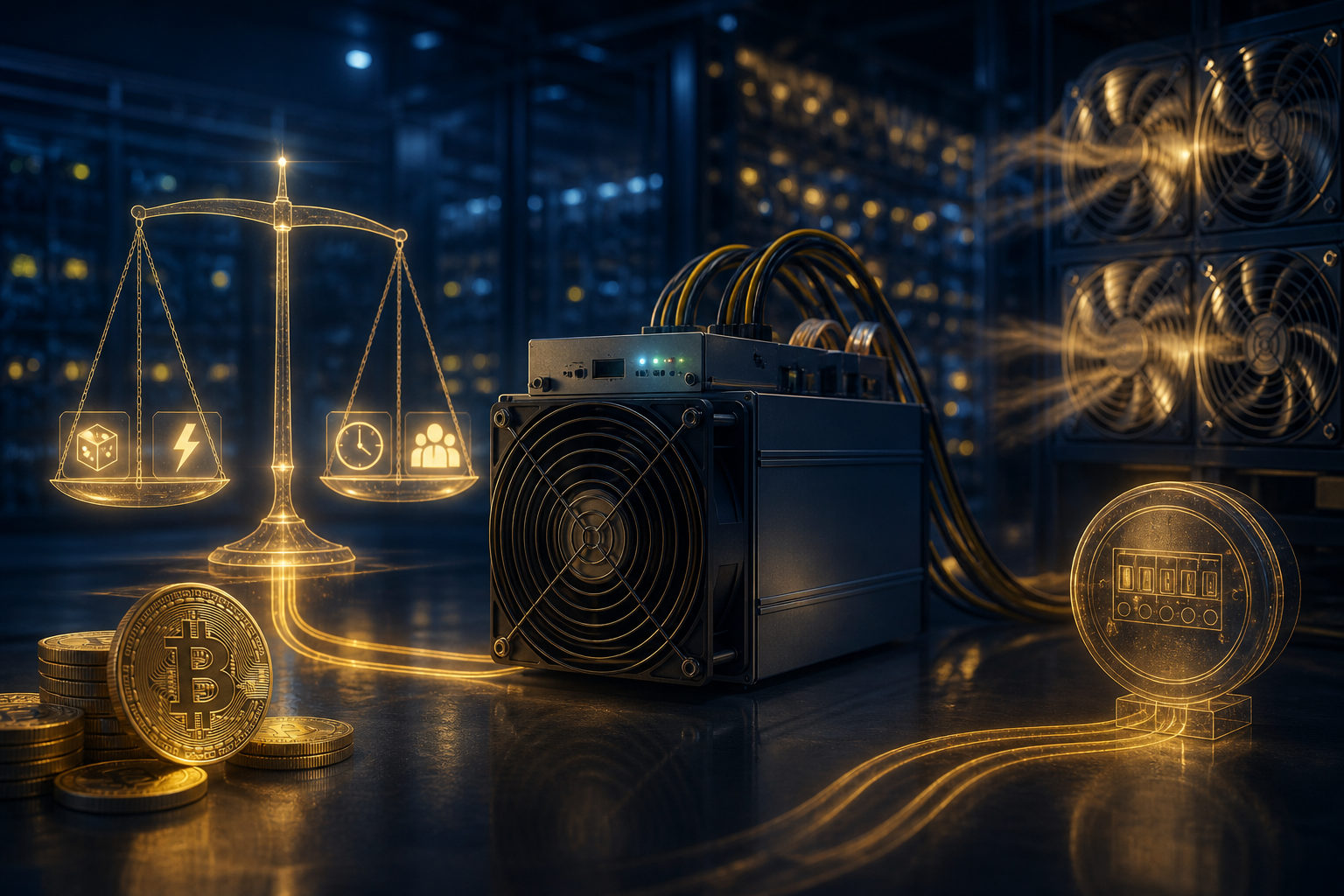
How much does bitcoin mining make? There is no fixed answer: some miners can stay profitable, while others fail to cover electricity, hardware wear, and operating hassle. The result depends on hash power, cost structure, and how rewards are actually earned.
Think of mining as a bookkeeping race
A simple way to picture bitcoin mining is to treat it as a nonstop contest for the right to add the next page to a shared ledger. Miners run specialized machines that keep making guesses. When one participant meets the network target, that miner gets to add a new block and may receive the block reward plus transaction fees.
That does not mean every machine prints steady income. Bitcoin produces a new block about every 10 minutes, but an individual miner only gets a slice of that output based on how much hash power they control compared with the whole network. Small miners face uneven results, and those swings can be severe.
That is why people often misread the business. A machine can be online all day and still deliver disappointing economics if its share of total network work is too small.
What decides how much bitcoin mining makes
Reward method matters first
You can mine alone or join a mining pool. Solo mining gives you a chance at the full block outcome, but the timing is unpredictable and can be very long. A pool combines many miners, then distributes rewards under its own payout rules, which usually makes income smoother but introduces pool fees and policy risk.
For most people asking how much bitcoin mining makes, pool mining is the more practical place to start. It is closer to what a normal participant can actually access.
Power cost can make or break the whole plan
Electricity is usually the most obvious ongoing expense, yet many beginners still treat it as a side issue. Mining hardware runs continuously and also needs cooling, airflow, and a stable setup. Even if gross output looks fine, expensive power can eat away most of the margin.
This is the point many sales pitches blur. They highlight what a machine might produce, not what you still have left after paying to keep it running.
Hardware cost is not a one-time thought
Mining machines age. They need maintenance, parts replacement, setup time, and occasional troubleshooting. On top of that, newer models can push older ones into a weaker position, so a device that looks acceptable today may become less competitive later.
That means you should not judge mining by daily coin output alone. You need to ask whether that output can recover the purchase cost and the wear on the hardware over time.
Difficulty changes the economics
If more miners join the network, competition gets tougher. Your machine may keep working at the same level, yet your share of network rewards can still shrink because the total amount of competing hash power has grown.
Bitcoin also goes through a halving every 210,000 blocks, or about every 4 years. Past halving years were 2012, 2016, 2020, and 2024. After a halving, newly issued block rewards drop, so efficiency and cost control matter even more.
What you do with the coins also affects the result
Some miners sell coins quickly to cover bills. Others hold what they mine and wait for a better market price. Those are very different strategies. One focuses on cash flow; the other adds more exposure to price volatility.
So when someone claims mining is profitable, ask one extra question: are they talking about gross coin production, or actual realized results after costs and sales?
The hidden costs many people miss
Mining is not just a machine plus an outlet. You may need proper ventilation, noise management, network stability, monitoring tools, repair time, and a plan for downtime. Any weak point can drag down the whole operation.
Home mining sounds simple on paper, but the real-world tradeoffs are hard to ignore. Mining rigs create heat and noise, and they are not friendly to every living space. A unit that appears to be running can still throttle, overheat, or stop, which cuts into output without much warning.
There is another trap here. Some people assume hosted mining, managed mining, or cloud contracts are an easier version of the same business. They may reduce setup work, but they add contract risk, platform risk, payout rule risk, and withdrawal limits. If the terms are hard to explain in plain language, that alone is a warning sign.
How to judge mining without using profit numbers
You can still make a sound decision without plugging in headline income figures. Start by separating fixed costs from ongoing costs. Fixed costs include hardware and deployment. Ongoing costs include power, maintenance, cooling, pool fees, and the time you spend managing the setup.
Then decide what kind of activity this is for you. Are you trying to build bitcoin holdings over time, or are you trying to create regular cash flow? Those goals lead to different choices, and they also change how much market volatility you can tolerate.
It also helps to frame mining as a competitive operating business, not as a passive income gadget. Once you see it that way, the appeal of easy-money marketing tends to disappear fast.
For many people, buying bitcoin directly or using another market approach may be easier to manage than running mining hardware. That does not mean mining never works. It means the business is far more demanding than the first sales pitch makes it sound.
FAQ
Can you still make money mining bitcoin at home?
It is possible, but the bar is high. Home setups face power costs, heat, noise, and maintenance issues that can turn a promising idea into a weak operation.
Is solo mining better than joining a pool?
Solo mining offers a chance at the full block result, but income is highly uneven. Pools spread rewards across many participants, so payouts are usually more regular, which is why most beginners look there first.
What matters more, bitcoin price or electricity cost?
Both matter, but electricity is often the cost you feel every day. A favorable market price can help, yet high power expense can still wipe out the benefit.
Does a newer mining machine guarantee better returns?
No. A newer unit may be more efficient, but the outcome still depends on purchase cost, uptime, cooling, pool terms, and network competition.
Where should I check real-time mining value?
Check live bitcoin price on major market data platforms, then compare that with your machine efficiency, power rate, and pool payout rules. Looking at a promotional revenue screen alone is not enough.
Before buying anything, write down your power rate, hardware source, pool terms, cooling plan, and exit plan. If any one of those points is still vague, you are not ready to judge the economics.
Disclaimer: This article is for informational and educational purposes only and is not investment, financial, or legal advice. Crypto assets are highly volatile and you could lose your entire investment. Do your own research and decide carefully.