
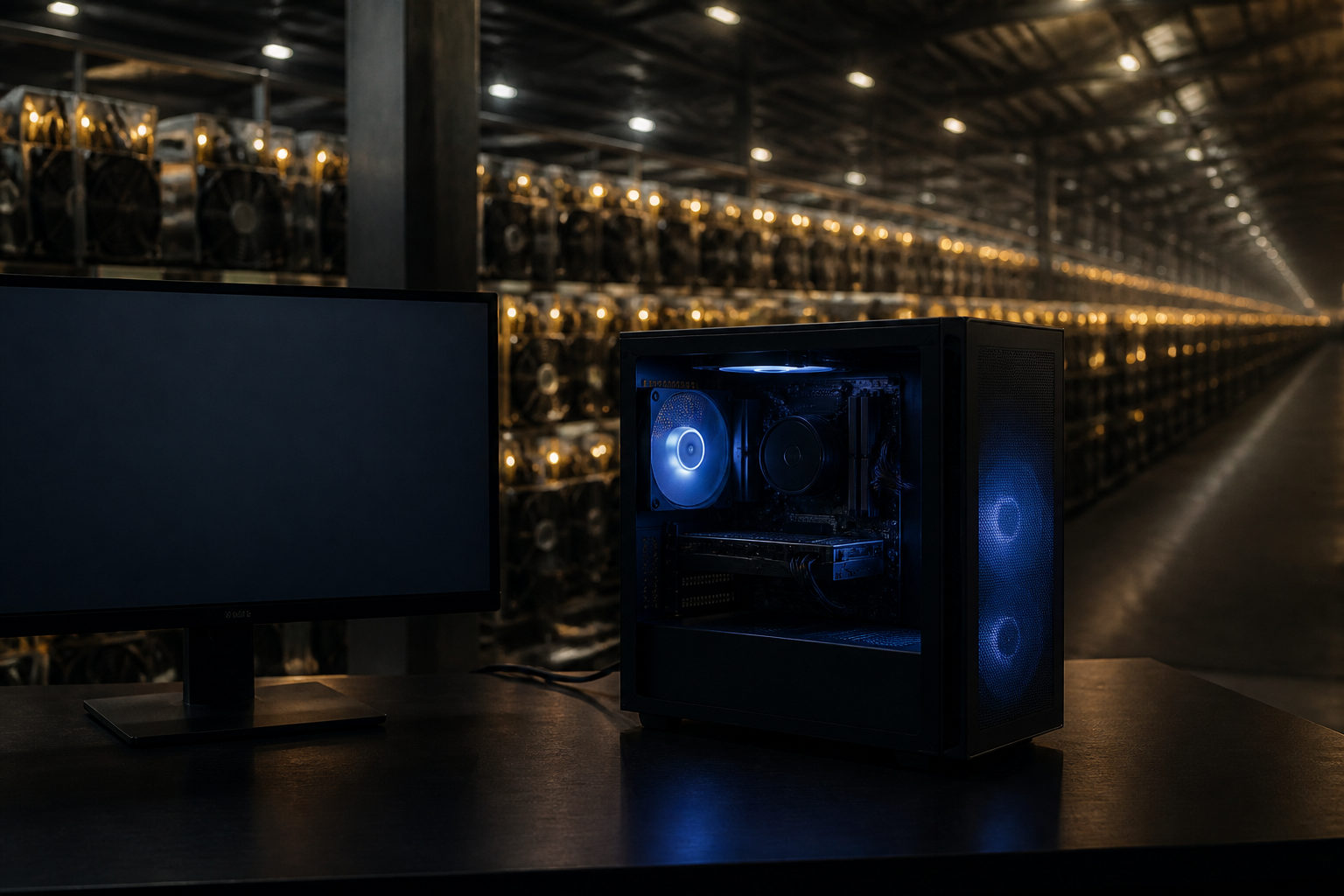
How much can my computer mine in bitcoin? For most home users, the honest answer is: usually very little. A normal computer can take part in bitcoin mining, but it is entering a nonstop contest to win the right to add the next block, and general-purpose machines are weak competitors in that race.
Think of bitcoin mining as a bookkeeping contest
Bitcoin mining is the process of competing to add a new block of transactions to the blockchain. You can picture it as a giant bookkeeping game where many participants try to solve the same puzzle. The first one to produce a valid result gets to write the next page of the ledger and receive the block reward.
That basic idea matters because many people ask the wrong question first. They focus on whether a computer can run mining software, when the bigger issue is whether that computer has enough useful computing power to compete against the rest of the network. Bitcoin uses proof of work, so miners keep trying different outputs until one satisfies the network rules.
The network produces a block about every 10 minutes on average. Over time, a miner with a larger share of total network hash power has a better chance of receiving a share of the rewards. A home computer may still submit work, but its slice of that competition is often tiny.
What determines how much your computer can mine
There is no single answer for every device. The result depends on the hardware inside your machine, how long it can run under load, how much electricity costs you, how stable your internet connection is, and whether you mine alone or through a mining pool.
| Factor | Why it matters | What it means for a regular computer |
|---|---|---|
| CPU and GPU | They determine how much work your system can attempt | They can run software, but they usually lack an edge in bitcoin mining |
| Cooling | Heat affects sustained performance | Home machines may throttle, get noisy, or become unstable under constant load |
| Electricity cost | Mining is not only about output, but also expense | Even a small amount of mined bitcoin may not justify the power draw |
| System uptime | Interrupted mining reduces valid participation time | Sleep mode, restarts, and crashes hurt results |
| Mining method | Solo mining and pool mining produce very different experiences | Pools make participation easier to observe, while solo mining is highly uncertain |
People often assume that if software is running, the machine is “mining bitcoin” in a meaningful sense. That is too loose. A computer can be active without contributing enough effective hash power to matter much. In bitcoin mining, useful output is shaped by competition, not by effort alone.
Why ordinary computers struggle today
A desktop PC, gaming rig, or laptop is built for broad tasks. It may be good at schoolwork, office work, browsing, editing, or games. Bitcoin mining is different. It rewards specialized efficiency, long uninterrupted operation, and hardware chosen for one narrow kind of computation.
That is why ordinary computers face a harsh reality. Even if they can participate, they often run into the same issues: weak competitiveness, high heat, fan noise, system wear, and an electricity bill that can cancel out the value of the bitcoin they earn. The machine may be busy all day while producing only a very small share of mining output.
Laptops are the least suitable choice for long runs. Their compact design limits cooling, and heavy sustained load can raise temperatures quickly. A desktop is easier to monitor and usually handles heat better, but that still does not make it economically attractive for bitcoin mining.
| Device type | Can it run mining software? | Main drawback | Best use case |
|---|---|---|---|
| Office desktop | Usually yes | Limited performance and constant resource use | Learning the process |
| Gaming PC | Usually yes | Heat, noise, and power use become obvious over time | Short tests and pool monitoring |
| Laptop | Possible but unwise for long sessions | Tight cooling and higher thermal stress | Brief experimentation only |
| ASIC miner | Yes, designed for it | Deployment demands, heat, and noise | People focused on bitcoin mining itself |
The gap between a regular computer and specialized mining hardware is the key practical point. A machine designed for many tasks rarely performs well in a competition shaped by narrow efficiency. If your question is really about whether your personal computer can mine a meaningful amount of bitcoin, that gap is the first thing to understand.
Solo mining vs pool mining changes the experience
When people ask how much bitcoin their computer can mine, they often mix up three separate questions: can the machine participate, can it receive any bitcoin at all, and is it worth leaving it on. The answer shifts depending on whether you mine solo or join a pool.
Solo mining means your computer tries to win a block on its own. That gives you full exposure to the result, but the odds for a regular computer are extremely poor. You could run for a long time and see nothing. Pool mining combines the hash power of many participants, and rewards are then distributed according to pool rules. For a weak machine, a pool is usually the only way to see any steady record of contribution.
Pool mining does not turn a home computer into a strong miner. It only changes how the participation is measured and paid out. Instead of waiting for a rare all-or-nothing outcome, you are more likely to see small allocations that reflect your tiny share of the pool’s work.
| Method | How it works | What a regular computer should expect |
|---|---|---|
| Solo mining | You compete alone for an entire block | Very high uncertainty and long stretches with no result |
| Pool mining | You combine hash power with others | Smaller but more frequent reward records, still limited by weak hardware |
How to judge whether trying it makes sense
If your goal is education, trying bitcoin mining on a spare machine can be useful. You can learn how mining software works, how a pool dashboard reports shares, and how system temperature and load change during operation. In that case, the value is the hands-on experience, not the output alone.
If your goal is to earn a substantial amount of bitcoin with a normal home computer, the answer is usually disappointing. You have to account for power use, noise, heat, hardware stress, and the fact that your machine is tied up doing one demanding task for long periods. What you gain in bitcoin may be too small to justify those tradeoffs.
There is also a security angle. Mining software should be downloaded carefully, because fake or tampered packages can expose your device to malware or remote abuse. Wallet addresses, payout settings, and account credentials all need to be checked with care. A mistake here can matter more than the mining result itself.
A sensible approach is to test on a noncritical machine, run it briefly, watch temperatures and stability, and decide from there. That gives you a realistic picture without risking your main work computer or assuming that participation will automatically be profitable.
FAQ
Can a normal PC still mine bitcoin?
Yes, in the technical sense. It can run mining software and contribute work, but that does not mean it can mine a meaningful amount of bitcoin in practice.
Is solo mining worth trying on a home computer?
Usually only if you want to understand how the process works. For most home machines, solo mining is so uncertain that it is a poor fit for anyone expecting consistent results.
Why do mining pools matter for weak hardware?
Pools let small participants combine their work with others, so contributions are measured and rewarded more regularly. Your share is still small, but the experience is easier to track than waiting alone for a block.
Can I mine bitcoin on a laptop?
You can, but long sessions are a bad idea for most laptops. Heat buildup, fan noise, and sustained performance limits make them a risky choice for continuous mining.
What should I check before testing bitcoin mining?
Start with cooling, power stability, system health, and software source. If the computer stores important work files or personal data, using it for long mining tests is usually a poor tradeoff.
If you want a real answer for your own setup, treat mining as a short controlled test on a spare machine, then judge the heat, noise, stability, and pool records you actually see. That tells you far more than the idea that any computer can mine bitcoin.
Disclaimer: This article is for informational and educational purposes only and is not investment, financial, or legal advice. Crypto assets are highly volatile and you could lose your entire investment. Do your own research and decide carefully.